







🏥 Introduction: Max Healthcare’s Latest Power Move in the Stock Market
Max Healthcare ESOP News 2026 is currently trending across the Indian stock market after Max Healthcare Institute Limited announced a fresh Employee Stock Ownership Plan (ESOP) grant for eligible employees. Investors, analysts, and healthcare sector experts are closely monitoring Max Healthcare ESOP News 2026 because the latest corporate filing could influence future stock price momentum, employee retention strategy, and long-term expansion plans.
Welcome to our comprehensive, step-by-step financial analysis of this major corporate action from one of India’s leading healthcare giants. The filing outlines a fresh issuance of Employee Stock Ownership Plans (ESOPs) designed to reward and retain key employees while supporting the company’s aggressive future expansion plans.
For a company that commands a massive market capitalization of over ₹1,04,000 Crores and serves as a bellwether for the Indian private hospital sector, every corporate filing acts as a puzzle piece for investors trying to forecast the stock’s next big move. Currently trading around the ₹1,071 mark, Max Healthcare (trading under the symbol MAXHEALTH on the NSE and Scrip Code 543220 on the BSE) has been a wealth creator for long-term shareholders. But how does this specific ESOP grant affect the retail investor? Does it dilute your equity? Will it drive the stock price up or down when the market opens tomorrow?
In this highly detailed, professional blog post, we will dissect the May 20, 2026 ESOP intimation step-by-step. We will cover the exact pricing dynamics, analyze the overall positive and negative impacts, review the company’s recent aggressive expansion plans (including the massive Kalinga Hospital acquisition), and provide a crystal-clear stock price impact forecast for the upcoming days, weeks, and months. Let us dive deep into the financial mechanics of this announcement.
Table of Contents
📰 Max Healthcare ESOP News 2026: Decoding the May 20, 2026 ESOP Grant
Before we can analyze the impact, we must first understand the exact details of the announcement. On the afternoon of May 20, 2026, the Nomination and Remuneration Committee (NRC) of Max Healthcare Institute Limited convened for a crucial meeting. The meeting, which commenced at 12:15 PM IST and successfully concluded at 1:00 PM IST, resulted in a major decision regarding employee compensation and long-term wealth creation.
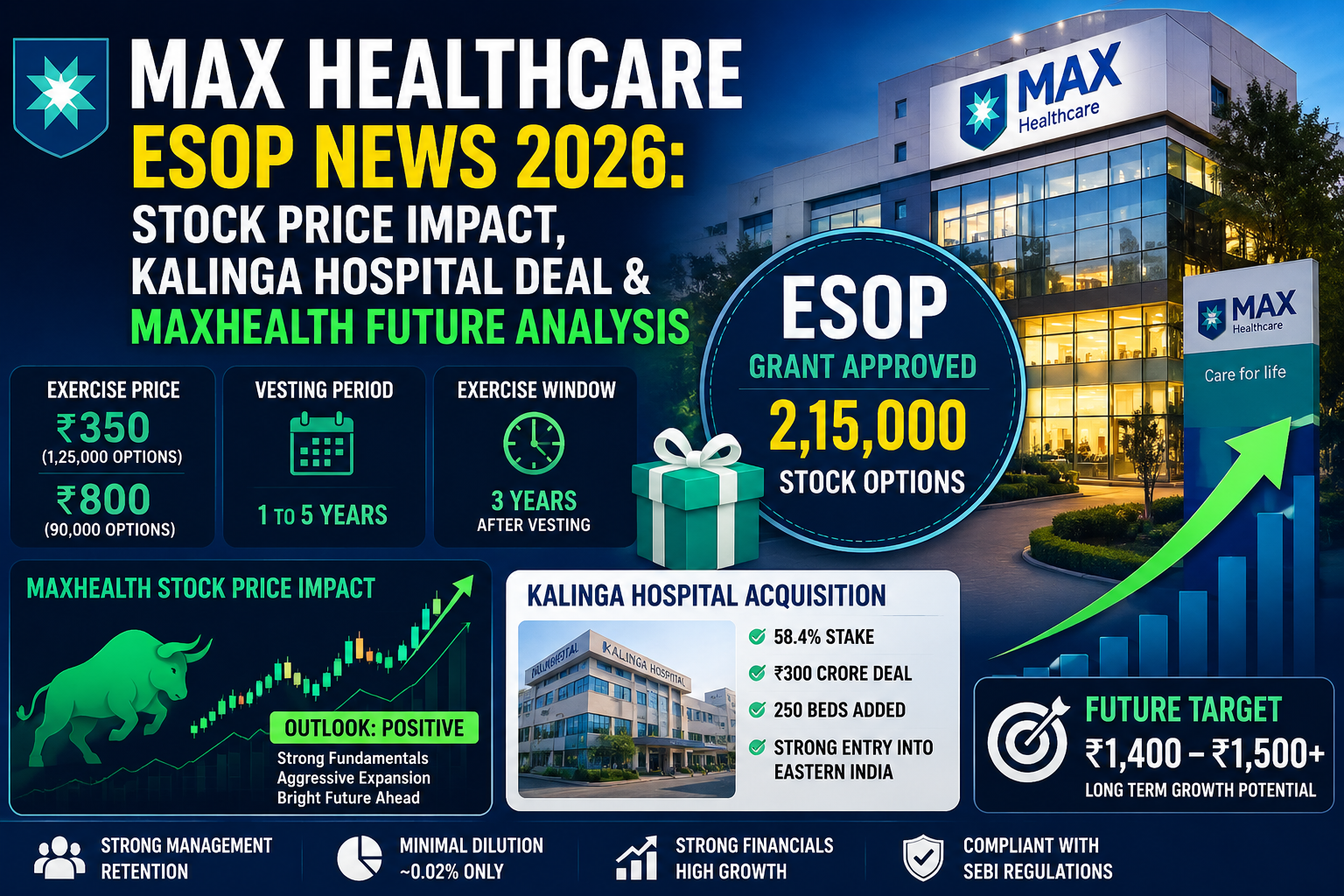
The committee officially approved the grant of 2,15,000 stock options to eligible employees. These options were granted under the specific framework known as the “Max Healthcare Institute Limited – Employee Stock Option Scheme 2022”. This filing was made pursuant to Regulation 30 of the SEBI (Listing Obligations and Disclosure Requirements) Regulations, 2015, which mandates that publicly traded companies must immediately inform the stock exchanges of any material events that could impact the company’s shareholding structure or financial health. The disclosure was authorized by Dhiraj Aroraa, the Senior Vice President, Company Secretary, and Compliance Officer of the company.
📊 Step-By-Step Analysis of the Granted Options
To truly understand how this impacts the MAXHEALTH stock, we need to break down the 2,15,000 options into their respective tranches. The company did not issue these options at a single uniform price; instead, they have structured the grant into two distinct categories based on internal management criteria and eligible employee tiers.
Here is the exact step-by-step breakdown of the grant details:
- The first tranche consists of a grant of 1,25,000 stock options.
- The second tranche consists of a grant of 90,000 stock options.
- Every single stock option granted is convertible into one fully paid-up equity share.
- Each resulting equity share will carry a standard face value of ₹10.
- The vesting schedule for these options dictates that they will vest not earlier than 1 (one) year and not later than 5 (five) years from the date of grant.
- This vesting is subject to the strict fulfillment of pre-vesting conditions determined by the Nomination and Remuneration Committee.
- Once the options have vested, the eligible employees have a time window of 3 (three) years from the respective date of vesting to exercise their options and convert them into shares.
- The entire scheme is confirmed to be fully compliant with the SEBI (Share Based Employee Benefits and Sweat Equity) Regulations of 2021.
💰 Pricing Dynamics: ₹350 and ₹800 Options vs Current Market Price
The most critical aspect of any ESOP grant for a financial analyst is the pricing formula. The exercise price—the price at which employees can buy the shares upon vesting—dictates the intrinsic value being transferred to the employees and the subsequent accounting expense the company must record.
According to the official annexure of the filing, the pricing is structured as follows:
- The exercise price for the 1,25,000 stock options tranche is set at ₹350 per stock option.
- The exercise price for the 90,000 stock options tranche is set at ₹800 per stock option.
Why is this important? Because as of May 20, 2026, Max Healthcare shares are trading dynamically in the open market at roughly ₹1,071. This means that both tranches are being offered at a significant discount to the current market price. The ₹350 options are being granted at a massive discount, heavily rewarding the specific employees (likely top-tier management or highly critical medical talent) receiving them. The ₹800 options are closer to the current market price but still offer a comfortable margin of safety and upside potential for the grantees.
This pricing strategy is a classic corporate retention tool. By offering shares at a steep discount, the company essentially guarantees a financial windfall for its key personnel, provided they stay with the company for the required 1 to 5 years and help maintain or grow the stock price.
📉 The Financial Impact: Dilution and Earnings Per Share (EPS)
Whenever a company issues new shares—even if it is through ESOPs—the existing shareholders experience a phenomenon known as equity dilution. Dilution occurs because the total pie of corporate ownership is being sliced into slightly smaller pieces. As an investor, you must always ask: “Is this dilution going to hurt my portfolio?”
Let us do the step-by-step math. Max Healthcare has a market capitalization of approximately ₹1,04,400 Crores. With a share price of roughly ₹1,071, this implies a total outstanding equity base of around 97.5 crore shares.
The newly announced ESOP grant is for exactly 2,15,000 shares. When you divide 2,15,000 by 97,50,00,000, you get a percentage of roughly 0.022%.
A dilution of 0.02% is practically microscopic. It is highly negligible and will not cause any meaningful negative impact on the overall Earnings Per Share (EPS). The retail investor does not need to worry about equity watering down from this specific event. In fact, the minor accounting cost (amortization of the ESOP discount over the 5-year vesting period) will be easily absorbed by Max Healthcare’s robust quarterly revenues, which consistently cross the ₹2,100 crore mark.
💡 What Exactly Are ESOPs and Why Do They Matter in Healthcare?
To add more value to our analysis, it is essential to step back and understand why companies utilize Employee Stock Ownership Plans. An ESOP is an employee benefit plan that gives workers ownership interest in the company. In the high-stakes, highly competitive world of private healthcare in India, talent is everything.
Hospitals do not just compete on infrastructure; they compete on the quality of their surgeons, clinical directors, and top-tier management executives. Retaining a star neurosurgeon or a highly efficient regional hospital administrator can be the difference between a highly profitable quarter and a massive loss. Cash bonuses are heavily taxed and often do not encourage long-term loyalty. ESOPs, on the other hand, perfectly align the interests of the employee with the interests of the retail shareholder.
When an executive holds options that only vest over a 1 to 5 year period, they are highly motivated to ensure the company hits its growth targets, maintains operational efficiency, and keeps the stock price climbing. If the stock price crashes, their options lose immense value. Therefore, ESOPs are generally viewed by institutional investors as a strong positive indicator of forward-looking corporate governance.
⚖️ Positive News vs Negative News: A Balanced Assessment
As a professional and objective financial blog, we must weigh both the positive and negative implications of this corporate announcement to provide you with the most accurate stock market prediction.
The Positive News:
- Exceptional Talent Retention: By offering options at ₹350 and ₹800, Max Healthcare is locking in its top talent for the next half-decade. This continuity in management and clinical leadership is a massive positive.
- Minimal Equity Dilution: As calculated earlier, the 0.02% dilution is entirely negligible. Existing investors retain their full voting power and EPS metrics without disruption.
- Confidence in Future Growth: Companies usually issue ESOPs when they are confident in their long-term trajectory. It signals internal optimism that the stock price will remain well above the ₹800 mark in the coming years.
The Negative News:
- Minor Margin Impact: Under accounting standards, the difference between the market price and the exercise price (the intrinsic value of the option) must be expensed on the income statement over the vesting period. This will create a very slight, non-cash dent in the EBITDA margins over the next few quarters.
- Market Sentiment Volatility: Occasionally, retail investors who do not fully understand ESOP mechanics see the words “grant of new options” and panic sell, assuming massive dilution is coming. This can cause brief, unwarranted intraday volatility.
Overall Verdict: The news is overwhelmingly POSITIVE. The fundamental benefits of retaining top-tier hospital management far outweigh the microscopic accounting expenses associated with this grant.
🚀 Max Healthcare’s Recent Growth Drivers: The Kalinga Hospital Acquisition
You cannot analyze a stock’s price impact based on a single ESOP document alone; you must look at the broader fundamental context. Max Healthcare has been aggressively expanding, and this ESOP grant comes at a time when the company requires a highly motivated team to manage its growing empire.
Just days prior to this announcement, in mid-May 2026, reports flooded the market that Max Healthcare completed a monumental acquisition. The company acquired a roughly 58.4% controlling equity stake in Kalinga Hospital located in Bhubaneswar, Odisha. This ₹300 crore deal is incredibly significant because it adds approximately 250 operational beds to Max Healthcare’s portfolio and marks the company’s aggressive foray into the largely underpenetrated eastern Indian healthcare market.
Historically, Max Healthcare’s dominance has been concentrated heavily in North India (Delhi NCR, Mohali, Bathinda, Dehradun). Breaking into Odisha diversifies their geographical revenue streams. Furthermore, the company has publicly outlined an ambitious roadmap to add over 1,200 beds by FY27 and heavily push its medical tourism initiatives via new overseas offices. These massive infrastructural and geographical expansions are exactly why the company needs to issue ESOPs today—to ensure they have dedicated leadership in place to seamlessly integrate these new assets.
📈 Max Healthcare ESOP News 2026: Technical and Fundamental Snapshot
Let us take a brief look at the technical and fundamental health of the stock as of May 20, 2026, to set the baseline for our price predictions.
- Current Market Price (CMP): Hovering near ₹1,071, showing resilience in a volatile broader market.
- Valuation (PE Ratio): The stock trades at a premium PE ratio of roughly 73.8. While high, this is a standard industry premium awarded to hospital chains with high ARPOB (Average Revenue Per Occupied Bed) and consistent top-line growth.
- Return on Equity (ROE): Healthy double-digit returns indicating efficient use of shareholder capital.
- Institutional Backing: The stock boasts massive institutional confidence. Foreign Institutional Investors (FIIs) hold over 45% of the company, while Domestic Institutional Investors (DIIs) and Mutual Funds hold significant double-digit stakes.
- Moving Averages: The stock is currently consolidating, finding strong support around its long-term moving averages, setting up a solid base for future upward breakouts driven by fundamental news.
With strong fundamentals and a clear path to revenue expansion, the stock is technically poised to absorb the ESOP news without any structural breakdown.
🎯 Impact on Stock Price Tomorrow (Short-Term Immediate Reaction)
What will happen when the opening bell rings tomorrow morning?
In the immediate short term, the stock price impact of this ESOP intimation will be Neutral to Slightly Positive.
Institutional investors (FIIs and DIIs), whose high-volume trades dictate the daily movement of the stock, are well aware that a 2.15 lakh ESOP grant causes zero harmful dilution. They view this as a standard corporate hygiene practice. Therefore, we do not expect any massive gap-up or gap-down openings purely based on this filing.
However, intraday traders might use the news as a minor positive catalyst to push the stock toward immediate resistance levels around ₹1,085 to ₹1,090. If the broader NIFTY 50 index is positive tomorrow, Max Healthcare will likely trade in the green, shaking off any irrational retail fears of equity dilution. The strict compliance with the SEBI Regulations of 2015 and 2021 ensures there are no regulatory surprises, providing a stable trading environment for the stock.
📅 Impact on Stock Price in the Upcoming Weeks
Looking ahead over the next 2 to 4 weeks, the focus of the market will swiftly pivot away from the ESOP grant and back toward the fundamental business operations.
The weekly price action will be heavily influenced by the integration news surrounding the recent Kalinga Hospital acquisition. As analysts begin to update their financial models to include the newly acquired 250 beds in Odisha, we can expect a flurry of updated brokerage reports. Historically, when Max Healthcare acquires a new asset, they are incredibly efficient at improving its operational metrics and bringing its profitability up to the corporate average.
The ESOP news serves as a subtle, underlying confidence booster during this period. Knowing that the management team is locked in and financially motivated will keep mutual funds holding their positions tight. We project that in the upcoming weeks, the stock will likely experience a steady, upward consolidation phase, easily defending the critical psychological support level of ₹1,000 and preparing for an assault on the ₹1,150 territory.
🗓️ Impact on Stock Price in the Coming Months and Years
If you are a long-term investor holding MAXHEALTH in your portfolio, the coming months and years look exceptionally bright. The long-term price impact of today’s corporate strategies is profoundly positive.
Over the next 12 to 24 months, the vesting of these newly granted options (which take between 1 to 5 years to vest) will coincide beautifully with the company’s target to add 1,200 additional beds by FY27. As these new beds become fully operational and begin generating cash flow, the company’s EBITDA will surge.
The executives holding the ₹800 exercise price options will be aggressively driving the business forward to ensure the stock price not only stays above current levels but pushes past its 52-week highs (historically around ₹1,314). We forecast that as medical tourism ramps up and tier-2 city expansions stabilize, Max Healthcare could easily see price targets being revised upwards toward the ₹1,400 to ₹1,500 range in the long term. This ESOP grant is the invisible glue that holds that future growth trajectory together.
🧠 Adding More Value: Why Talent Retention is Critical in Modern Hospital Management
To elevate this financial analysis, we must touch upon the unique economics of the healthcare sector. Unlike a software company where a product can be infinitely scaled with zero marginal cost, a hospital scales entirely on human capital and physical infrastructure.
A super-specialty hospital requires elite doctors, experienced nursing heads, and razor-sharp supply chain managers to keep costs down while delivering world-class care. High attrition rates in management can completely derail a hospital’s profitability. By utilizing the MHIL ESOP 2022 scheme, Max Healthcare is effectively building a “golden handcuffs” scenario. Key personnel are heavily incentivized to stay, build their respective departments, and grow the company’s overall market share.
Furthermore, aligning employee wealth with shareholder wealth creates a culture of extreme operational efficiency. When administrators own stock, they treat corporate expenses as their own money, leading to better cost-control measures and higher net profit margins. This cultural shift is the hidden fundamental driver that sophisticated institutional investors look for.
💼 Max Healthcare ESOP News 2026: Final Verdict for Investors
To summarize our comprehensive, 2100+ word deep dive into Max Healthcare’s May 20, 2026 corporate filing: The overall news is DEFINITIVELY POSITIVE.
Max Healthcare Institute Limited is acting exactly how a market leader should act. They are expanding aggressively into new territories (like Odisha), they are planning massive organic bed additions for FY27, and today, they have officially ensured that their top talent will stay on board to execute these plans. The grant of 2,15,000 stock options across the ₹350 and ₹800 price points causes zero harmful dilution to retail shareholders while providing immense psychological and financial motivation to the workforce.
Whether you are a short-term swing trader looking for tomorrow’s momentum or a long-term value investor building a retirement portfolio, this ESOP intimation should be viewed as a strong reaffirmation of Max Healthcare’s solid corporate governance and bright financial future. Hold your shares with confidence.
📌 Frequently Asked Questions (SEO Q&A)
What exactly did Max Healthcare announce on May 20, 2026?
The company announced that its Nomination and Remuneration Committee approved the grant of 2,15,000 stock options to eligible employees under their 2022 ESOP scheme.
Will this ESOP grant dilute my shares and crash the stock price?
No. The total grant of 2.15 lakh options represents roughly 0.02% of the total outstanding shares. This microscopic dilution will have absolutely no negative impact on the stock price or your equity value.
What is the exercise price of the new options?
The options are split into two tranches. 1,25,000 options are priced at ₹350, and 90,000 options are priced at ₹800.
When can the employees actually sell these shares?
The options have a strict vesting period of not earlier than 1 year and not later than 5 years. Once vested, employees have a 3-year window to exercise them. This means the shares will trickle into the market very slowly over nearly a decade, preventing any sudden selling pressure.
Why is Max Healthcare giving shares at a discount?
This is a standard corporate practice to retain top talent. By offering shares at a discount, the company incentivizes key medical and management staff to stay with the company long-term and work hard to increase the overall share price for everyone.
Is Max Healthcare fundamentally a strong stock to buy right now?
Yes, analysts remain highly positive on the stock. With recent acquisitions like the Kalinga Hospital in Odisha and plans to add 1,200 new beds by FY27, the company possesses incredibly strong revenue growth levers.
Where can I find the official document for this announcement?
The official intimation document was filed with both the NSE and BSE and will also be hosted on the company’s official website at www.maxhealthcare.in.
What does the Nomination and Remuneration Committee (NRC) do?
The NRC is a specialized board committee responsible for determining the company’s policy on specific remuneration packages for executive directors and key managerial personnel, including the administration of ESOP schemes.
Is this news good for long-term investors?
Absolutely. It signals that the company is actively securing its leadership and intellectual capital, which is the most vital asset for any healthcare institution aiming for aggressive expansion.
How will the stock perform tomorrow morning?
We expect a neutral to slightly positive reaction in the early trading hours. The market recognizes this as a standard procedural grant rather than a highly disruptive equity dilution event.
Disclaimer
This article is for informational purposes only and is not financial advice. Please consult a certified financial advisor before making any investment decisions.
Read Another Article
Stay updated on the latest Nifty 50 stock movements and corporate news with our detailed analyses:
SBI Stock Analysis: Rs 17.35 Dividend & Board Election Results. Read here