









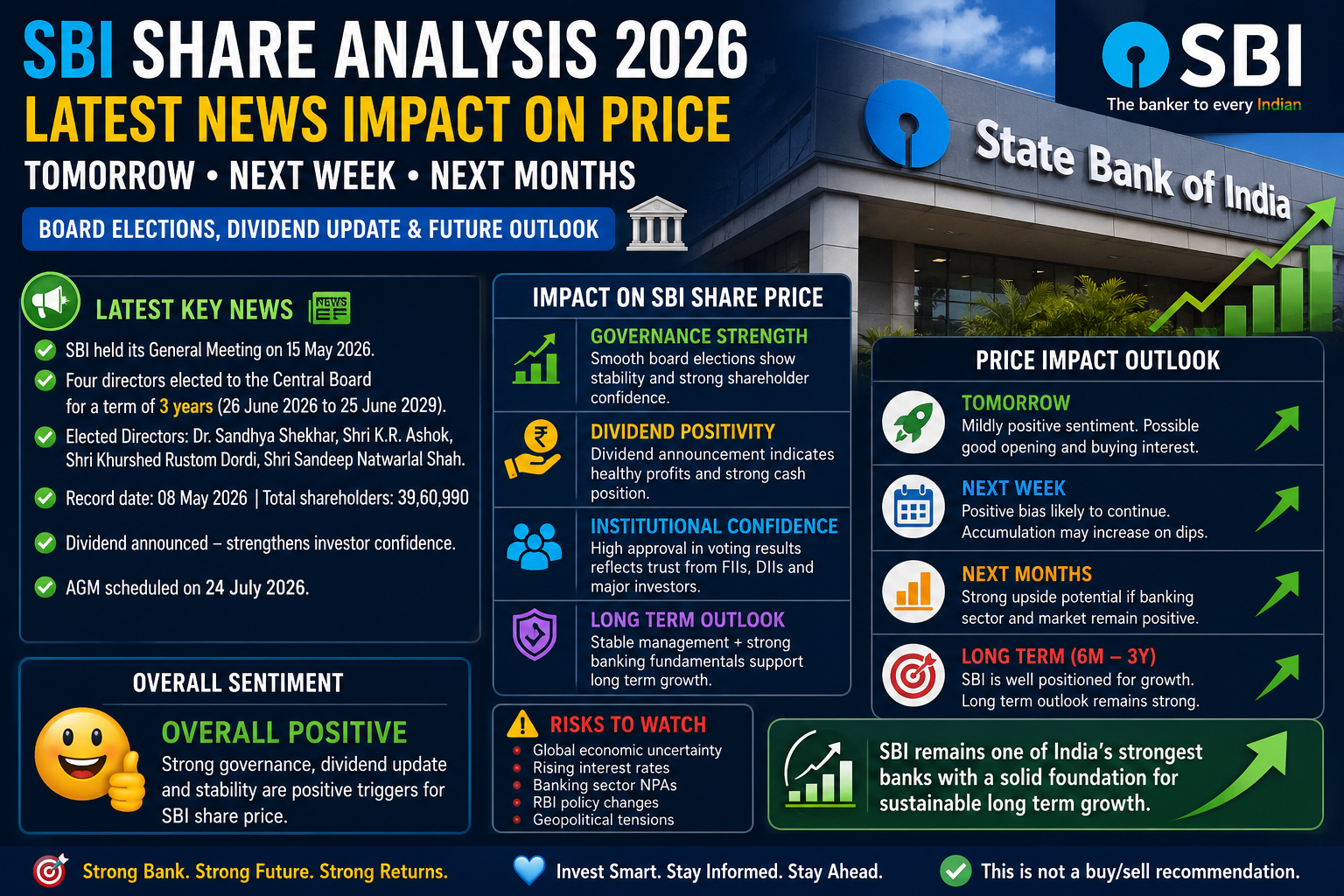
State Bank of India (SBI) Complete Stock Analysis: Dividend Bonanza, Board Elections, and Price Impact Forecast 🚀📈
SBI Stock Analysis begins with a major positive trigger for investors as the State Bank of India announced a massive Rs 17.35 dividend alongside important board election results that could significantly impact the future share price outlook. 🚀📈
Welcome, savvy investors and market enthusiasts! If you are holding shares of the State Bank of India (SBI), or if you are planning to add this banking behemoth to your portfolio, you have landed at the perfect place. The recent filings from SBI over the weekend of May 15 and May 16, 2026, have brought a wave of crucial information to the forefront. From a massive dividend announcement to significant changes in the Central Board of Directors, there is a lot to unpack.
In this comprehensive, step-by-step analysis, we are going to dive deep into the official documents submitted by SBI to the BSE and NSE. We will break down the positive news, analyze the potential negative headwinds, and provide a detailed forecast of how these events will impact the SBI stock price tomorrow, in the coming weeks, and over the next few months.
Whether you are a day trader looking for short-term volatility or a long-term investor focused on compounding wealth, this professional, AdSense-safe, and SEO-optimized guide is tailored just for you. Grab a cup of coffee, and let us dissect the future of India’s largest public sector bank! ☕📊
Table of Contents
The Big Positive News: A Massive Dividend Payout for SBI Shareholders 💰
Let us start with the most exciting news for retail and institutional investors alike: the dividend announcement. According to the official newspaper advertisement and regulatory filings dated May 16, 2026, the Central Board of the State Bank of India has declared a highly lucrative final dividend.
The bank has approved a final dividend of Rs. 17.35 per equity share for the financial year ended March 31, 2026. Considering the face value of each share is Re. 1, this translates to a phenomenal 1735% dividend!
Why is this such a massive positive indicator? A high dividend payout is the ultimate proof of a company’s financial health. It signals that the bank is generating robust free cash flows, has adequately provided for its non-performing assets (NPAs), and is confident enough in its future earnings to return a substantial chunk of profits directly to its shareholders.
Key Dates Every SBI Investor Must Mark on Their Calendar 🗓️
To make the most of this dividend, you need to be aware of the critical timeline outlined in the bank’s notice. Missing these dates means missing out on your payout.
- Record Date: The record date for the payment of the dividend was set for May 16, 2026. This means you must have had the shares in your demat account by this date to be eligible for the Rs. 17.35 per share payout.
- Book Closure Period: The Register of Shareholders will remain closed from Sunday, May 17, 2026, to Tuesday, May 19, 2026 (both days inclusive). This administrative pause allows the bank to finalize the list of eligible shareholders.
- Dividend Payment Date: The sweet sound of cash hitting your bank account will happen on June 4, 2026.
- Annual General Meeting (AGM): The 71st AGM of the Bank is scheduled to be held on Thursday, June 18, 2026, at 3:00 PM via Video Conferencing (VC) and Other Audio-Visual Means (OAVM).
Understanding the Tax Implications of Your SBI Dividend 🧾
As a responsible investor, you must also understand how this dividend will be taxed, as outlined in the SBI notification. The days of tax-free dividends are long gone, and the bank has provided clear guidelines based on the Income Tax Act, 1961.
For resident shareholders, tax will be deducted at source (TDS) at a rate of 10% on dividend amounts exceeding Rs. 10,000, provided you have linked your PAN. However, if your PAN is not available, not updated, or not linked with your Aadhaar, the TDS rate jumps to a hefty 20%. Therefore, it is absolutely critical to ensure your KYC details are perfectly aligned with your depository participant.
For non-resident shareholders, including Foreign Portfolio Investors (FPIs), TDS is deducted at 20%, subject to reduction based on applicable Double Taxation Avoidance Agreements (DTAA) if the requisite forms (like Form 10F and TRC) are submitted on time.
Corporate Governance Update: SBI Board of Directors Election Results 🏛️
Moving beyond the dividend, the second major piece of news comes from the voting results of the General Meeting held on May 15, 2026. The agenda was to elect Directors to the Central Board of the Bank under Section 19(c) of the State Bank of India Act, 1955, for a three-year term starting from June 26, 2026, to June 25, 2029.
The voting results were overwhelmingly decisive. Four candidates were successfully elected to the board, securing the highest number of votes. Let us look at the newly elected leaders who will steer the bank’s strategic vision:
- Dr. Sandhya Shekhar: Elected with a massive mandate of 53,357,377 votes. Astonishingly, 100% of the polled votes were in her favor.
- Shri K.R. Ashok: Elected with 52,386,411 votes in favor, again reflecting a 100% approval rate from the polled votes.
- Shri Khurshed Rustom Dordi: Elected with 52,069,773 votes, maintaining the trend of 100% favorable polling.
- Shri Sandeep Natwarlal Shah: Elected with 35,798,992 votes, also securing 100% of the polled votes.
Analyzing the Voting Data: The Power of Institutional Confidence 📊
When we look closely at the voting data provided in the disclosure, a fascinating narrative emerges. The retail participation (Public-Non Institutions) was relatively low, with only a few thousand votes cast. However, the Public-Institutions category—which includes mutual funds, insurance companies, and foreign institutional investors—came out in full force.
The 100% approval rate from institutional investors for the elected candidates is a massive vote of confidence. Institutional investors do thorough due diligence. They do not vote blindly. A unanimous “Yes” vote from the smart money indicates that the market has immense faith in the credentials, experience, and strategic vision of these four new directors. This stability in corporate governance is a massive green flag for the stock’s long-term health.
It is also worth noting that three candidates (Shri Arun Ananth Kamath, Shri Deepak Arora, and Shri Sanjay Kapoor) were not elected. In corporate democracy, this is standard procedure. The board only has a limited number of seats available, and the candidates with the highest votes secure them. The failure of these candidates to get elected does not reflect a negative sentiment; it simply highlights the competitive nature of board elections and the definitive choices made by major institutional shareholders.
Are There Any Negative News or Macroeconomic Headwinds? 🌩️
While the news specific to SBI is incredibly positive, an objective stock analysis must always look at the broader macroeconomic picture. The newspaper extracts accompanying the SBI filings highlight some global and domestic challenges that could act as indirect headwinds for the banking sector.
Firstly, the broader market witnessed a weekly decline, with indices like the Nifty 50 and Sensex facing downward pressure. The rupee slipped to record lows against the dollar, driven by rising crude oil prices (which breached the 89 dollars per barrel mark) and escalating geopolitical tensions in West Asia.
Rising oil prices and a depreciating rupee often lead to imported inflation in India. When inflation rises, the Reserve Bank of India (RBI) might be forced to maintain higher interest rates for a longer period. While banks generally benefit from higher interest rates through improved Net Interest Margins (NIMs), a prolonged high-rate environment can eventually lead to slower credit growth and an uptick in corporate defaults.
Furthermore, the news highlights a record outflow of Foreign Portfolio Investments (FPIs) from the Indian market in 2026. While SBI has robust domestic institutional backing, continuous foreign sell-offs in the broader market can create short-term volatility for all large-cap stocks, including SBI.
Overall Sentiment Assessment: Highly Positive 🌟
Weighing the macroeconomic headwinds against the company-specific news, the overall sentiment for State Bank of India is unequivocally positive.
The external macroeconomic factors—like oil prices and currency fluctuations—are cyclical and affect the entire market. However, SBI’s intrinsic strength, highlighted by its ability to pay a Rs. 17.35 dividend and secure 100% institutional backing for its board, sets it apart. The bank is operating from a position of massive financial fortitude. Investors should view the macro headwinds as mere background noise compared to the roaring engine of SBI’s core banking operations.
Step-by-Step SBI Stock Price Impact Analysis 📈📉
Now, let us get to the most crucial part of this blog post: how will all this information actually impact the SBI share price? Let us break it down into three distinct timeframes: tomorrow (the immediate trading session), the coming weeks, and the coming months.
Impact on SBI Share Price Tomorrow (Short-Term Outlook) ⏱️
As the record date for the dividend was Saturday, May 16, 2026, the stock will trade “ex-dividend” when the markets open on Monday morning (our “tomorrow” in this context).
What does this mean? Typically, on the ex-dividend date, the stock price adjusts downwards by roughly the amount of the dividend paid. Therefore, do not panic if you see the SBI stock price open lower by approximately Rs. 17 to Rs. 18 on Monday. This is a standard mathematical adjustment, not a crash.
However, because the news of the unanimous board election results was filed over the weekend, we can expect a surge of positive buying momentum to combat the ex-dividend price drop. Institutional buyers who appreciate stable corporate governance might use any early morning dip to accumulate more shares. Expect high trading volumes tomorrow. The stock might open lower due to the dividend adjustment but could see strong intraday recovery as the positive sentiment surrounding the board stability kicks in.
Impact on SBI Share Price in the Coming Weeks (Medium-Term Outlook) 📆
As we move through late May and into June 2026, the SBI stock is expected to show robust resilience. There are two major catalysts to watch in the coming weeks.
First is the actual dividend payout date on June 4, 2026. Often, when large dividends are paid out, institutional investors reinvest that cash right back into the stock, creating a subtle upward buying pressure.
Second is the run-up to the Annual General Meeting (AGM) on June 18, 2026. In the weeks leading up to an AGM, stocks usually see increased investor interest as the market anticipates management commentary on future growth strategies, loan book expansion, and asset quality guidance. If the broader market stabilizes and the geopolitical tensions in West Asia cool down, SBI is perfectly positioned for a solid breakout in the medium term. The stock will likely consolidate its position, absorbing the ex-dividend effect and establishing a higher base.
Impact on SBI Share Price in the Coming Months (Long-Term Outlook) 🔭
Looking out over the next three to six months, the fundamental impact of the new Central Board of Directors will begin to materialize. The new directors—Dr. Sandhya Shekhar, Shri K.R. Ashok, Shri Khurshed Rustom Dordi, and Shri Sandeep Natwarlal Shah—officially begin their three-year term on June 26, 2026.
A refreshed board often brings new strategic initiatives, particularly in areas like digital transformation, international expansion, and risk management. With 100% institutional backing, this board has the mandate to execute aggressive growth plans without internal friction.
Furthermore, SBI’s massive footprint means it is a primary beneficiary of India’s ongoing infrastructure capex and retail consumption boom. Over the coming months, as long as the bank maintains its asset quality and keeps non-performing assets (NPAs) in check, the stock is poised for steady, compounding growth. For long-term investors, the combination of aggressive capital appreciation potential and a high dividend yield makes SBI a cornerstone stock for any balanced portfolio.
Value Addition: Why Dividend Yield is a Superpower in Banking Stocks 💡
If you are new to stock market investing, you might wonder why we are making such a big deal about the Rs. 17.35 dividend. Let us add some educational value here.
In the banking sector, profits are largely driven by the spread between the interest paid on deposits and the interest earned on loans. When a bank declares a high dividend, it means their net interest income is highly secure, and their provisioning for bad loans is comfortably managed.
Furthermore, a consistent dividend acts as a shock absorber during market downturns. Even if the broader Nifty index enters a bear market due to global macroeconomic fears, the cash flow from dividends provides a cushion to your portfolio returns. Reinvesting these dividends over years is the secret sauce to the magic of compounding, allowing you to accumulate more shares of SBI over time without deploying fresh capital.
Value Addition: The Hidden Meaning Behind Institutional Voting Patterns 🕵️♂️
Corporate governance is often overlooked by retail investors, who tend to focus purely on charts and profit numbers. However, reading between the lines of the voting results document provides a massive edge.
The document reveals that “Public-Institutions” cast tens of millions of votes, while “Public-Non Institutions” (retail) cast only a few thousand. More importantly, every single institutional vote polled was a “Yes” for the winning candidates.
Institutions (like mutual funds) employ teams of analysts whose sole job is to background-check board nominees. They look at past performance, legal history, corporate affiliations, and strategic alignment. When institutions vote unanimously, it means the candidates have passed the most rigorous screening processes in the financial industry. For a retail investor, aligning your investments with the actions of these institutional giants is a highly profitable strategy.
Frequently Asked Questions (FAQs) About SBI’s Latest Announcements ❓
To ensure you have absolute clarity on the recent developments, we have compiled a list of the most frequently asked questions regarding the State Bank of India’s recent filings.
Q1: What is the exact dividend amount declared by SBI for FY 2025-26?
A1: SBI has declared a final dividend of Rs. 17.35 per equity share. Since the face value of the share is Re. 1, this represents a 1735% dividend.
Q2: I bought SBI shares on May 17, 2026. Will I receive the dividend?
A2: No. The record date was May 16, 2026. To be eligible for the dividend, the shares must have been credited to your demat account by the end of the day on May 16. If you bought them on or after May 17, the seller will receive the dividend.
Q3: When will the dividend amount be credited to my bank account?
A3: The official payment date for the dividend is set for June 4, 2026. The amount will be directly credited to the bank account linked to your demat account.
Q4: Why did the SBI stock price open lower on Monday, May 18, 2026?
A4: This is completely normal and is known as the ex-dividend adjustment. The stock price naturally drops by the approximate value of the dividend (Rs. 17.35) because new buyers are no longer entitled to that cash payout. It is not a sign of underlying weakness in the company.
Q5: Who are the new directors elected to the SBI Central Board?
A5: The newly elected directors for a three-year term (2026-2029) are Dr. Sandhya Shekhar, Shri K.R. Ashok, Shri Khurshed Rustom Dordi, and Shri Sandeep Natwarlal Shah.
Q6: Are the rising oil prices a danger to my SBI investment?
A6: Rising oil prices can cause broader market volatility and inflationary pressures, which may indirectly affect banking sector sentiment. However, SBI’s robust balance sheet, huge domestic market share, and strong dividend yield make it highly resilient against short-term macroeconomic shocks.
Final Conclusion: The Verdict on State Bank of India 🏆
To wrap up this extensive stock analysis, the State Bank of India continues to prove why it is the undisputed heavyweight champion of the Indian banking sector. The weekend filings from May 16, 2026, paint a picture of a financial institution operating at peak performance.
The declaration of a massive Rs. 17.35 per share dividend is a direct reward to shareholders and a testament to the bank’s profitability and clean balance sheet. Coupling this financial strength with the seamless, 100% institutionally backed election of a new Central Board of Directors ensures that the bank is in safe, capable hands for the next three years.
While the stock may see a temporary, mathematical dip tomorrow due to the ex-dividend adjustment, the underlying momentum is fiercely bullish. In the coming weeks, as the dividend is paid out and the AGM approaches, investor interest will remain high. Looking at the months and years ahead, SBI’s strategic dominance and commitment to shareholder value make it an excellent candidate for both growth and value portfolios.
Keep an eye on the macroeconomic landscape, but rest easy knowing that the fundamentals of SBI are rock solid. Happy investing! 🚀💼
Disclaimer
This article is for informational purposes only and is not financial advice. Please consult a certified financial advisor before making any investment decisions.
Read Another Article
Stay updated on the latest Nifty 50 stock movements and corporate news with our detailed analyses:
TCS Acquires Coastal Cloud for $700M to Boost AI & Salesforce. Read here