







Source: Official exchange filing from the National Stock Exchange of India (NSE).
Introduction: Why Maruti Suzuki Stock Deserves Attention Right Now in 2026
Maruti Suzuki Share Impact After IOCL Partnership has become a major talking point among stock market traders and investors. Maruti Suzuki India Limited recently announced a strategic collaboration with Indian Oil Corporation Limited (IOCL) to expand vehicle servicing facilities at fuel stations across India, a move that could strengthen its service ecosystem and improve long-term revenue stability.
Recently, Maruti Suzuki announced a strategic collaboration with Indian Oil Corporation Limited (IOCL) to expand its vehicle service facilities across IOCL fuel stations nationwide. This development is not just operational news—it has direct and indirect implications on Maruti Suzuki’s revenue stability, customer retention, margins, and future valuation.
In this detailed post, we will break down how this news impacts Maruti Suzuki’s share price, analyze intraday and short-term trading opportunities, explore swing trading potential, and evaluate long-term investment outlook—all in a structured, professional, and easy-to-understand manner.
Maruti Suzuki Share Impact After IOCL Partnership: What Investors Should Know
The Maruti Suzuki Share Impact After IOCL Partnership is expected to be structurally positive because the collaboration improves service accessibility, customer retention, and long-term brand loyalty.
Table of Contents
Business Overview: Understanding Maruti Suzuki’s Market Strength 💼
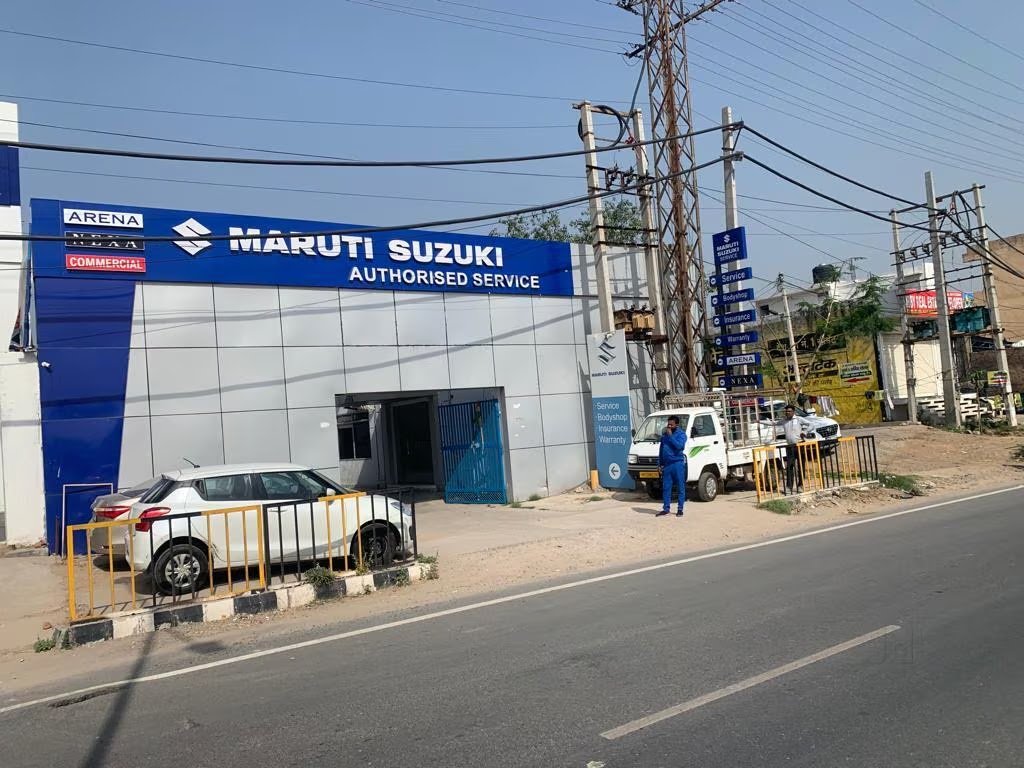
Maruti Suzuki is India’s largest passenger car manufacturer with a presence across entry-level hatchbacks, compact SUVs, premium sedans, and hybrid vehicles. Its strength lies not only in vehicle sales but also in after-sales service, spare parts availability, and brand loyalty.
A key reason Maruti Suzuki maintains stable margins—even during economic slowdowns—is its service ecosystem. The company already operates more than 5,780 service touchpoints across 2,800+ cities, which gives it unmatched reach compared to competitors.
The new collaboration with IOCL further enhances this ecosystem.
Key News Explained: Maruti Suzuki–IOCL Partnership 🚘⛽
Maruti Suzuki has signed an MoU with Indian Oil Corporation Limited, India’s largest fuel retailer with over 41,000 fuel stations nationwide. Under this partnership:
- Customers can access routine servicing, minor repairs, and select major services at IOCL fuel outlets
- Car servicing becomes more convenient and accessible, especially in semi-urban and rural areas
- Maruti strengthens its after-sales dominance without heavy capex
- IOCL benefits by increasing footfall and value-added services
This collaboration brings together mobility and energy infrastructure, which is a strong long-term strategic move.
Why This News Is Fundamentally Positive for Maruti Suzuki ✅
This announcement may appear operational on the surface, but its implications are deeply financial and strategic.
First, service revenue is high-margin revenue. Unlike vehicle sales—which are cyclical and sensitive to interest rates—service income is relatively stable and recurring. Expanding service access increases:
- Customer retention
- Lifetime value per customer
- Brand stickiness
Second, the partnership improves rural and highway penetration, where IOCL stations are widely present. This supports Maruti’s push to dominate Tier-2 and Tier-3 markets.
Third, this move enhances customer experience, which indirectly boosts vehicle sales, repeat purchases, and word-of-mouth marketing.
From an investor’s perspective, all these factors support earnings stability and valuation expansion over time 📊.
Immediate Market Sentiment: How Traders May React Tomorrow ⚡
In the very short term (next trading day), this type of corporate development generally creates a positive bias, not an explosive rally.
Possible intraday reactions include:
- Mild gap-up opening if overall market sentiment is supportive
- Increased volumes due to news-based participation
- Buying interest near key support zones
- Limited upside if broader auto index is weak
This is not speculative hype news, but structural improvement news, which markets usually digest gradually.
The Maruti Suzuki Share Impact After IOCL Partnership is likely to create a positive sentiment among investors as the company strengthens its nationwide service infrastructure.
Intraday Trading Outlook: What Short-Term Traders Should Watch ⏱️
For intraday traders, Maruti Suzuki is typically a low-volatility, high-liquidity stock, suitable for disciplined setups rather than aggressive scalping.
Key intraday observations:
- Stock tends to respect VWAP and previous day high/low levels
- News-backed buying often appears in the first 60–90 minutes
- False breakouts are rare compared to mid-cap auto stocks
Intraday traders should focus on price action confirmation rather than anticipation, as Maruti moves steadily, not sharply.
Short-Term Outlook (1–2 Weeks): Consolidation With Positive Bias 📈
Over the next few weeks, this development supports a gradual upside bias rather than immediate sharp movement.
Reasons for short-term stability:
- Auto sector valuations are already premium
- Institutional investors prefer confirmation through quarterly results
- This news improves outlook but does not immediately change earnings numbers
However, downside risk reduces because structural positives strengthen the support zones.
Short-term traders can expect:
- Higher probability of pullback buying
- Reduced selling pressure on minor corrections
- Relative outperformance versus weaker auto peers
Swing Trading Perspective: 1–3 Month View 🔄
From a swing trading standpoint, this news improves risk-reward ratio for positional trades.
Why swing traders may prefer Maruti now:
- Strong brand + strong balance sheet
- Consistent cash flows
- Expansion without heavy capital expenditure
- Defensive nature during market volatility
Swing traders usually look for clarity and stability, and this partnership adds exactly that.
Over the next 1–3 months, Maruti Suzuki stock has the potential to:
- Gradually move toward higher resistance zones
- Attract institutional accumulation on dips
- Deliver steady percentage returns rather than sudden spikes
From a trading perspective, the Maruti Suzuki Share Impact After IOCL Partnership improves confidence for swing traders looking for stable large-cap opportunities.
Medium-Term Outlook (3–6 Months): Earnings Visibility Improves 🔍
In the medium term, the real impact of this partnership starts reflecting indirectly.
While service revenue may not explode immediately, the operational leverage improves:
- Better service reach → higher customer satisfaction
- Better retention → consistent service income
- Better brand recall → higher probability of repeat vehicle purchases
If auto demand remains stable and raw material costs stay under control, Maruti’s earnings predictability improves, which is highly valued by institutional investors.
This creates room for valuation re-rating, even without aggressive volume growth.
Long-Term Investment Outlook: 1–3 Years 🏦
For long-term investors, this development reinforces Maruti Suzuki’s moat, not just its revenue.
Key long-term positives:
- Strong leadership in passenger vehicles
- Deep rural and urban penetration
- Expanding service ecosystem
- Focus on customer convenience and lifecycle value
- Strategic alignment with large PSU like IOCL
Maruti Suzuki is transitioning from being just a car manufacturer to a mobility ecosystem company. This shift supports sustainable growth rather than cyclical performance.
Long-term investors typically look for predictability, brand strength, and capital efficiency—and Maruti ticks all three boxes.
Over the long term, the Maruti Suzuki Share Impact After IOCL Partnership could strengthen the company’s ecosystem strategy by integrating mobility services with energy infrastructure.
Risks and Negative Factors to Consider ⚠️
A professional analysis must include risks.
Potential concerns include:
- Overall auto demand slowdown due to interest rates
- EV transition pressure and competition
- Rising competition in compact SUV segment
- Dependency on economic cycles
However, this IOCL partnership reduces business risk rather than increasing it, which is a net positive.
Overall Market Impact: Positive or Negative? ✅
When evaluated holistically:
- Short-term impact: Mildly positive
- Medium-term impact: Clearly positive
- Long-term impact: Structurally strong
This is not speculative news, but foundation-strengthening news, which markets reward over time.
Final Verdict: Should Traders and Investors Be Positive? 🎯
Yes—with realistic expectations.
Maruti Suzuki is not a momentum stock; it is a quality compounder.
- Intraday traders should trade levels, not emotions
- Swing traders can use dips as opportunities
- Long-term investors can view this as a confidence-boosting development
This collaboration strengthens Maruti Suzuki’s competitive advantage, supports earnings stability, and improves long-term valuation comfort.
Closing Thoughts: Why This Matters More Than It Appears 🚀
In stock markets, small operational decisions often create big long-term outcomes. By expanding its service reach through IOCL, Maruti Suzuki is quietly locking in customer loyalty for years to come.
For serious traders and investors, this is the kind of development that builds confidence, not hype—and confidence is what ultimately drives sustainable stock price growth.
The Maruti Suzuki Share Impact After IOCL Partnership highlights how strategic collaborations can strengthen operational efficiency and long-term shareholder value.
⚠️ Disclaimer
This analysis is for educational and informational purposes only. It does not constitute financial advice. Please consult a registered financial advisor before making investment decisions.
Read Another Article
Stay updated on the latest Nifty 50 stock movements and corporate news with our detailed analyses:
L&T Share Price Analysis. read here