






Source: Official exchange filing from the National Stock Exchange of India (NSE).
Introduction to Tata Consultancy Services Market Dynamics and Recent Volatility 🚀
TCS Stock Price Forecast 2026 has become one of the hottest topics in the Indian stock market after Tata Consultancy Services announced major AI partnerships with NVIDIA, Pearson, and Google Cloud. Investors are closely watching TCS stock price movements as artificial intelligence, global macroeconomic conditions, and enterprise digital transformation reshape the future of the Indian IT sector.
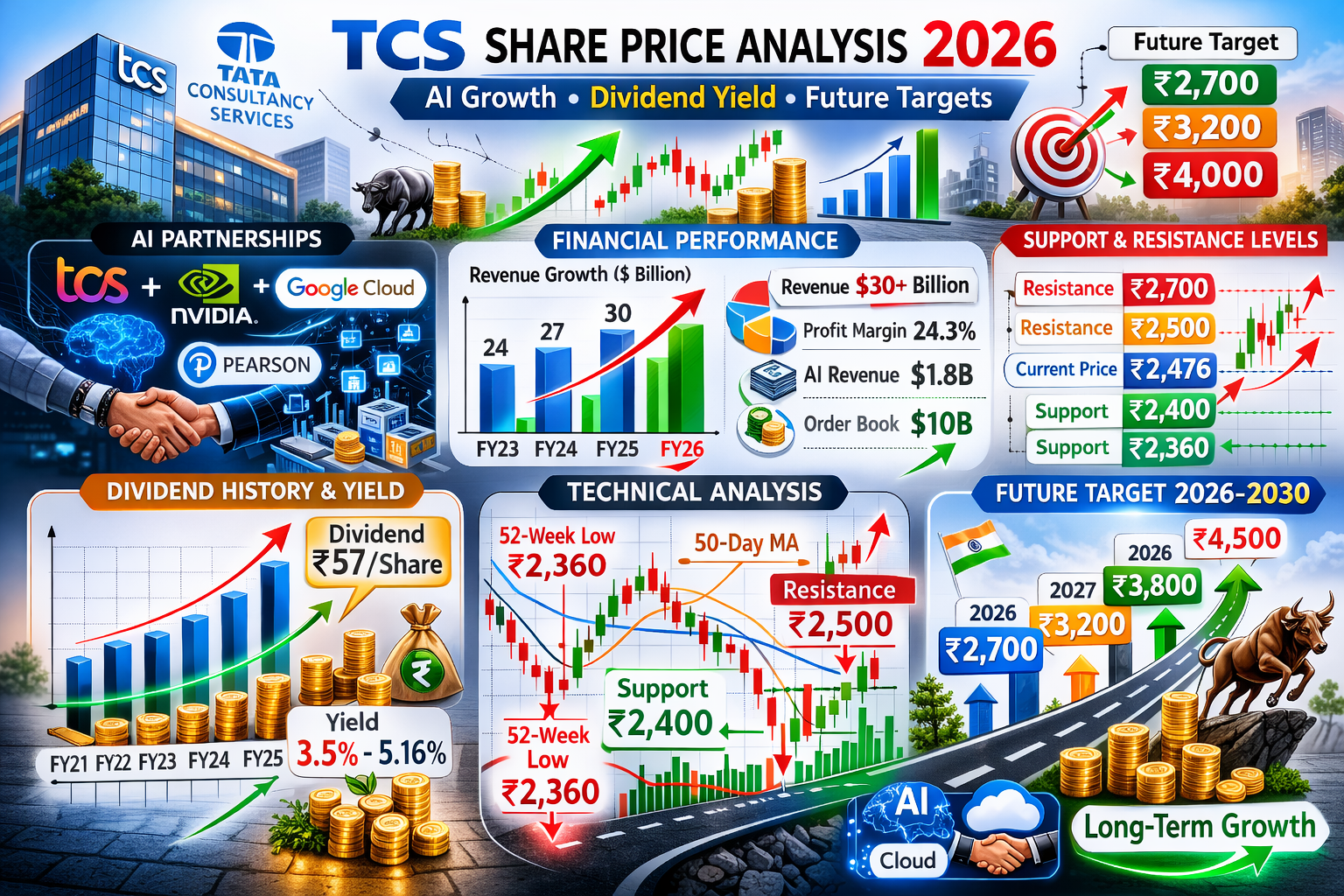
The landscape of the Indian Information Technology sector is currently undergoing a profound and unprecedented structural transformation, and Tata Consultancy Services (TCS) stands firmly at the epicenter of this seismic shift. Navigating the complex interplay between severe macroeconomic headwinds and breathtaking technological breakthroughs, the stock market has witnessed extreme volatility regarding IT equities in the first quarter of 2026. After facing relentless selling pressure that drove the stock near its 52-week low of Rs 2,360, TCS experienced a dramatic and powerful resurgence on March 18, 2026, surging by 3.55% to trade around Rs 2,476.70, with intraday highs reaching Rs 2,482.90.
This comprehensive expert analysis provides a step-by-step, exhaustive breakdown of the fundamental corporate catalysts, macroeconomic pressures, technical indicators, and news sentiment driving the TCS share price. By examining strategic corporate partnerships, robust artificial intelligence pipelines, lucrative dividend yields, and the impact of global geopolitical conflicts, this professional blog post delivers high-value content designed to forecast the immediate, medium, and long-term price impact on TCS stock. The analysis strictly relies on continuous, human-crafted narrative prose to provide a nuanced, professional evaluation suitable for serious investors, market analysts, and financial professionals looking for deeply researched insights.
Table of Contents
Step-by-Step Fundamental Analysis of TCS 📊
To accurately understand the future trajectory of Tata Consultancy Services, it is imperative to first deconstruct the underlying business fundamentals and recent strategic maneuvers that the company has executed. The transition from traditional digital transformation to an “AI-first” operating model is the defining theme of the current fiscal year, and TCS is aggressively positioning itself to capture this massive market opportunity.
The NVIDIA Game-Changer: Rapid Outcome AI Platform 🧠
On March 17, 2026, TCS announced a monumental leap in its enterprise artificial intelligence capabilities by officially launching the “TCS Rapid Outcome AI” platform, developed in direct collaboration with global semiconductor and AI leader NVIDIA. This platform fundamentally alters the value proposition TCS offers to its global clientele. For the past year, global enterprises have been trapped in the “experimentation phase” of artificial intelligence, running localized pilot programs that struggle to scale securely. The Rapid Outcome AI platform leverages NVIDIA’s accelerated computing infrastructure to transition these enterprises directly into production-scale deployment.
This development is far more than a simple software update; it is a deeply integrated capability combining generative AI, predictive analytics, computer vision, and Agentic AI blueprints tailored specifically for complex industry processes. By integrating these cutting-edge capabilities, TCS is enabling autonomous decision-making across the manufacturing, telecommunications, banking, and retail sectors. Amit Kapur, the Chief AI and Services Transformation Officer at TCS, emphasized that this platform combines TCS’s deep contextual industry knowledge with NVIDIA’s hardware and software stack to deliver tangible, scalable business outcomes. Furthermore, John Fanelli, Vice President of Enterprise Software at NVIDIA, highlighted that this combination allows organizations to accelerate the deployment of applications that deliver entirely new levels of automation. The second-order impact of this strategic development is immense: as clients move from small pilot projects to large-scale, enterprise-wide deployments, the deal sizes will significantly expand, transitioning from short-term consulting fees to long-term, high-margin platform subscriptions.
The Pearson Partnership: Revolutionizing Enterprise Learning 🎓
Following closely on the heels of the NVIDIA announcement, TCS declared a massive, multi-year integrated partnership with Pearson on March 18, 2026. This strategic alliance aims to accelerate AI-powered learning and assessment for global industries, bridging the critical gap between technological adoption and human capability. The core of this partnership involves integrating Pearson’s enterprise learning and assessment expertise with TCS’s leadership in Contextual AI and its highly robust TCS iON digital learning platform.
The fundamental rationale behind this partnership addresses a critical bottleneck in the global artificial intelligence rollout. As Omar Abbosh, CEO of Pearson, astutely noted, leaders in every sector are investing heavily in AI, but many struggle to demonstrate a tangible return on that investment because their workforce lacks the skills and confidence to operate alongside intelligent systems. By embedding Pearson’s learning modules directly into the workflow via TCS iON, enterprises can build a perpetually adaptive workforce. Research driving this initiative indicates that enabling workers to collaborate seamlessly with AI, rather than attempting to replace them entirely, could add between $4.8 trillion and $6.6 trillion to the U.S. economy by the year 2034. For TCS, this partnership creates a highly lucrative, sticky ecosystem. Once a global enterprise adopts the TCS iON platform validated by Pearson credentials to upskill its workforce, the operational switching costs become astronomically high, securing long-term recurring revenue for TCS and driving future margin expansion.
Google Cloud and the Gemini Experience Center Expansion 🏭
Expanding its footprint beyond traditional software and into the realm of physical AI, TCS launched its seventh Gemini Experience Center (GEC) at its Innovation Hub in Troy, Michigan, in partnership with Google Cloud in early March 2026. This cutting-edge facility is explicitly focused on the manufacturing sector, allowing global clients to test, iterate, and scale physical AI use cases involving quadruped and humanoid robotics, advanced sensing, and edge intelligence. By the end of 2026, TCS and Google Cloud aim to have a total of 13 such centers operating globally.
This physical infrastructure investment demonstrates clearly to the market that TCS is not relying solely on digital software integration but is actively capturing the multi-billion dollar industrial automation market. The facility utilizes the TCS Physical AI Blueprint, an end-to-end framework that orchestrates robotics with secure cloud intelligence to deliver real-time operational insight, autonomous patrolling, environmental anomaly detection, and predictive equipment health monitoring. By diversifying its revenue streams away from traditional IT services and into edge computing and robotics, TCS is insulating its future earnings from legacy business model disruptions.
Financial Performance, Order Book, and Revenue Trends 💰
Underpinning these rapid technological advancements is a fortress-like balance sheet characterized by disciplined execution and remarkable cash generation. TCS reported staggering consolidated revenues exceeding $30 billion for the fiscal year ended March 31, 2025, operating at an industry-leading margin of 24.3%. Tracing the performance through the current fiscal year provides a clear picture of resilience in a tough macroeconomic environment. In the first quarter of FY26, the company reported revenue of $7,421 million, with an operating margin of 24.5% and a robust net headcount addition of over 6,000 employees. By the second quarter, revenue climbed to $7,466 million, accompanied by an operating margin expansion to 25.2% and a massive Total Contract Value (TCV) of $10 billion.
In the most recent third quarter of FY26, the financial momentum continued despite seasonal headwinds. The company reported revenue of $7,509 million, representing a sequential growth of 0.8% in constant currency. While the headline growth appears relatively modest, the underlying metrics reveal immense, compounding strength in future-facing technologies. The annualized AI services revenue surged to a massive $1.8 billion, marking a rapid 17.3% quarter-over-quarter growth in constant currency. Furthermore, the Total Contract Value for Q3 stood at a highly robust $9.3 billion, heavily supported by the North American market, while cash flow from operations hit an impressive 130.4% of net income. The attrition rate, a key metric for IT service profitability, has steadily trended downwards from 13.8% in Q1 to highly manageable levels, signaling strong workforce stability and reduced replacement hiring costs.
TCS Dividend History and Long-Term Value Strategy 💸
For long-term value investors and institutional funds, TCS remains a premier dividend-paying asset, renowned for its commitment to aggressive capital return. The company has maintained a historic policy of returning cash to shareholders consistently through quarterly interim dividends, final year-end dividends, and occasional massive special dividends, boasting a payout ratio that reached 94% in FY25.
In the third quarter of FY26, the TCS board announced a massive, wealth-generating dividend of Rs 57 per share. This exceptional payout was composed of a standard interim dividend of Rs 11 per share coupled with a highly lucrative special dividend of Rs 46 per share. The record date for this distribution was set for January 17, 2026, with the payment date executed on February 3, 2026. With a consistent and rising payout structure, the stock offers an highly attractive dividend yield that frequently exceeds 3.5% to 5.16% depending on the entry price, providing a vital cushion against short-term capital depreciation. This massive cash return mechanism makes TCS a highly defensive, income-generating play in volatile, uncertain markets, ensuring that shareholders are rewarded even when top-line growth temporarily moderates.
The SEBI Dematerialization Window and Market Liquidity 📜
A unique domestic regulatory factor currently in play is the Securities and Exchange Board of India (SEBI) special window for the transfer and dematerialization of legacy physical shares. TCS recently published official notices in prominent newspapers regarding this compliance window, which remains officially open for a period of one year, from February 5, 2026, to February 4, 2027. This crucial regulatory move allows investors who purchased physical shares before the April 1, 2019 cutoff to rectify procedural documentation deficiencies and convert their holdings into electronic demat form.
While this appears on the surface as a mere administrative update, it holds profound implications for overall market liquidity. Shares successfully processed and transferred through this special window are subject to a mandatory, strict one-year lock-in period, during which the securities cannot be transferred, pledged, or lien-marked under any circumstances. This effectively removes a portion of legacy shares from the immediate floating supply of the market. Although the absolute percentage of physical shares is small relative to the massive Rs 8.73 trillion market capitalization of TCS, the restriction of available supply during a period of high institutional demand can create subtle, sustained upward pressure on the stock price over the coming year.
Competitive Landscape: TCS vs. Infosys, Wipro, and Global Giants 🥊
To truly gauge the value of TCS stock, it must be benchmarked against its primary competitors, both domestically and internationally. The competitive dynamics in early 2026 clearly highlight a divergence in strategy and execution among the top tier of IT service providers. According to Brand Finance, Accenture maintains the top spot globally with a brand value of $42.3 billion, but TCS firmly holds the second position at $21.2 billion, significantly ahead of Infosys at $16.4 billion and IBM Consulting at $11.0 billion.
When comparing the artificial intelligence platforms of these giants, distinct philosophical approaches emerge. TCS leverages its proprietary “TCS AI WisdomNext” platform, which acts as a sophisticated aggregator of multiple Generative AI services into a single, unified interface. This allows organizations to rapidly adopt, scale, and govern AI technologies while maintaining strict regulatory compliance. In contrast, Accenture focuses heavily on its “AI Refinery,” aiming at industrial-scale overhauls, while Wipro utilizes its “Holmes” platform, which is often praised for agile, experimental deployments but sometimes lacks the sheer scale of execution that TCS provides.
Financial analysts note a clear split between the “growth-led compounding stories” and the “margin-led recovery stories” within the Indian IT sector. TCS and Infosys are recognized for their massive scale, diversified revenue streams, and consistent earnings stability, making them highly defensive leaders. Conversely, Wipro and HCL Technologies are viewed as turnaround or targeted-growth plays, requiring more patience from investors as they work through operational consolidation and execution consistency issues. Furthermore, TCS was recently positioned as a definitive Leader in the Everest Group’s PEAK Matrix for Artificial Intelligence and Generative AI Services, with clients praising its platform-led strategy, proprietary assets like ignio and Cognix, and its strong price competitiveness in delivering extensive services at efficient price points. This competitive moat ensures that TCS will capture a disproportionate share of the upcoming AI implementation supercycle.
Overall Positive News Influencing TCS Sentiment 🌟
The stock market acts as a highly sensitive, forward-looking discounting mechanism driven heavily by sentiment and narrative. Analyzing the polarity of recent news flows provides critical insight into the immediate and explosive price action of TCS.
The CLSA Report and AI Vindication 📈
The single most significant positive catalyst driving the market currently is a pivotal, paradigm-shifting report released by global capital markets firm CLSA on Wednesday, March 18, 2026. For weeks leading up to this date, the Indian IT sector was battered by severe fears that advanced, generative AI tools from global giants like Anthropic and OpenAI would completely automate away the need for traditional IT outsourcing, leading to massive deflation in renewal contracts and structural job losses. This intense “AI scare” had previously wiped out nearly $56 billion in market value across top Indian IT firms, creating an atmosphere of capitulation among retail investors.
However, the comprehensive CLSA report thoroughly debunked this apocalyptic narrative. The global firm stated explicitly that they found absolutely no evidence of increased deflation or pricing pressure in client renewals due to the latest AI tools. In fact, CLSA highlighted that AI adoption is boosting productivity and margins without threatening core jobs, as clients require massive assistance to integrate these complex models into their legacy systems. Furthermore, CLSA noted that Indian IT stocks had corrected to highly attractive valuations near their 10-year historical averages, prompting them to maintain an “Outperform” rating on key names including TCS.
This report acted as a massive, high-volume trigger, sparking an aggressive short-covering rally across the sector. The Nifty IT index recorded its biggest single-day surge in ten months, rising over 3.8% to 4%, with TCS jumping 3.55% and peers like Coforge and Infosys posting equally strong advances. The market’s sudden realization that artificial intelligence is an expansive opportunity for TCS to build high-margin applications, rather than an existential threat, represents a massive paradigm shift in investor psychology that will support the stock moving forward.
Everest Group Recognition and Analyst Upgrades 🏆
Adding fuel to the bullish sentiment, TCS has garnered significant accolades and upgrades from industry watchers. Beyond the Everest Group recognizing TCS as a Leader in AI and Generative AI Services, the company was also named to Fortune’s prestigious World’s Most Admired Companies list for the fourth consecutive year in early March 2026. Brokerage firm Nuvama reinforced the positive outlook, stating that the recent $100-billion market value erosion in TCS since its 2021 peak was severely overdone. Nuvama aggressively upgraded all top 10 IT stocks to a ‘Buy’ rating, arguing that generative AI poses no existential threat to the sector and will eventually massively expand the industry’s total addressable market.
Overall Negative News and Sector Headwinds ⚠️
Despite the euphoric, CLSA-driven rally, professional analysis requires acknowledging the negative narratives and headwinds that continue to cast a shadow over the sector and create technical resistance.
Layoff Rumors, Attrition, and Workforce Restructuring 📉
Earlier in the quarter, widespread and alarming rumors circulated rapidly across social media regarding massive layoffs within the Indian IT sector. IT employee unions publicly claimed that up to 30,000 job cuts were being executed, planning global action and protests. These headlines generated significant negative retail sentiment. However, corporate human resources eventually clarified the situation, stating that while the overall headcount was reduced by 20,000 in Q2 FY26, only about 6,000 employees were actively let go. The remainder of the reduction was attributed to natural attrition, a pause in backfilling certain roles, and a strategic restructuring toward leaner, AI-assisted workflows. While the company expertly manages its operating margins through this workforce optimization, the negative press surrounding job security temporarily impacts retail investor sentiment and raises questions about long-term capacity constraints.
Global Client Caution and Delayed Decision Cycles 🛑
Furthermore, there is undeniable, empirical evidence of sustained client caution across global markets. The rapid emergence of disruptive AI tools, combined with severe geopolitical instability and inflation, has led to a significant lengthening of the decision-making cycle for global enterprises. Clients are actively delaying the signing of large, discretionary digital transformation projects until they have a clearer understanding of the technological landscape and the trajectory of the global economy. This hesitation acts as a firm speed limit on TCS’s immediate revenue growth velocity, forcing the company to rely on smaller, short-cycle implementation deals until macroeconomic confidence is fully restored.
The Macroeconomic Environment: Fed Decisions and Global Conflicts 🌍
No multinational equity operates in a vacuum, and TCS, deriving the vast majority of its massive revenue from North America and Europe, is highly sensitive to global macroeconomic variables. The current macro environment in March 2026 is exceptionally complex, characterized by geopolitical warfare, fragile supply chains, and incredibly stubborn inflation.
Geopolitical Tensions: The US-Iran Conflict and Oil Shocks 🛢️
The most severe external shock currently rattling global financial markets is the sharp escalation of the US-Israel conflict with Iran in early March 2026. This intense conflict has drastically affected the strategic Strait of Hormuz, a critical maritime chokepoint that handles approximately 20% of the world’s global oil transportation. As international insurance companies withdraw coverage and major shipping lines suspend transits to avoid missile strikes, global energy supplies have been severely disrupted, causing crude oil prices to surge violently by over 15%, easily breaching the critical $100 per barrel mark.
For the Indian IT sector specifically, the direct operational revenue exposure to Iran is virtually non-existent due to historical sanctions. However, the third-order macroeconomic ripple effects are profound and highly damaging. India is a massive net importer of crude oil; soaring energy costs put intense, immediate pressure on the Indian Rupee, which recently slipped past 92.50 to the US dollar amid aggressive importer demand. More importantly, for TCS’s core clients in the United States and Europe, a sudden, sustained spike in energy costs acts as a regressive tax on corporate earnings. As profit margins severely compress due to higher operational and logistics costs, corporate boards typically respond by instantly freezing discretionary IT budgets to preserve cash. The longer this Middle Eastern conflict persists, the higher the risk that enterprise technology spending will moderate, directly impacting the order book execution timelines for companies like TCS over the next several quarters.
Impact of the US Federal Reserve Rate Hold on IT Spending 🏦
The surging price of global oil feeds directly into the second major macroeconomic headwind: United States monetary policy. Over the past few years, the Federal Reserve has waged a relentless war against inflation. Following three consecutive, highly anticipated rate cuts in late 2025, the global market had confidently anticipated further monetary easing throughout 2026. However, the energy shock originating from the Middle East has completely upended this narrative, causing US wholesale producer price inflation (PPI) to unexpectedly jump to 3.4% year-over-year in February.
Faced with the terrifying threat of stagflation—stagnant economic growth coupled with sticky, rising inflation—the Federal Reserve, under Chair Jerome Powell, is widely expected to hold the benchmark interest rate steady in the range of 3.5% to 3.75% during their highly scrutinized March 18, 2026 FOMC meeting. Market probability tools price in a near 99% chance of a rate pause, with the market’s focus shifting entirely to the “dot plot” projections to see if the Fed eliminates forecasts for any rate cuts in 2026.
For TCS, a “higher for longer” interest rate environment is a significant structural headwind. High interest rates massively increase the cost of capital for US corporations, making it substantially more expensive to finance large-scale digital transformation, cloud migrations, and AI integration projects. The delay in anticipated rate cuts means that the highly anticipated acceleration in IT spending may be forcefully pushed out to late 2026 or early 2027, requiring investors to exercise significant patience as clients navigate expensive borrowing costs.
Detailed Technical Analysis of TCS Share Price 📉📈
Transitioning from fundamental data and macroeconomic theory, a rigorous technical analysis provides the necessary, actionable framework to understand short-term price mechanics and identify optimal market entry and exit points.
Current Trading Status and Moving Averages 🔍
Prior to the massive CLSA-induced relief rally on March 18, TCS was trading in deeply, historically oversold territory. The stock had consistently dropped below its recent moving averages, reaching a fresh 52-week low of Rs 2,360. The 14-day Relative Strength Index (RSI) had plummeted to an extreme low of 18.5, an aggressive, screaming signal to technical analysts that the asset was experiencing severe capitulation and was mathematically ripe for a violent technical rebound. The Moving Average Convergence Divergence (MACD) was deeply negative at -132.7, signaling incredibly strong bearish momentum at the time.
The massive volume surge on March 18 radically altered the short-term technical posture of the stock. Closing powerfully near Rs 2,476.70, the stock has violently broken out of its immediate, steep downtrend. However, analyzing the complex web of moving averages reveals a market that is still very much in transition. While the stock has successfully reclaimed its 5-day Exponential Moving Average (EMA) and 5-day Simple Moving Average (SMA), which sits around Rs 2,391, it remains trapped below crucial long-term resistance indicators, including the 50-day and 200-day moving averages. This specific technical configuration suggests that while the immediate panic selling has ceased and the bleeding has stopped, the stock is currently entering a phase of sideways consolidation and base-building, rather than a confirmed, unhindered long-term bullish reversal.
Crucial Support and Resistance Levels 🚧
For active traders and long-term investors looking to navigate the current extreme volatility, identifying strict technical boundaries is essential for risk management. On the downside, the ultimate, unbreakable support level has been firmly established at the recent 52-week low of Rs 2,360. Immediate psychological and technical support lies slightly higher in the Rs 2,390 to Rs 2,400 zone, heavily reinforced by the pivot points and the 5-day moving average. As long as the stock maintains its footing comfortably above this foundational support, the structural integrity of the recent recovery remains fully intact.
On the upside, the stock faces a dense, formidable thicket of historical resistance. The immediate ceiling is positioned around the Rs 2,487 to Rs 2,514 range, which aligns with the R1 and R3 resistance markers. If the intense bullish momentum triggered by the Rapid Outcome AI platform announcements and the CLSA report can force a decisive, high-volume daily close above Rs 2,514, the next major technical target immediately becomes the Rs 2,618 to Rs 2,677 zone. A clean breakout above these elevated levels would technically invalidate the entire medium-term downtrend and invite heavy, sustained institutional algorithmic participation.
Environmental, Social, and Governance (ESG) Initiatives 🌱
In the modern investment landscape, institutional capital flows are heavily dictated by Environmental, Social, and Governance (ESG) compliance. TCS continues to excel in this domain, integrating sustainability deeply into its corporate ethos and technological offerings. The company recently highlighted its “Sustainability Action Barometer 2026,” urging enterprises to deepen measurement, scale AI for enterprise-wide deployment, and build climate resilience.
Furthermore, TCS has gained significant recognition for its “ReScore” application, a cloud-based platform developed to help sporting event organizers measure and reduce their environmental impact. Commissioned by the Council for Responsible Sport, the app has successfully helped 53 events—including the massive TCS London Marathon—earn sustainability certificates by tracking greenhouse gas emissions and promoting practices that move beyond simple carbon offsetting. These high-profile, globally visible ESG initiatives not only fulfill corporate social responsibilities but also attract premium valuations from ESG-focused mutual funds and sovereign wealth portfolios, providing a hidden pillar of support for the TCS stock price.
Step-by-Step Price Impact Forecast 🔮
Synthesizing the fundamental corporate developments, macroeconomic constraints, technical realities, and ESG positioning allows for a highly robust, multi-tiered forecasting model for the TCS stock price.
Price Impact Tomorrow (Short-Term Outlook) ⏱️
In the immediate term, specifically the trading sessions immediately following the March 18, 2026 close, extreme intraday volatility is practically guaranteed. The dominant factor dictating tomorrow’s price action will not be corporate fundamentals, but rather the overnight outcome of the US Federal Reserve’s FOMC meeting and the subsequent, highly scrutinized press conference by Chair Jerome Powell. Early indicators, such as the GIFT Nifty trading slightly lower around 23,639 in the late evening, suggest a cautious, flat-to-negative open as the market holds its breath.
If the Federal Reserve adopts an aggressively hawkish tone, explicitly stating that rate cuts are completely off the table for the entirety of 2026 due to the Middle East oil shock and sticky 3.4% inflation, global equity markets will experience a sharp, immediate risk-off reaction. In this bearish scenario, the recent TCS rally will face aggressive profit-booking, likely retreating swiftly to test the Rs 2,400 to Rs 2,420 support zone. Conversely, if the Fed acknowledges the inflation risks but maintains a balanced, data-dependent stance that leaves the door open for easing later in the year, the relief rally will resume with ferocity. Combined with the lingering positive momentum from the CLSA report and the NVIDIA partnership, TCS could rapidly slice through the Rs 2,487 resistance and confidently test the psychological Rs 2,500 level tomorrow. Given the heavily oversold nature of the stock prior to this week, the path of least resistance in the very short term appears cautiously tilted toward the upside, provided the Fed does not deliver a devastating hawkish shock.
Price Impact in the Coming Weeks (Medium-Term Outlook) 📅
Looking ahead over the next three to eight weeks, the narrative will begin to shift away from macroeconomic speculation and back toward hard corporate earnings. TCS and the broader Indian IT sector will be actively preparing for the Q4 FY26 earnings season in April. The market will scrutinize management commentary with intense focus, specifically seeking quantitative, undeniable data on how quickly the massive $1.8 billion AI pipeline is converting into recognized, top-line revenue.
During this crucial period, the stock is expected to enter a broad, healthy consolidation phase. The geopolitical premium built into crude oil prices will either stabilize into a new normal or de-escalate. If the US-Iran conflict shows signs of diplomatic resolution, allowing Brent crude to drop back below the critical $85 a barrel threshold, it will provide massive, immediate relief to the currency markets and corporate IT budgets. Analysts project that the integration of the Pearson enterprise learning modules and the NVIDIA Rapid Outcome AI deployments will begin reflecting in forward-looking guidance during this timeframe. Consequently, the medium-term outlook points toward a steady, methodical grind higher, with the stock likely establishing a firm, reliable trading range between Rs 2,500 and Rs 2,700 as value investors quietly accumulate shares at these historically attractive valuations.
Price Impact in the Coming Months (Long-Term Outlook) 🗓️
Taking a much broader perspective over the next six to twelve months, the strategic positioning of Tata Consultancy Services paints a highly compelling, lucrative picture for substantial capital appreciation. The initial, reactionary panic regarding artificial intelligence serving as an existential threat to IT outsourcing has been proven fundamentally flawed and woefully shortsighted. Instead, AI has emerged as a massive, unparalleled catalyst for complex systems integration. Global enterprises simply lack the internal expertise to deploy secure, governed, and compliant AI architectures on their own. TCS, armed with its proprietary WisdomNext platform, NVIDIA’s unmatched computing infrastructure, and Pearson’s credentialing capabilities, is perfectly positioned to monopolize this digital transition.
Global financial institutions and leading equity research analysts have maintained highly aggressive, long-term price targets for TCS. Consensus estimates from major brokerages target an average price of Rs 3,436 to Rs 3,480, with high-end, bullish estimates reaching staggering heights of Rs 3,743 to Rs 4,810 over a 12-month horizon. This represents a potential, massive upside of 40% to 50% from current trading levels. As the global economy eventually absorbs the current sentiment shocks, inflation cools, and the Federal Reserve eventually normalizes interest rates, the suppressed demand for corporate IT modernization will unleash an unprecedented wave of short-cycle AI implementation deals starting in mid-to-late 2026.
Final Conclusion and Delivering Added Value to Investors 💡
The exhaustive analysis clearly indicates that Tata Consultancy Services is currently navigating one of the most complex, multi-faceted market environments in recent financial history. The perfect storm convergence of severe macroeconomic headwinds—ranging from Middle Eastern geopolitical warfare and spiking crude oil prices to hawkish central bank policies and exaggerated AI disruption fears—has undoubtedly placed a temporary, artificial speed limit on discretionary enterprise spending. This intense macro pressure is solely responsible for the severe price correction witnessed throughout early 2026.
However, beneath this turbulent, noisy surface, the fundamental business machinery of TCS is stronger, more resilient, and more strategically aligned than ever before. The company is actively migrating its service offerings to the very top of the value chain. By partnering with apex technology providers like NVIDIA to launch the Rapid Outcome AI platform, teaming with educational giants like Pearson to build the adaptive workforces of the future, and deploying physical AI via the Gemini Experience Centers, TCS is masterfully transforming itself from a traditional outsourcing vendor into an indispensable, deeply integrated AI implementation partner.
The profound realization by market makers, as evidenced by the watershed CLSA report and the subsequent record-breaking market surge, is that generative AI will not destroy Indian IT; it will elevate it to unprecedented heights of profitability and scale. While short-term, day-to-day volatility is guaranteed as the market digests fluctuating inflation data, Federal Reserve policy decisions, and geopolitical headlines, the underlying investment value proposition is highly asymmetrical. Investors acquiring shares at these deeply discounted, technically oversold levels are positioning themselves alongside a fundamentally superior, cash-rich enterprise poised to absolutely dominate the next decade of digital and artificial intelligence transformation. Supported by an impenetrable balance sheet and a massive, shareholder-friendly dividend yield, the ultimate trajectory for TCS remains overwhelmingly positive, promising substantial, compound wealth creation for the patient, discerning long-term investor.
⚠️ Disclaimer
This analysis is for educational and informational purposes only. It does not constitute financial advice. Please consult a registered financial advisor before making investment decisions.
Read Another Article
Stay updated on the latest Nifty 50 stock movements and corporate news with our detailed analyses:
L&T Wins Major West Bengal Bridge Order: Stock Impact & Analysis. read here