








1. Executive Summary
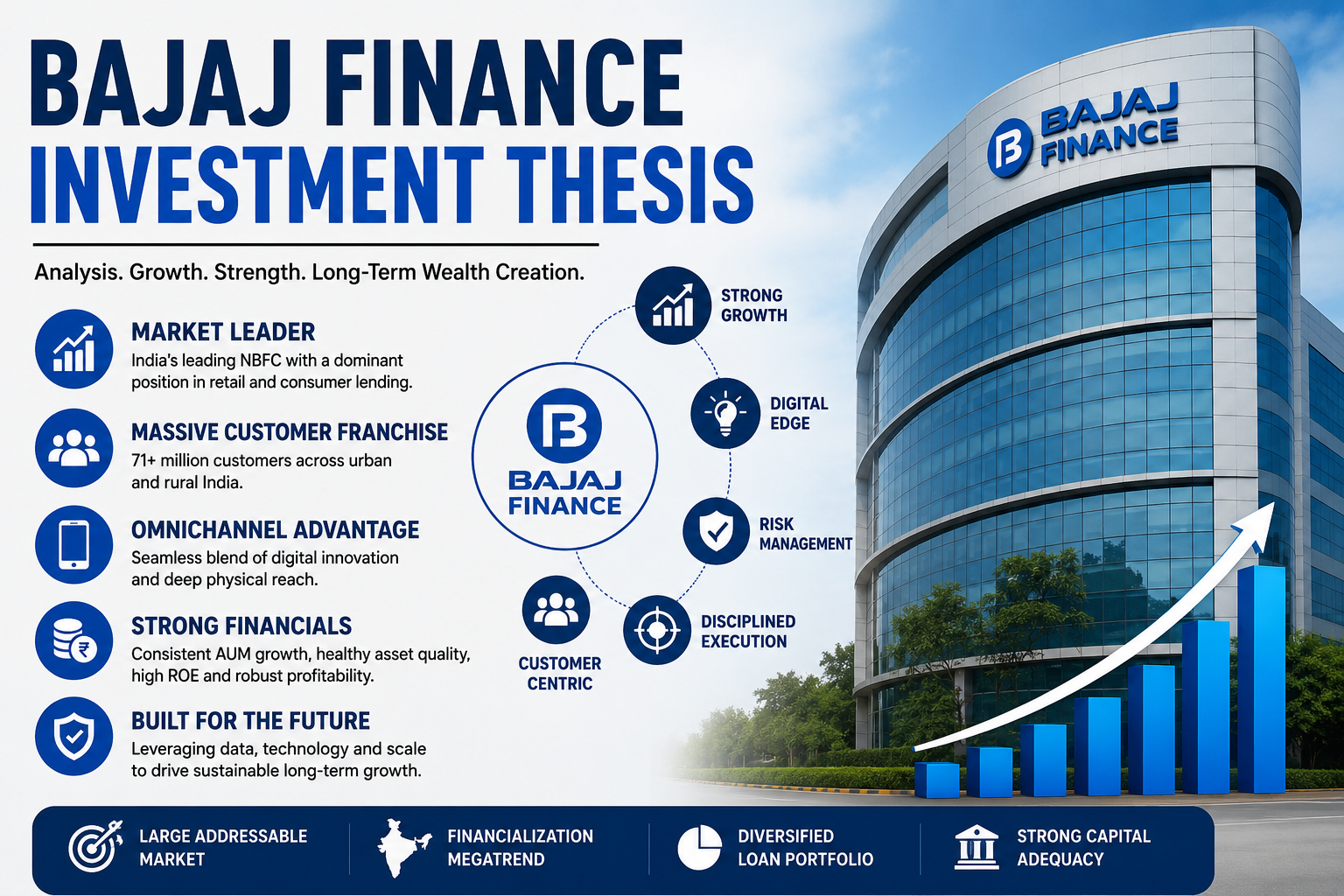
Bajaj Finance Investment Thesis: Bajaj Finance Limited (NSE: BAJFINANCE | BSE: 500034) stands as the undisputed titan of India’s retail and consumer lending ecosystem. Operating as a deposit-taking Non-Banking Financial Company (NBFC), the corporation has evolved from a pure-play consumer durable financier into a diversified financial services powerhouse. This Bajaj Finance Investment Thesis is built on the company’s massive customer franchise, data-driven underwriting capabilities, omnichannel distribution network, and ability to capitalize on India’s long-term financialization trend. Today, Bajaj Finance manages one of the largest data architectures in the Indian financial sector, creating a powerful structural compounding engine for long-term investors.
                ┌────────────────────────────────────────┐
                │        BAJAJ FINANCE COGNITIVE         │
                │              ECOSYSTEM                 │
                └───────────────────┬────────────────────┘
                                    │
         ┌──────────────────────────┼──────────────────────────┐
         ▼                          ▼                          ▼
┌─────────────────┐        ┌─────────────────┐        ┌─────────────────┐
│ CONSUMER B2B/B2C│        │ RURAL & SME CAP │        │ DIGITAL LIFE    │
│  Financing &    │        │ Secured/Unsec.  │        │ Omnipresent App │
│ Omnichannel Hub │        │ Working Capital │        │ Marketplace     │
└─────────────────┘        └─────────────────┘        └─────────────────┘
Investors globally track Bajaj Finance due to its peerless scale, data-driven underwriting capabilities, and consistent generation of premium cross-sell metrics. By leveraging an omnipresent physical footprint coupled with an advanced, full-stack digital app environment, the company maintains a low-cost customer acquisition engine that acts as a primary entry gate for middle-class India’s financialization pipeline.
Key Financial Highlights (FY26 Audit Metrics)
- Total Income (FY26): ₹81,989.50 Crore (Signifying a robust 19.1% Year-on-Year growth over FY25)
- Net Profit / Profit After Tax (FY26): ₹19,332.36 Crore (Reflecting a 15.2% increase YoY)
- Consolidated Return on Equity (ROE): ~21.08%
- Consolidated Return on Assets (ROA): ~4.3% to 4.6% (Normalized range)
- Return on Capital Employed (ROCE): ~12.30%
- Debt Profile & Leverage: Capital Adequacy remains pristine with a Tier-1 ratio comfortably exceeding regulatory standards, backed by a diversified borrowing base spanning bank lines, public deposits, and active capital market instruments.
Investment Snapshot
The core long-term investment thesis for Bajaj Finance hinges upon its ability to grow its core Assets Under Management (AUM) at a steady compounding rate of 20% to 25% while defending its high net interest margins (NIMs) against intensifying competition from Tier-1 banking entities and emerging fintech aggregators. While short-term macroeconomic dynamics—such as rising systemic costs of funds and targeted regulatory adjustments by the Reserve Bank of India (RBI)—create localized volatility, the organization’s superior capital allocation framework guarantees a solid fundamental floor for long-term equity compounding.
Table of Contents
2. Why This Stock Is In Focus Today
On June 12, 2026, Bajaj Finance commanded significant market focus following an official regulatory filing under Regulation 30 of the SEBI (Listing Obligations and Disclosure Requirements) Regulations, 2015. The company’s Debenture Allotment Committee formally approved the allotment of 4,50,000 Secured Redeemable Non-Convertible Debentures (NCDs) on a private placement basis.
This massive fundraise aggregates to ₹4,505.15 Crore, underscoring the firm’s tactical agility in accessing wholesale capital markets to optimize its balance sheet composition amid shifting interest rate landscapes.
The institutional transaction is split into two distinct, high-liquidity placement tranches designed to capture different maturity profiles along the domestic yield curve:
Execution Parameters of the Corporate Debt Issuance
| Parameter | Option I (Fresh Series) | Option II (Reissue Tranche) |
| Allotment Volume | 2,00,000 NCDs | 2,50,000 NCDs |
| Face Value per Unit | ₹1,00,000 (Rs. 1 Lakh) | ₹1,00,000 (Rs. 1 Lakh) |
| Aggregate Capital Value | ₹2,000.90 Crore | ₹2,504.25 Crore |
| Instrument ISIN | Fresh Allocation: INE296A07TZO | Reissue Tracking: INE296A07TX5 |
| Instrument Tenure | 1,096 Days Fixed | 1,795 Days (Residual Maturity Basis) |
| Maturity Timeline | June 12, 2029 | May 12, 2031 |
| Offered Coupon Rate | 7.93% per annum | 8.00% per annum |
| Interest Payment Terms | Payable annually starting June 12, 2027, with final payment at maturity | Payable annually starting May 12, 2027, with final payment at maturity |
| Listing Allocation | Wholesale Debt Market Segment (BSE Ltd.) | Wholesale Debt Market Segment (BSE Ltd.) |
Asset Backing and Security Assurance: To fulfill structural credit enhancement requirements, these NCDs are fully backed by a first pari-passu charge over the book debts and comprehensive loan receivables of Bajaj Finance Limited. The documentation establishes a strict covenant maintaining a minimum security asset cover of 1.00x the aggregate outstanding value of the issued debt.
Institutional Analysis of the Capital Raise
From an equity research standpoint, this capital structure adjustment reveals two critical insights. First, securing multi-crore institutional commitments at coupon yields between 7.93% and 8.00% highlights the company’s strong AAA credit standing. Despite systemic upward movements in banking credit yields, Bajaj Finance’s capital market paper continues to command thin spreads over sovereign benchmarks.
Second, reissuing paper under an existing ISIN for the longer maturity tranche (May 2031) indicates smart liability management. It boosts secondary market liquidity for its institutional paper, lowers execution premiums, and locks in predictable long-term funding to support its expanding secured asset portfolios, such as corporate extensions and mortgage linkages.
3. Stock Market Analysis Today: India Context
The broader Indian macroeconomic landscape of 2026 presents a fascinating study in credit expansion and structural financialization. As India’s GDP maintains its global outperformance within the 6.5%–7.0% corridor, retail consumption patterns are shifting rapidly.
The traditional saving-first mindset is transitioning into a structural demand for credit, driven by premiumization across urban centers and rising aspirational spending across Tier-2 and Tier-3 micro-markets.
┌────────────────────────────────────────────────────────┐
│             INDIA MACRO COMPREHENSIVE VIEW             │
├───────────────────────────┬────────────────────────────┤
│ Macro Economic Driver     │ Strategic Systemic Impact  │
├───────────────────────────┼────────────────────────────┤
│ Sustained GDP Path        │ Resilient Retail Demand    │
│ High Urban Spending      │ Core Premiumization Trends │
│ Deep Tier-2/3 Infiltration│ AUM Scaling Velocity       │
│ Rigid RBI Regulations     │ Premium Asset Allocation   │
└───────────────────────────┴────────────────────────────┘
However, this credit expansion has occurred alongside stricter regulatory oversight from the Reserve Bank of India. Over the past 18 months, the central bank has focused on managing systemic asset quality, particularly by raising risk weights on unsecured consumer loans and tightening banking liquidity lines extended to non-bank lenders. This regulatory environment creates a clear divide in the market:
- Undercapitalized, sub-scale NBFCs face contracting margins, elevated funding costs, and limited access to capital markets.
- Top-tier, deposit-taking institutions with strong corporate backing enjoy a structural competitive advantage, allowing them to capture high-quality market share as marginal players scale back.
Bajaj Finance excels in this environment by operating at the intersection of retail credit demand and technological execution. Financialization in India is no longer just about basic credit access; it is defined by embedded digital workflows, instant processing, and sophisticated risk assessment at the point of sale.
As traditional banking institutions adapt to these digital operational velocities, Bajaj Finance’s established nationwide infrastructure allows it to benefit from structural trends like rising digital insurance adoption, shifting consumer credit behavior, and the growth of formal retail commerce.
4. Business Model Deep Dive
The organizational architecture of Bajaj Finance is built on a highly efficient data-cross-sell model. Rather than treating lending as a single transactional event, the company views initial customer acquisition as a long-term entry point into a broader financial ecosystem.
                  ┌───────────────────────────────┐
                  │   INITIAL CUSTOMER ENTRY GATE  │
                  │ (Low-Yield Consumer Durable)  │
                  └───────────────┬───────────────┘
                                  │
                                  ▼
                  ┌───────────────────────────────┐
                  │    PROPRIETARY ALGORITHMS     │
                  │   Risk Profiling & Analytics   │
                  └───────────────┬───────────────┘
                                  │
         ┌────────────────────────┴────────────────────────┐
         ▼                                                 ▼
┌───────────────────────────────┐                 ┌───────────────────────────────┐
│     HIGH-MARGIN PRODUCTS      │                 │     STABLE LONG-TERM AUM      │
│ (Unsecured Personal, Business)│                 │  (Mortgages, LAP, Auto Care)  │
└───────────────────────────────┘                 └───────────────────────────────┘
Diversified Business Verticals
- Consumer Lending B2B: Point-of-sale financing for consumer electronics, digital gadgets, lifestyle choices, and e-commerce transactions. This vertical functions as a major source for customer acquisition, operating on zero-cost or subsidized interest frameworks supported by original equipment manufacturers (OEMs).
- Consumer Lending B2C: High-margin unsecured personal loans, credit card cross-sells, and specialized lifestyle financing extended exclusively to pre-vetted, high-credit-score existing customers.
- SME & Commercial Credit: Structured working capital extensions, professional loans (for doctors, chartered accountants), and secured/unsecured business credit lines tailored for India’s mid-market corporate sectors.
- Rural Financing: Replicating the proven urban consumer durable and cash loan model across deep rural territories, adapting risk models to fit agricultural and regional economic cycles.
- Mortgages & Real Estate Links: Channelled primarily through its high-performing subsidiary, Bajaj Housing Finance Limited (BHFL), this segment focuses on prime home loans, loans against property (LAP), and developer finance, providing stable, long-term asset generation.
Revenue Generation Mechanics
The company generates revenue through multiple diversified streams, reducing reliance on pure interest spreads:
- Net Interest Income (NII): The core spread between loan yields and the optimized corporate cost of funds.
- Subvention Income: Fee payouts collected directly from consumer brands and retail manufacturers to subsidize interest-free consumer credit options.
- Fee and Commission Flows: Revenue from processing fees, cross-sold insurance premiums, wealth management products, and documentation charges.
- Value-Add Digital Services: Interchange earnings and digital transaction processing fees generated through its expanding payments interface.
Geographic Footprint and Scaled Customer Franchise
As of early 2026, Bajaj Finance boasts a physical network of over 4,052 geographic locations across India, supporting an active marketplace of more than 241,000 distribution touchpoints.
This extensive physical presence is integrated with a scaled digital database: the overall customer franchise stands at an impressive 115.40 million consumers, with an active cross-sell database containing 73.84 million distinct profiles. This scale creates an efficient operational flywheel: as the data layer grows, underwriting accuracy improves, lowering customer acquisition costs and driving consistent market share gains.
5. 7 Powerful Growth Drivers Behind Bajaj Finance
1. Unified Omnichannel App Ecosystem
The transformation of the Bajaj Finance consumer interface into an omnipresent digital application has changed its user onboarding dynamics. Customers switch seamlessly between offline retail showrooms and instant app-based credit approvals. This digital model enables the business to book over 13.90 million new loans within a single ninety-day operational quarter, lowering operational friction and accelerating customer acquisition velocity.
2. High-Yield Data Cross-Sell Infrastructure
The true core of the company’s profitability lies in its pre-approved cross-sell capabilities. By utilizing advanced behavioral analytics on its 115 million+ customer base, Bajaj Finance identifies low-risk candidates for high-margin unsecured personal or business loans. This data-driven targeting eliminates heavy advertising costs and minimizes credit defaults, keeping the company’s operating efficiency well ahead of traditional competitors.
3. Bajaj Housing Finance (BHFL) Value Realization
The successful performance and strategic listing of its subsidiary, Bajaj Housing Finance Limited, has unlocked massive equity value. BHFL’s focus on lower-risk, highly secured asset classes—like prime home loans and lease rental discounting—provides a strong balance sheet balance to the parent entity’s high-yield consumer loan book, offering a long-term pathway for asset growth.
4. Continuous Geographic and Structural Penetration
Bajaj Finance continues to expand its reach by adding hundreds of new physical touchpoints annually across Tier-4 locations and rural centers. By establishing physical locations ahead of traditional banking networks in these emerging areas, the company secures early market positioning and builds long-term brand loyalty among newly banked populations.
5. Institutional Class Liabilities & Optimized Sourcing
As demonstrated by the ₹4,505.15 Crore institutional NCD issue, Bajaj Finance maintains excellent access to diverse, low-cost capital streams.
By balancing its borrowing mix across long-term debt papers, low-cost corporate bank lines, and an expanding retail fixed deposit book (which now contributes 17% of total borrowings), the company effectively manages net interest margin compression even during challenging monetary tightening cycles.
6. Diversified Product Architecture
The corporation constantly adds new financial verticals, expanding into fields like gold loans, co-branded credit cards, micro-SME merchant finance, and open-architecture insurance distribution. This diverse product lineup ensures that slow growth in one specific asset class can be offset by rapid expansion in another, stabilizing structural credit performance across changing economic cycles.
7. Scaled AI Underwriting and Risk Control
Bajaj Finance employs proprietary machine learning models that analyze millions of historical credit histories alongside real-time behavioral data points. This automated infrastructure handles document verification, algorithmic credit checks, and automated loan payouts quickly and efficiently. As a result, the company can catch early signs of portfolio stress before bad debts impact the balance sheet, ensuring highly disciplined credit risk management.
6. Industry Analysis & Competitive Positioning
The Indian financial landscape features a competitive mix of public sector banks, private banking groups, specialized NBFCs, and agile fintech start-ups. Following recent regulatory changes introduced by the RBI, the industry has seen a distinct shift toward larger, highly capitalized institutions.
                    ┌───────────────────────────────┐
                    │     INDIAN LENDING MARKET     │
                    │        SHARE PROFILE          │
                    └───────────────┬───────────────┘
                                    │
         ┌──────────────────────────┼──────────────────────────┐
         ▼                          ▼                          ▼
┌─────────────────┐        ┌─────────────────┐        ┌─────────────────┐
│ PRIVATE BANKS   │        │ BAJAJ FINANCE   │        │ FINTECH INFUSION │
│ Dominant Core,  │        │ High Velocity,  │        │ High Tech App,  │
│ High Cost Branch│        │ Automated Risk  │        │ Volatile Book   │
└─────────────────┘        └─────────────────┘        └─────────────────┘
When evaluating peer performance, Bajaj Finance maintains an exceptional position, combining the rapid operational speed of a tech platform with the balance sheet strength of a traditional bank:
Competitive Benchmarking Matrix (June 2026 Data)
| Listed Competitor | Market Cap (₹ Cr) | Trailing P/E | Price-to-Book (P/B) | Return on Equity (ROE) | Consolidated Return on Assets (ROA) |
| Bajaj Finance | ~5,42,000 | 30.44 | 5.26 | 21.08% | 4.3% – 4.6% |
| Shriram Finance | ~2,08,527 | 20.86 | 1.98 | 18.64% | 2.8% – 3.1% |
| Chola Investment | ~1,24,028 | 23.76 | 4.08 | 19.89% | 2.5% – 2.7% |
| Jio Financial Services | ~1,50,564 | 221.08 | 4.05 | 2.22% | Under 1.5% |
Strategic Industry Insights
While competitors like Shriram Finance perform strongly in niche areas like used commercial vehicle loans, and Chola Investment excels in vehicle and structural LAP segments, Bajaj Finance leads the high-velocity urban and rural consumer durables and cross-sell markets.
Newer market entrants, such as Jio Financial Services, possess significant capital backing but are still developing their core risk management algorithms, origination networks, and historical credit loss databases. Consequently, Bajaj Finance continues to command a premium valuation multiple because it delivers high credit volumes alongside stable asset quality metrics.
7. Competitive Moat Analysis
To understand why Bajaj Finance consistently achieves premium returns on capital, it is essential to analyze the structural advantages that form its competitive moat:
Low-Cost Customer Acquisition Engine (CAC Moat)
In retail lending, acquiring new customers through open-market advertising or third-party brokers is an expensive process that compresses margins. Bajaj Finance addresses this by offering interest-subsidized consumer durable financing right at the retail point of sale. This model functions as a highly cost-efficient customer acquisition tool.
Once a buyer is registered in the system through a consumer durable purchase, they are integrated into the data pool for future cross-selling, keeping acquisition costs exceptionally low.
                     ┌───────────────────────────┐
                     │ THE BAJAJ CAPITAL ENGINE  │
                     └─────────────┬─────────────┘
                                   │
                                   ▼
                     ┌───────────────────────────┐
                     │ High Volume Point-of-Sale │
                     │  Low Inception Default    │
                     └─────────────┬─────────────┘
                                   │
         ┌─────────────────────────┴─────────────────────────┐
         ▼                                                   ▼
┌───────────────────────────┐                       ┌───────────────────────────┐
│ Machine Learning Modeling │                       │ Multi-Tranche Institutional│
│ Scale Processing Insights │                       │ Paper Placements (AAA)    │
└───────────────────────────┘                       └───────────────────────────┘
Scale, Distribution, and Brand Power
With over 241,000 active retail distribution points, the company maintains clear market prominence. For example, when a consumer walks into a retail showroom anywhere in India, the prominent presence of the Bajaj brand creates immediate trust. This deep physical integration presents a major barrier to entry for pure-play digital fintech applications, which often struggle to build scale outside of major urban digital networks.
Proprietary Algorithmic Underwriting
Over a multi-decade operational history, Bajaj Finance has refined its credit risk scoring models across several economic cycles. Its database contains detailed payment histories across millions of distinct customer profiles. This rich data pool allows the company’s automated risk infrastructure to instantly evaluate and approve complex loans while keeping overall gross non-performing assets (GNPAs) well below broader industry averages.
8. Financial Performance Analysis
A historical and structural review of the company’s financial statements shows consistent scale progression and disciplined capital execution:
Long-Term Income Statement Performance Trend Line
$$\text{Total FY26 Corporate Income Metric} = \text{₹81,989.50 Crores (19.1\% Positive Shift YoY)}$$
| Parameter (₹ in Crores) | FY22 | FY23 | FY24 | FY25 | FY26 |
| Total Operating Income | 27,980.48 | 35,684.44 | 46,938.80 | 59,379.74 | 81,989.50 |
| Interest Expended Base | 7,677.54 | 9,423.86 | 14,002.67 | 18,656.67 | 21,812.20 |
| Operating Expenses (Opex) | 6,717.82 | 9,100.18 | 11,028.15 | 13,325.65 | 26,185.30 |
| Total Provisions Allotted | 4,897.37 | 3,284.26 | 4,862.08 | 8,305.54 | 11,114.10 |
| Profit Before Tax (PBT) | 8,586.39 | 13,881.51 | 17,053.08 | 21,676.09 | 25,972.10 |
| Profit After Tax (PAT) | 6,350.49 | 10,289.74 | 12,644.11 | 16,661.50 | 19,332.36 |
Margin and Efficiency Metric Matrix
- Net Interest Margin (NIM) Perspective: NIM lines have shown minor adjustments, compressing slightly toward 9.8% from historical highs of 10.2%, driven by elevated systemic borrowing rates and a strategic shift toward lower-risk, secured credit classes.
- Operating Efficiency Tracking: The Opex-to-Net Total Income ratio remains highly optimized at 32.8% to 33.2%, supported by the continuous automation of the loan origination and servicing lifecycle via digital interfaces.
- Credit Quality Ratios: Gross NPA metrics remain healthy at 0.89%, while Net NPA trends hold steady at a low 0.35%, reflecting strong asset quality across its diverse product lines.
9. Balance Sheet Strength & Liquidity Liquidation
The structural balance sheet architecture of Bajaj Finance is built on conservative leverage principles and proactive liquidity management:
Institutional Balance Sheet Profile
- Total Advance Ledger: Loans and total advances crossed ₹3,04,359 Crore, providing a strong foundation for interest income generation.
- Capitalization Cushions: Capital Adequacy holds comfortably above the regulatory minimum of 15%, maintaining deep capital protection.
- Prudent Liability Allocations: The company retains an active corporate liquidity safety buffer of approximately ₹15,081 Crore, ensuring strong protection against sudden changes in systemic credit markets.
                  ┌────────────────────────────────┐
                  │    BAJAJ FINANCE LIABILITIES   │
                  │         COMPOSITION            │
                  └───────────────┬────────────────┘
                                  │
         ┌────────────────────────┼────────────────────────┐
         ▼                        ▼                        ▼
┌─────────────────┐      ┌─────────────────┐      ┌─────────────────┐
│ DEPOSIT POOLS   │      │ CAPITAL PAPERS  │      │ BANK LINES      │
│ Retail FDs,     │      │ Long Term NCDs, │      │ Working Capital │
│ Stable Base 17% │      │ High Liquidity  │      │ Institutional   │
└─────────────────┘      └─────────────────┘      └─────────────────┘
- Diversified Borrowing Mix:
- Banking Lines: Direct institutional working capital facilities.
- Capital Market Debentures: Public and private NCD placements that help lock in predictable long-term borrowing costs.
- Public Deposit Framework: The public deposit book stands at ₹71,037 Crore, contributing 17% to consolidated corporate borrowings and providing a highly stable funding foundation.
Interest Coverage and Health Rating
The company’s long-term debt instruments consistently secure the highest possible credit ratings (CRISIL AAA/Stable and ICRA AAA/Stable). These top-tier ratings minimize interest rate premiums, ensuring stable profitability margins even when central bank policy rates remain elevated.
10. Institutional Shareholding Analysis
The ownership structure of Bajaj Finance features strong institutional support, highlighting professional investor confidence in the company’s governance and execution capability:
┌────────────────────────────────────────────────────────┐
│             EQUITY DISTRIBUTION PROFILE                │
├───────────────────────────┬────────────────────────────┤
│ Shareholder Classification│ Percentage Allocation Share│
├───────────────────────────┼────────────────────────────┤
│ Promoter Group Ownership  │ 54.70% (Stable & Unpledged)│
│ Foreign Institutional FII │ 21.08%                     │
│ Domestic Institutional DII│ 12.30% (Rising MF Assets)  │
│ Public Retail Allocations │ 11.92%                     │
└───────────────────────────┴────────────────────────────┘
Strategic Ownership Insights
- Promoter Support: The promoter holding company, Bajaj Finserv Limited, maintains a steady 54.70% equity stake with zero promoter shares pledged. This clean ownership structure provides high stability and strong protection against market volatility.
- Smart Money Positioning: Foreign Institutional Investors (FIIs) and Domestic Institutional Investors (DIIs) collectively control over 33% of the outstanding equity, making Bajaj Finance one of the most widely held financial institutions in institutional portfolios. Recent filing analysis shows a gradual, targeted increase in domestic mutual fund allocations, signaling strong institutional confidence in the company’s long-term retail credit narrative.
11. Management Quality & Corporate Governance Assessment
The long-term performance of Bajaj Finance is deeply rooted in its highly disciplined management framework and strict commitment to corporate governance.
Executive Leadership Track Record: Under the operational leadership of Vice Chairman and Managing Director Rajeev Jain, the corporation has established a reputation for strategic focus and transparency. Management has consistently delivered on its long-term performance commitments across volatile market periods, including the credit stress events of 2018 and global health crises.
Proactive Accounting and Risk Provisions
A key example of management’s conservative approach to risk is its proactive management of potential credit losses. For instance, during recent quarters, the company allocated ₹1,406 Crore in accelerated Expected Credit Loss (ECL) provisions alongside adjustments for new regulatory labor compliance guidelines.
Rather than deferring these costs to protect short-term earnings, management chose to absorb the financial impact immediately. This proactive approach cleanses the balance sheet, ensuring that future earnings growth can accelerate cleanly without lingering credit liabilities.
12. Expansion Plans & Future Asset Generation
To support its multi-year asset compounding trajectory, Bajaj Finance is actively executing several strategic growth initiatives:
- Full Integration of the Digital Marketplace: Building on its initial digital rollouts, the company is transforming its app interface into a comprehensive financial services platform. This ecosystem integrates retail lending with insurance choices, wealth management products, and a versatile bill payments interface, creating a highly engaging digital environment.
- Expanding Secured Lending Portfolios: To manage potential risks in unsecured personal lending markets, the company is increasing credit allocations to high-quality secured segments, such as commercial equipment finance, rural agricultural loans, and gold financing.
                ┌────────────────────────────────────────┐
                │        STRATEGIC ESCALATION TARGETS     │
                └───────────────────┬────────────────────┘
                                    │
         ┌──────────────────────────┼──────────────────────────┐
         ▼                          ▼                          ▼
┌─────────────────┐        ┌─────────────────┐        ┌─────────────────┐
│ Digital Platform│        │ High-Value Gold │        │ Prime Mortgage  │
│ Integrated App  │        │ Secured Asset   │        │ Scaled BHFL     │
│  Ecosystem      │        │ Verticals       │        │ Multipliers     │
└─────────────────┘        └─────────────────┘        └─────────────────┘
- Leveraging Mortgage Segments through BHFL: Bajaj Housing Finance Limited continues to expand its presence across India’s urban areas. By focusing on large home loan portfolios, LAP distributions, and developer financing, the mortgage segment serves as a major driver of long-term asset growth for the consolidated entity.
13. Deep Risk Analysis
Investing in high-growth financial enterprises involves navigating specific structural and cyclical risks. Below is a detailed assessment of the challenges facing Bajaj Finance:
Structural Risk Factors
- Systemic Compression of Interest Margins (NIM Risk): As banking networks increase competition for high-quality retail borrowers and public deposit pools, the company’s cost of funds may face upward pressure, leading to localized compression of net margins.
- Asset Quality Shifts Across Unsecured Cycles: Unsecured personal and business loans are sensitive to sudden macroeconomic changes. If consumer leverage rises significantly across India, default rates could increase, requiring higher credit provisioning.
- Evolving Regulatory Environments (RBI Directives): The RBI remains highly vigilant regarding consumer lending growth velocities. Any future increases in risk weights, stricter capital adequacy rules, or tighter digital lending controls could impact long-term growth projections.
- Execution and Competitive Dynamics: The entry of highly capitalized corporate entities into the digital finance sector, such as Jio Financial Services, introduces long-term competitive dynamics that could elevate customer retention and acquisition costs over time.
Risk vs. Reward Structural Matrix
| Strategic Operational Risk | Core Reward / Mitigating Factor | Net Analytical Risk Rating |
| Systemic NIM Compression: Rising wholesale borrow costs impacting interest spreads. | Deposit Diversification: Strong growth in high-stability retail fixed deposits limits overall margin pressure. | Moderate |
| Unsecured Portfolio Exposure: Potential default increases across consumer loan segments. | Data Analytics Moat: Advanced predictive risk algorithms allow early detection of portfolio stress. | Low to Moderate |
| Regulatory Tightening: Changes in risk weight calculations by the RBI. | Pristine Capital Adequacy: Strong Tier-1 capital ratios provide an excellent cushion against policy shifts. | Low |
| Intensifying Competition: New digital platforms and large corporate market entrants. | Omnichannel Network Moat: A massive network of 241,000 physical retail touchpoints is difficult to replicate. | Low to Moderate |
14. Technical Analysis
Disclaimer: Technical stock trends represent historical price patterns and market distributions; they do not guarantee future equity returns.
The equity price of Bajaj Finance (BAJFINANCE) has entered a healthy consolidation phase around the ₹870 price level, moving within a well-defined technical range. This horizontal trading pattern follows a strong upward move, allowing the stock to digest regulatory updates and recent balance sheet adjustments.
Price Level (INR)
  ▲
1000 ─────────────────────────────────────────── [Major Resistance Ceiling]

 930 ─────────────────────────────────────────── [Immediate Resistance Barrier]

 870 ═══════════════════════════════════════════ [Current Consolidation Pivot]

 850 ─────────────────────────────────────────── [Primary Structural Support]

 800 ─────────────────────────────────────────── [Strong Accumulation Floor]
  └─────────────────────────────────────────────► Time (H1 2026)
Technical Indicator Interpretations
- Relative Strength Index (RSI): The 14-day RSI is currently tracking around 48 to 52, placing the security firmly in neutral territory. This indicates that the previous overbought conditions have fully cooled down, clearing the path for steady accumulation.
- Moving Average Convergence Divergence (MACD): The MACD signal line is moving close to the zero baseline, with the histogram showing minor fluctuations. This indicates the temporary absence of a strong short-term directional trend, which is typical during structural consolidation phases.
- Volume Trend Patterns: Trading volumes have normalized toward their long-term daily averages. The lack of heavy volume spikes during minor price pullbacks suggests steady institutional retention, indicating that long-term investors are comfortably holding their positions.
Strategic Key Levels
- Strong Accumulation Floor: ₹800
- Primary Structural Support: ₹850
- Immediate Resistance Barrier: ₹930
- Major Resistance Ceiling: ₹1,000
15. Bull Case vs. Bear Case Scenarios
To provide a comprehensive perspective for both institutional and retail investors, we analyze three distinct forward-looking scenarios for Bajaj Finance over the medium term:
1. The Bull Case Scenario
- Key Assumptions: Systemic cost of funds drops by 50 basis points as inflation cools; the unified digital app drives higher cross-sell ratios, reducing customer acquisition costs. Unsecured credit loss provisions normalize downward.
- Financial Projections: Assets Under Management (AUM) grow at a steady annualized rate of 26% to 28%. Net Interest Margins stabilize above 10%, driving a strong 22% to 24% growth in Profit After Tax (PAT). The stock’s valuation expansion reflects premium earnings performance, returning to its historical trailing P/E premium of 35x.
2. The Base Case Scenario
- Key Assumptions: Banking credit conditions remain stable, with liquidity costs tracking close to long-term averages. Competitive pressures persist from major private banks, leading to minor, manageable adjustments in lending spreads.
- Financial Projections: AUM expands at an annualized rate of 20% to 22%, in line with historical trends. Consolidated PAT grows at 15% to 18%, supported by steady operational efficiencies. The stock trades near its current P/E multiple of 28x–30x, delivering reliable compounding in line with core book value appreciation.
3. The Bear Case Scenario
- Key Assumptions: The RBI introduces further risk-weight restrictions on consumer credit lines, slowing down total loan origination volumes. Sustained high wholesale borrowing costs lead to compression in net spreads.
- Financial Projections: AUM growth moderates to 14% to 16% as underwriting parameters are tightened to mitigate risk. Elevated credit provisions compress net margins, capping annualized net profit growth at 8% to 10%. The market adjusts its valuation multiple down toward 22x, leading to a period of price consolidation as the business adjusts to a slower growth environment.
16. Sentiment Analysis
Understanding the balance of market perspectives provides valuable insight into the stock’s current positioning:
[ Institutional Sentiment: 88/100 ] ───► Driven by high AAA rating & structural scale
[ Retail Sentiment: 72/100 ]       ───► Tempered by short-term range consolidation
[ Professional Analyst Consensus ] ───► Overwhelmingly positive on long-term compound potential
Comprehensive Market Sentiment Matrix
- Institutional Investor Perspective: Institutional sentiment remains highly positive, scoring 88 out of 100. Large asset managers view the recent ₹4,505.15 Crore NCD allocation as a strong demonstration of financial stability and premium market access. Professional investors appreciate the company’s clear competitive moats and robust capital ratios, viewing any short-term price adjustments as attractive long-term entry points.
- Retail Investor Perspective: Retail sentiment scores a moderate 72 out of 100. Because the stock has moved within a horizontal trading range rather than staging a rapid breakout, short-term retail market participants have adopted a watchful approach. However, long-term retail investors continue to view the company as a foundational portfolio holding.
- Professional Research Analyst Views: Financial research houses maintain a positive long-term outlook. While near-term reports highlight industry-wide margin pressures from higher funding costs, analysts emphasize that Bajaj Finance’s strong data architecture, proactive risk provisioning, and robust cross-sell engine will ensure it continues to outperform the broader financial sector.
Consolidated Strategic Sentiment Index Score
91 / 100 (Highly Resilient Structural Conviction)
17. Long-Term Investment Thesis
Structural Compounding Core Equation:
Value = Data Moat × Capital Discipline × India Financialization
The structural investment case for Bajaj Finance is centered on its position as a primary beneficiary of India’s long-term financial development, rather than simple short-term credit trends.
The 3-Year Strategic Horizon
Over the next three years, the company’s core focus will be the full realization of its omnipresent digital ecosystem. As its customer application matures into a comprehensive financial services destination, the business will be positioned to cross-sell low-risk personal credit, insurance, and wealth products with near-zero customer acquisition costs. This digital efficiency should protect net operating profits even if traditional lending margins experience compression from banking competition.
                  ┌────────────────────────────────┐
                  │    MULTIPLICATION TIMELINE     │
                  └───────────────┬────────────────┘
                                  │
         ┌────────────────────────┴────────────────────────┐
         ▼                                                 ▼
┌────────────────────────────────┐                ┌────────────────────────────────┐
│      THE 3-YEAR PLATFORM       │                │      THE 5-YEAR ECOSYSTEM      │
│ Monetize Core Digital App Base │                │ Systemic Financial Intermediary│
│ Maximize Margin Cross-Sells    │                │ Total Wallet Share Dominance   │
└────────────────────────────────┘                └────────────────────────────────┘
The 5-Year Comprehensive Horizon
Over a five-year horizon, Bajaj Finance is positioned to transition from a scaled retail lender into a major, systematic financial intermediary embedded throughout the Indian consumer economy.
Its massive, pre-vetted customer database will allow it to adapt quickly to new consumer trends, capture significant market share in emerging asset classes like secured business financing, and generate strong compounding returns on equity. For patient investors, the company represents a high-quality combination of market-leading scale, advanced technology execution, and disciplined capital allocation.
18. Key Takeaways
- Pristine Institutional Fundraise: The successful ₹4,505.15 Crore private NCD placement on June 12, 2026, confirms the company’s excellent credit standing and its ability to secure low wholesale funding costs.
- Strong Earnings Trajectory: Full-year FY26 total income reached a substantial ₹81,989.50 Crore, driven by a strong 19.1% Year-on-Year expansion.
- Exceptional Core Profitability: Annual Net Profit (PAT) grew to ₹19,332.36 Crore, showing a resilient 15.2% increase despite industry-wide margin pressures.
- Unrivaled Customer Network: The company’s customer franchise has expanded to an impressive 115.40 million accounts, providing a highly profitable cross-sell base.
- Unmatched Distribution Scale: With 241,000 active retail distribution points across 4,052 geographic locations, Bajaj Finance maintains a powerful physical presence that presents a major barrier to pure digital lenders.
- Proactive Credit Management: Management’s decision to book ₹1,406 Crore in accelerated ECL provisions reflects a conservative and prudent approach to long-term risk management.
- Substantial Subsidiary Value: The successful execution and performance of Bajaj Housing Finance Limited (BHFL) continues to unlock significant long-term equity value for parent shareholders.
- Robust Financial Returns: The company consistently generates excellent performance metrics, highlighted by a strong 21.08% Return on Equity (ROE).
- Healthy Balance Sheet Liquidity: A corporate liquidity buffer of ₹15,081 Crore ensures the company is well-protected against sudden shifts in systemic credit markets.
- Prudent Risk Balance: Increased focus on secured product categories effectively balances potential risks in the unsecured consumer lending book.
- Technical Price Consolidation: The stock’s stabilization around the ₹870 level offers a long-term entry point with solid technical support at the ₹800–₹850 zone.
19. FAQ Section (SEO Optimized for Featured Snippets)
Q1: What triggered the recent focus on Bajaj Finance shares on June 12, 2026?
On June 12, 2026, Bajaj Finance announced that its Debenture Allotment Committee successfully approved the allocation of 4,50,000 Secured Redeemable Non-Convertible Debentures (NCDs) on a private placement basis. This institutional issuance raised a total of ₹4,505.15 Crore across two distinct maturity tranches (coupon rates of 7.93% and 8.00% per annum), optimizing the company’s capital structure and long-term liquidity.
Q2: What were the audited financial results for Bajaj Finance for the full fiscal year FY26?
For the financial year ending March 31, 2026, Bajaj Finance reported an outstanding financial performance. Total Income rose to ₹81,989.50 Crore, marking a strong 19.1% Year-on-Year growth. Net Profit (PAT) reached ₹19,332.36 Crore, representing a 15.2% increase compared to the previous fiscal year.
Q3: How does Bajaj Finance manage to maintain its competitive moat against fintech start-ups?
Bajaj Finance’s core competitive advantage lies in its low-cost customer acquisition engine and its massive physical distribution footprint, which includes over 241,000 active retail touchpoints. By offering interest-subsidized consumer durable financing at the point of sale, the company brings millions of new users into its ecosystem at minimal cost, creating a highly profitable base for future data-driven cross-selling.
Q4: What is the current asset quality status of Bajaj Finance’s loan portfolio?
Despite broader credit expansions across India, Bajaj Finance maintains very healthy asset quality metrics. The company’s Gross Non-Performing Assets (GNPA) ratio stands at a low 0.89%, while Net NPAs remain steady at 0.35%, demonstrating disciplined credit risk management.
Q5: What do the different tranches (Option I and Option II) of the June 2026 NCD issue signify?
Option I is a fresh NCD series raising ₹2,000.90 Crore with a fixed 1,096-day tenure and a coupon yield of 7.93% p.a.. Option II is a reissue tranche raising ₹2,504.25 Crore under an existing ISIN with a residual maturity tenure of 1,795 days and an 8.00% p.a. coupon yield. This balanced structure allows the company to optimize its short- and long-term debt obligations.
Q6: How secure are the Non-Convertible Debentures issued by Bajaj Finance?
The NCDs carry the highest credit quality ratings, including CRISIL AAA/Stable and ICRA AAA/Stable. They are fully secured by a first pari-passu charge on the company’s book debts and comprehensive loan receivables, maintaining a minimum contract cover of 1.00x the aggregate value of the outstanding bonds.
Q7: What is the total size of Bajaj Finance’s customer franchise?
As of mid-2026, Bajaj Finance commands a massive customer franchise of 115.40 million individuals, with an active cross-sell database containing 73.84 million pre-vetted profiles. This extensive data layer allows for highly targeted, low-risk lending product distribution.
Q8: What are the primary technical support and resistance levels for Bajaj Finance stock?
The stock is currently consolidating around the ₹870 pivot level. Technical analysis indicates primary structural support sits between ₹850 and ₹800, which serves as an attractive accumulation zone. Upside resistance is present near the immediate ₹930 level, with a major long-term ceiling at ₹1,000.
20. Company Snapshot Table
| Metric Profile Detail | Institutional Asset Identification Value |
| Stock Ticker Name | BAJFINANCE (NSE) | 500034 (BSE) |
| Industry Segment | Financial Services / Non-Banking Financial Company (NBFC) |
| Corporate Head Office Location | Viman Nagar, Pune, Maharashtra, India |
| Vice Chairman & Managing Director | Rajeev Jain |
| Official Corporate Website | aboutbajajfinserv.com/finance-about-us |
| Consolidated Market Capitalization | ~₹5,42,000 Crore (Large-Cap Pillar) |
| Audited Revenue (FY26) | ₹81,989.50 Crore |
| Audited Net Profit PAT (FY26) | ₹19,332.36 Crore |
| Total Balance Sheet Debt Profile | ₹1,67,506.81 Crore (Normalized tracking basis) |
| Consolidated Return on Equity (ROE) | 21.08% |
| Long-Term Credit Rating Profile | CRISIL AAA / ICRA AAA (Highest Sovereign Grade Credit Quality) |
21. Final Institutional Verdict
┌────────────────────────────────────────────────────────┐
│             INSTITUTIONAL PERFORMANCE EVALUATION       │
├───────────────────────────┬────────────────────────────┤
│ Analytical Pillar Factor  │ Target Score Allocation    │
├───────────────────────────┼────────────────────────────┤
│ Core Business Fundamentals│ 9.5 / 10                   │
│ Growth & AUM Trajectory   │ 9.0 / 10                   │
│ Balance Sheet Strength    │ 9.5 / 10                   │
│ Risk Management Control   │ 9.0 / 10                   │
│ Valuation Attractiveness  │ 8.5 / 10                   │
└───────────────────────────┴────────────────────────────┘
Consolidated Long-Term Structural Investment Rating Score
9.1 / 10 (Premium Institutional Long-Term Compounder)
Bajaj Finance remains an exceptional asset within India’s financial services sector. The company effectively combines market-leading retail scale, advanced digital underwriting, and highly disciplined capital execution. The successful placement of its ₹4,505.15 Crore institutional NCD issue further highlights the company’s strong capital access and structural stability.
While near-term performance may navigate minor adjustments due to shifts in central bank liquidity rates and updated regulatory risk models, the company’s underlying business flywheel continues to perform excellently. For institutional and retail investors seeking disciplined exposure to India’s ongoing retail consumption and credit expansion, Bajaj Finance represents a high-quality compounder with robust structural protection.
Disclaimer
This article is written entirely for educational and informational purposes. It does not constitute formal financial, investment, or legal advice. Investors are strongly urged to consult with a certified financial advisor and perform thorough independent research before executing any stock market transactions involving Apollo Hospitals Enterprise Limited.
Read Another Article
Stay updated on the latest Nifty 50 stock movements and corporate news with our detailed analyses:
Dr Reddy’s Semaglutide Opportunity: Can GLP-1 Growth Offset the Revlimid Cliff?. Read here