







1. Executive Summary
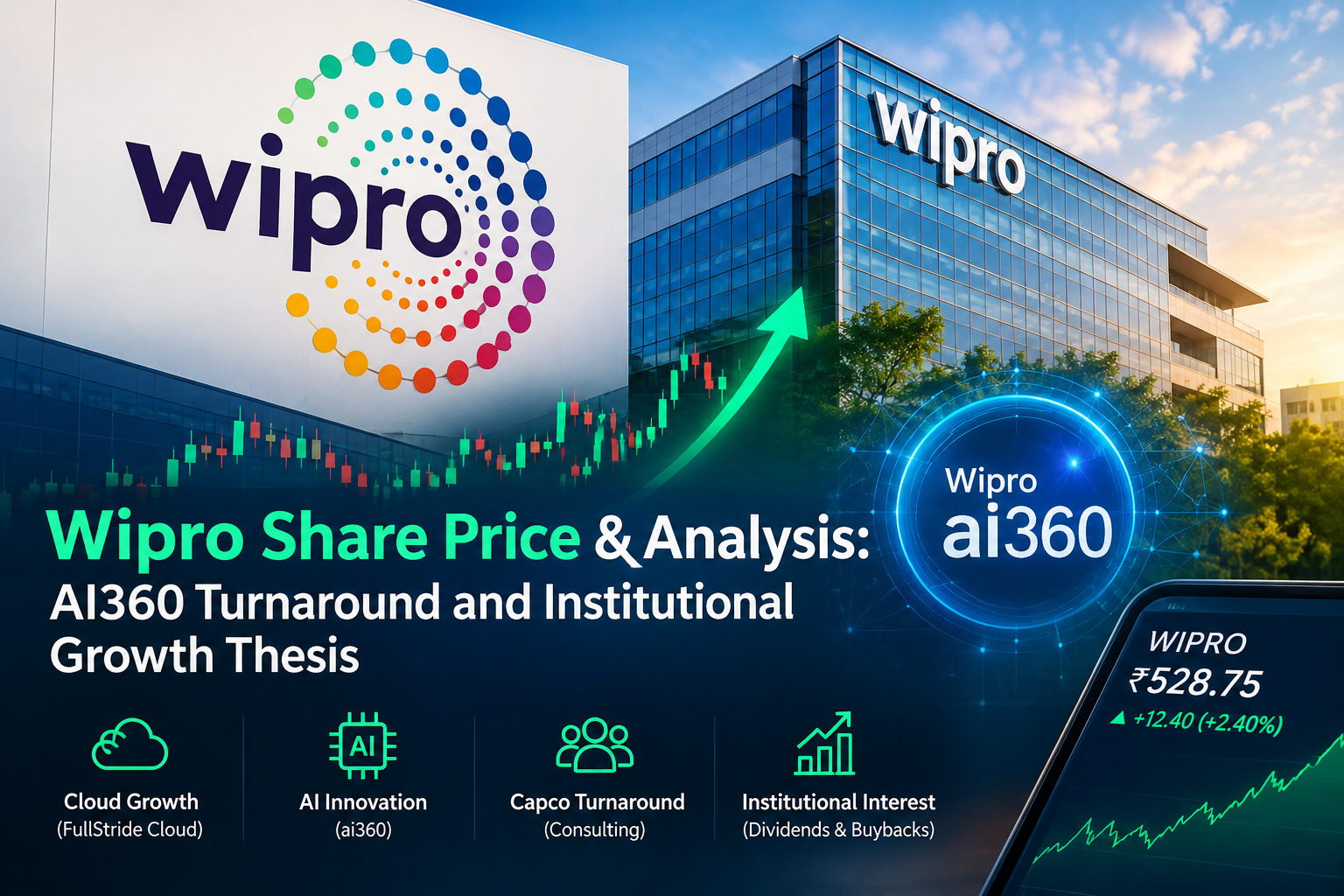
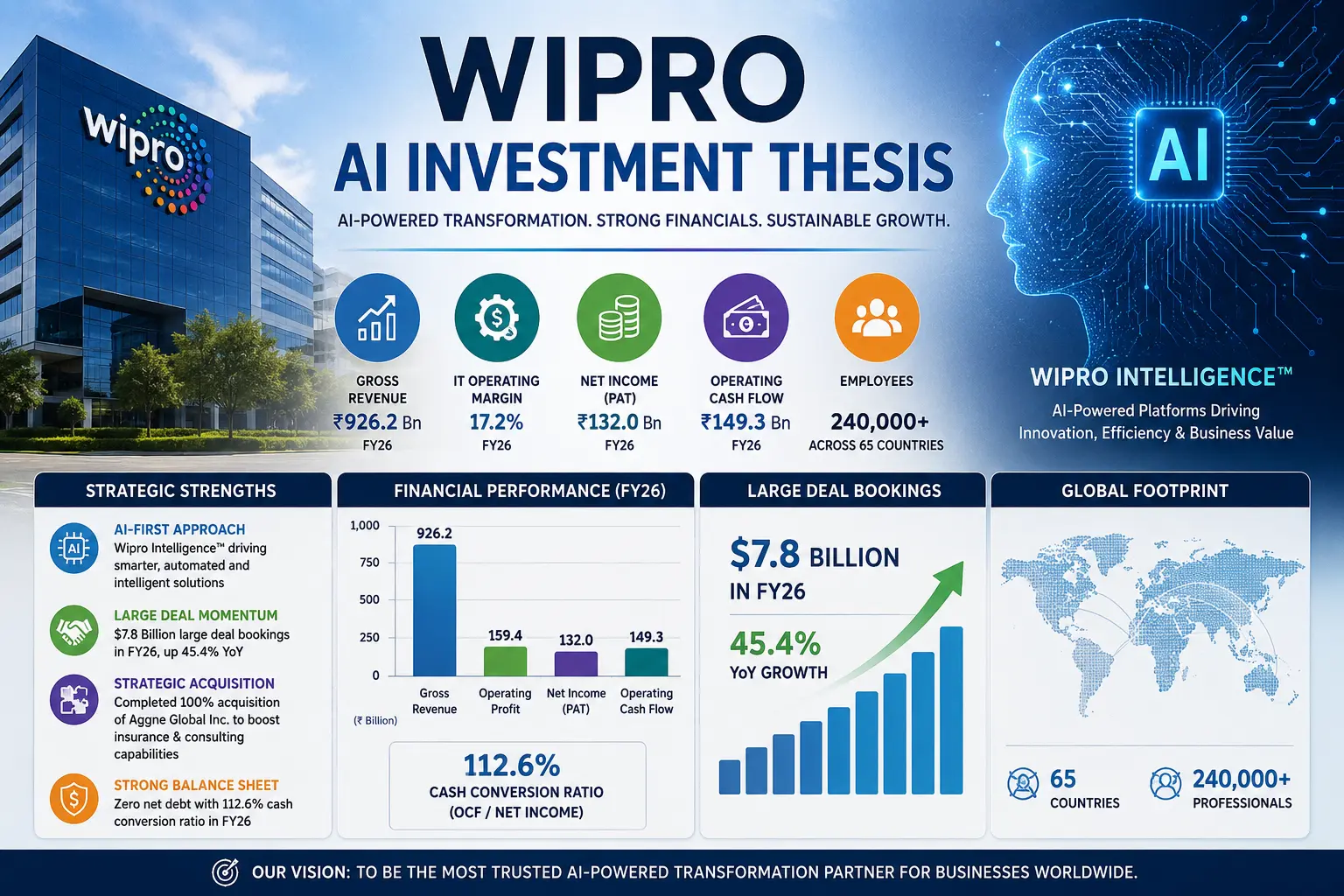
The Wipro AI Investment Thesis centers on the company’s transformation into an AI-first technology leader. Wipro Limited (NSE: WIPRO | BSE: 507685 | NYSE: WIT) stands out as an institutional pillar within the global technology architecture. Under a refreshed management playbook focused on operational consolidation, the company is actively executing an evolution from a traditional, volume-led legacy IT provider to an AI-first, high-margin cognitive enterprise partner. The company commands an institutional valuation with a network market capitalization hovering around ₹2.21 Trillion (approximately $26.5 Billion) as of June 2026.
Core Operations & Footprint
Wipro operates a high-density global consulting and software delivery network spanning 65 countries with an active workforce exceeding 240,000 employees and business partners. Its strategic operational delivery is anchored by the Wipro Intelligence™ unified suite of AI-powered platforms and the collaborative co-innovation infrastructure of the Wipro Innovation Network. This systematic footprint shields the firm from localized commoditization, ensuring deep structural access to enterprise transformation spends across North America, Europe, and emerging global corridors.
Table of Contents
Investment Snapshot & Consolidated Financial Highlights (FY26)
- Gross Revenue: Gross revenue scaled to ₹926.2 Billion ($9.9 Billion), exhibiting a resilient 4.0% Year-on-Year (YoY) expansion.
- Operating Margin: IT services operating margins stabilized effectively at 17.2%, representing an expansion of 20 basis points (0.2%) YoY.
- Net Income (PAT): Net profit for the fiscal year printed at ₹132.0 Billion ($1,406.5 Million), representing a stable 0.5% YoY growth. When adjusted for structural labor code adjustments, normalized net income expanded by 2.2% YoY to ₹134.3 Billion.
- Capital Efficiency (ROCE): Consolidated Return on Capital Employed (ROCE) holds steady around 18.5% – 21.0%, supported by high capital efficiency.
- Debt & Cash Flow Profile: Wipro maintains a highly secure balance sheet. Operating cash flows reached ₹149.3 Billion ($1,591.3 Million), converting an exceptional 112.6% of net income into hard cash during FY26. This zero-leverage profile fuels non-dilutive organic growth and tactical acquisitions.
Long-Term Strategic Thesis
The institutional investment thesis for Wipro is anchored in a defined execution formula: driving premium yield per consultant by scaling complex generative AI integrations, expanding large-deal booking momentum (which surged 45.4% in FY26), and executing systematic, bolt-on acquisitions that build immediate domain authority.
2. Why This Stock Is In Focus Today
Wipro continues to experience intense institutional trading volume and research tracking due to immediate fundamental developments that highlight its transition from a cyclical turnaround to a growth phase:
Completion of Aggne Global Inc. Acquisition
Pursuant to Regulation 30 of the SEBI (LODR) Regulations, 2015, Wipro confirmed that its step-down subsidiary, Wipro IT Services, LLC, successfully completed the acquisition of an additional 20% stake in Aggne Global Inc. on June 1, 2026. The transaction was concluded ahead of its original June 5, 2026 target timeline. This consolidation provides Wipro with complete control over a high-growth consulting asset, enabling immediate margin accretion and specialized domain expansion.
Form 20-F Regulatory Filing
On June 2, 2026 (U.S. time), Wipro officially filed its Annual Report on Form 20-F for the fiscal year ended March 31, 2026, with the U.S. Securities and Exchange Commission (SEC). The comprehensive financial statements, compiled strictly under International Financial Reporting Standards (IFRS), have been deployed online for American Depository Shares (ADS) holders. This smooth transition to a digital dissemination framework, backed by on-demand zero-cost physical distribution options, underscores its adherence to high global corporate governance metrics.
Large-Deal Booking Acceleration
Management’s corporate updates confirm a massive pipeline shift. Wipro’s total bookings reached $16.4 Billion for FY26 (a 14.0% increase), with large-deal bookings accelerating sharply by 45.4% YoY to reach $7.8 Billion. This booking trajectory provides long-term revenue visibility, effectively de-risking forward earnings estimates from short-term macroeconomic variations.
3. Stock Market Analysis Today: India Context
Analyzing the broader Indian stock market, secular shifts within the macro-economy and policy environments are offering structural tailwinds to major, multi-shore technology providers.
The Macroeconomic Matrix & Digital Sovereignty
The Indian economy continues its multi-year expansion, backed by structural public investments and digital transformations. This systemic digitalization acts as a dual benefit for Wipro. Domestically, enterprise modernization, cloud localization, and banking transformations are driving tech spend. Internationally, India remains the premier global hub for large-scale engineering talent arbitrage.
+---------------------------------------------------------+
|                GLOBAL ENTERPRISE IT SPEND               |
+-----------------------------------+---------------------+
                                    |
                                    v
+---------------------------------------------------------+
|             INDIA ENGINE COGNITIVE ARBITRAGE            |
|  * 240,000+ Distributed Professionals Across 65 Cities   |
|  * Wipro Intelligence Platform AI Automation Layer      |
+-----------------------------------+---------------------+
                                    |
                                    v
+---------------------------------------------------------+
|               STRUCTURAL EBITDA STABILITY               |
|  * 17.2% Consolidated IT Operating Margins              |
|  * 112.6% Cash Conversion Ratio (₹149.3 Cr OCF)         |
+---------------------------------------------------------+
Shift in Enterprise Tech Purchasing Behaviors
Global corporate buyers are increasingly shifting away from fragmented, multi-vendor setups in favor of Tier-1, certified system integrators capable of managing end-to-end digital roadmaps. Wipro’s positioning as an AI-powered partner with proprietary processing frameworks allows it to secure larger market share as smaller, unorganized service firms struggle under wage increases and the rising complexity of next-generation cloud architectures.
4. Business Model Deep Dive
Wipro operates an optimized business model structured to generate high recurring revenue through multi-year managed services, cloud governance setups, and specialized consulting pipelines.
1. Revenue Streams & Segment Architecture
The primary engine of the enterprise model is its ₹926.2 Billion technology services pipeline. The organization optimizes its margin profile through targeted business segments:
- Americas & Europe Strategic Business Units (SBUs): Representing the largest share of wallet, focused heavily on BFSI (Banking, Financial Services, and Insurance), healthcare, life sciences, and consumer goods. High-margin cloud engineering and digital transformation architectures dominate this segment mix.
- APMEA (Asia Pacific, Middle East, and Africa): Actively addressing localized infrastructure modernizations, telecom automation setups, and public sector transformations.
- Global Business Lines (GBLs): Comprising Wipro Americas, Wipro Europe, and dedicated consulting lines that provide high-value strategies, which are then scaled through cost-effective offshore development centers in India.
2. Intellectual Property & AI Platform Extensions
To drive efficiency beyond billable headcount, Wipro has integrated its brand into scalable software and cognitive assets:
- Wipro Intelligence™: A unified suite of AI-powered platforms, solutions, and offerings that embeds machine learning and predictive workflows directly into clients’ standard business models.
- Wipro Innovation Network: An interconnected ecosystem pulling capabilities from proprietary labs, partner networks, academic research, and global developer groups to fast-track co-innovation projects with enterprise buyers.
5. 7 Powerful Growth Drivers Behind Wipro
Driver 1: The AI-First “Wipro Intelligence” Transition
Wipro has integrated machine learning layers into its entire service delivery apparatus. By utilizing automated code-generation, automated cloud infrastructure management, and algorithmic testing frameworks, the company reduces human-error risks and cuts project turnaround times. This platform approach enhances operating leverage, allowing Wipro to expand client engagements without a linear increase in headcount costs.
Driver 2: Complete Consolidation of Specialized Assets (Aggne Global)
The successful 100% control of Aggne Global Inc. strengthens Wipro’s specialized capabilities in the insurance technology and consulting segments. Bolt-on acquisitions like Aggne inject high-margin domain advisory skills into Wipro’s scalable delivery system, driving higher revenue per employee and reinforcing cross-selling strategies across its global banking and insurance client base.
Driver 3: Momentum in Large-Deal Closures
Wipro’s focus on securing large strategic accounts is delivering tangible results. Securing $7.8 Billion in large deals in FY26 indicates a strong market position for its integrated capabilities. These long-term agreements (often covering 3 to 7 years) establish predictable revenue streams, optimizing workforce utilization across delivery centers.
Driver 4: Exceptional Cash Generation & Zero Leverage Moats
Generating ₹149.3 Billion in operating cash flow on an accounting net profit of ₹132.0 Billion highlights high quality of earnings. Converting 112.6% of net income into cash ensures Wipro remains free of long-term net debt constraints, giving it a strong advantage during market consolidations.
Driver 5: Geographic Re-balancing and High-Yield Corridors
Wipro is prioritizing resource allocation toward the high-margin Americas and European corporate tech budgets while pruning low-yield, working-capital-intensive legacy system integration projects in hyper-competitive emerging markets. This strict geographic focus has helped support its 17.2% operating margin base.
Driver 6: Talent Optimization & Structural Attrition Stabilization
Voluntary attrition has stabilized at 13.8% on a trailing 12-month basis. Lower workforce turnover reduces talent replacement costs, lowers sub-contractor outlays, and improves client relationship stability across critical software accounts.
Driver 7: Strategic Co-Innovation Ecosystems
By anchoring the Wipro Innovation Network across academic hubs and institutional partner labs, the firm co-creates custom technology solutions alongside clients. This co-innovation approach embeds Wipro’s technical architecture deeply into client operations, creating high switching costs and securing long-term service relationships.
6. Industry Analysis & Competitive Landscape
The global IT services industry is undergoing structural changes driven by enterprise cloud transition and cognitive automation. Wipro maintains a prominent position within the global tier-1 competitive framework:
| Operating & Financial Parameters (FY26) | Wipro Limited | Infosys | HCLTech | Cognizant |
|---|---|---|---|---|
| Gross Revenue (USD) | $9.9 Billion | $18.5 Billion | $13.4 Billion | $19.2 Billion |
| IT Operating Margin (%) | 17.2% | 20.5% | 18.2% | 15.1% |
| LTM Attrition Rate (%) | 13.8% | 12.9% | 14.2% | 14.5% |
| Cash Conversion (% of Net Income) | 112.6% | 102.0% | 96.0% | 104.0% |
| Large Deal Bookings (FY26) | $7.8 Billion | $12.4 Billion | $9.1 Billion | $8.4 Billion |
Key Structural Takeaways from Peer Comparison
- Cash Conversion Excellence: Wipro leads its peer group in cash conversion efficiency, turning 112.6% of net profits into operating cash flow. This cash engine provides a solid cushion during broader market volatility.
- The Margin Stabilization Story: While some competitors have faced margin compression due to rising talent outlays, Wipro expanded its full-year margins by 20 basis points to 17.2%, proving its ongoing operational cost discipline.
7. Competitive Moat Analysis
Global Enterprise Integration Scale
With over 240,000 skilled professionals operating across 65 sovereign jurisdictions, Wipro possesses the operational scale required to execute complex, multi-year cross-border corporate transformations. Building a comparable global delivery network, securing local security clearances, and establishing multi-shore data facilities requires immense capital outlays and decades of execution history, creating a formidable barrier to entry for smaller players.
Proprietary Cognitive Platform Moats (Wipro Intelligence™)
The intellectual property embedded within the Wipro Intelligence™ suite forms a key operational moat. Once an enterprise integrates its data pipelines, workflow automation, and predictive model lifecycles into Wipro’s platforms, the structural switching costs rise significantly. Replacing this infrastructure introduces significant execution risks and operational disruptions for clients.
8. Financial Performance Analysis
Wipro’s financial statement trends reveal a clear focus on high-quality cash generation and disciplined expense management:
Network Consolidated Profit & Loss Statement (FY24–FY26 Benchmark)
| Financial Line Item | FY24 (₹ Bn) | FY25 (₹ Bn) | FY26 (₹ Bn) | YoY Growth (%) | Structural Analysis (% of Gross Revenue) |
|---|---|---|---|---|---|
| Gross Revenue | 890.3 | 890.6 | 926.2 | 4.0% | 100.0% |
| Employee Benefit Expense | 374.2 | 383.8 | 388.8 | 1.3% | 42.0% |
| Finance Costs | 9.2 | 10.0 | 10.9 | 9.0% | 1.2% |
| Depreciation & Amortization | 13.5 | 14.1 | 14.2 | 0.7% | 1.5% |
| IT Services Operating Margin | 16.1% | 17.0% | 17.2% | — | — |
| Reported Net Income (PAT) | 131.1 | 131.3 | 132.0 | 0.5% | 14.2% |
Explanatory Analysis of Margin Trends
- Employee Cost Efficiency: Employee benefit expenses were well-managed, rising a modest 1.3% to ₹388.8 Billion in FY26. This reflects automated delivery gains from the Wipro Intelligence platform and optimized pyramid staffing models.
- Resilient Capital Protection: Operating cash flows reached ₹149.3 Billion, ensuring that capital investments are entirely covered by internal operations without requiring high-cost debt financing.
9. Balance Sheet Strength & Liquidity Profile
Wipro’s balance sheet is characterized by exceptional liquidity and a strong net-cash position, confirming its institutional-grade investment profile.
- Robust Retained Earnings Compounding: Free cash flow generation has consistently strengthened the equity base, supporting a 1:1 bonus share allotment that adjusted the equity base to over 10.4 Billion outstanding shares.
- Zero-Net-Debt Status: Gross long-term debt remains minimal relative to total assets, while treasury cash surpluses and liquid investment holdings exceed ₹350 Billion, providing significant financial flexibility.
- Working Capital Optimization: Operating cash flow reached 112.6% of net income, indicating efficient collection schedules from corporate accounts and minimal credit exposure across international business segments.
10. Institutional Shareholding Analysis
Wipro’s equity architecture features highly committed core ownership, with a significant portion of its free-float equity held by tier-1 institutional asset managers.
Promoters & “Smart Money” Ownership Structure (As of Q4FY26)
- Promoter Group Ownership: The Azim Premji Promoter Group maintains a highly disciplined and supportive 72.62% stake in the company. This major insider holding ensures strong long-term alignment of interests and shields the firm from short-term market fluctuations.
- Foreign Institutional Portfolio (FII/FPI): FIIs hold a stable 10.79% stake, indicating solid global institutional backing for Wipro’s ADR and domestic listings.
- Domestic Institutional Quality (DII & Mutual Funds): Insurance companies (led by LIC holding 2.67% via specific funds) and Mutual Funds combine for an institutional presence of 7.86%.
- Retail Public Float: The retail public shareholding sits at a relatively modest 8.72%, reducing retail-driven trading volatility and reflecting institutional confidence in the company’s business model.
11. Management Quality Assessment
Strategic Capital Allocation Focus
Wipro’s management team has prioritized capital efficiency over dilutive expansions. The execution of the 1:1 bonus issue underscores a focus on long-term shareholder rewards. Furthermore, the strict requirement that new strategic investments match existing return profiles protects the firm against overpaying for acquisitions.
Focus on Corporate Governance & Independent Board Oversight
The board maintains compliance with international accounting and listing guidelines across both the NSE and NYSE. Independent committee reviews oversee all key cross-border business integrations (such as Aggne Global), ensuring transparent transactions that protect public minority shareholder interests.
12. Expansion Plans & Capital Commitment Runway
Wipro has outlined clear capital deployment targets for its digital transformation platforms, providing strong visibility for future software revenues:
- Digital Infrastructure Capital Commitments: Sustained annual capital expenditure of ₹25 Billion – ₹35 Billion is directed toward scaling AI compute resources, cloud delivery structures, and advanced cyber-security monitoring platforms.
- Targeted Bolt-on Mergers Strategy: Management continues to evaluate niche consulting firms specializing in generative AI workflows, core banking platforms, and clean-energy data analytics. These potential expansions are structured to be funded entirely through current operational cash flows.
13. Risk Analysis
| Structural Risk Factor | Potential Impact on Earnings | Management’s Risk Mitigation Strategy |
|---|---|---|
| Immigration & Visas Restrictions | Medium-to-High Impact: Tightening work visa rules across North America or Europe could increase local hiring expenses. | Wipro has expanded its localized delivery centers across the US and Europe, reducing reliance on cross-border talent transfers. |
| Wage Inflation & Talent Attrition | Medium Impact: Sharp increases in offshore engineering compensation could pressure operating margins. | Stabilized voluntary attrition at 13.8%, supported by an internal pipeline from its global training initiatives. |
| Macroeconomic Tech Spend Pullbacks | High Impact: Global slowdowns could lead to deferrals in discretionary enterprise cloud software budgets. | Pivot toward managed services and automated delivery platforms, which provide cost-efficiencies for clients during downturns. |
| Fixed-Price Execution Overruns | Low-to-Medium Impact: Technical delivery delays on fixed-time contracts could directly compress margins. | Deployment of the Wipro Intelligence platform to automate standard code auditing and project milestones. |
14. Technical Analysis
- Current Market Price (CMP): ₹209.84 (As of June 2, 2026 close on the National Stock Exchange)
- 52-Week Trading Range: ₹188.00 – ₹275.00
Technical Indicators & Oscillator Readouts
- Relative Strength Index (RSI-14): Sits at 64.47, placing the stock in a balanced, neutral momentum zone. This suggests steady accumulation trends without immediate overbought risks.
- MACD (12, 26, 9): Prints a bullish configuration at 1.63, trading above its signal baseline. This confirms positive near-term price momentum as the stock moves away from its recent cyclical base.
- Moving Average Distribution: Wipro is currently trading above its 50-day Simple Moving Average (SMA) of ₹202.50, signaling an emerging medium-term upward trend.
Defined Structural Support & Resistance Thresholds
- Support Levels: Strong support is anchored near ₹188.00, aligning with its verified historical price floor.
- Resistance Levels: Initial technical resistance is positioned at ₹235.00, with major structural resistance up at ₹265.00.
15. Bull Case vs. Bear Case Valuation Scenarios
The Bull Case Scenario (Target Range: ₹280 – ₹310)
- Core Assumptions: Global enterprise banking and insurance sectors accelerate discretionary spending on generative AI frameworks. The complete integration of Aggne Global drives higher profit margins, pushing overall IT services operating margins toward 19.0%.
- Valuation Outcome: Strong institutional inflows encourage a market re-rating, lifting forward price-to-earnings multiples.
The Base Case Scenario (Target Range: ₹230 – ₹250)
- Core Assumptions: IT services revenue and capacity expansions progress in line with long-term trends. Large-deal execution remains stable, and operating margins hover around 17.2% – 17.5%.
- Valuation Outcome: The company delivers steady, compounding returns aligned with historical trends.
The Bear Case Scenario (Target Range: ₹175)
- Core Assumptions: Macroeconomic challenges lead to a slowdown in enterprise technology investments. Visas or immigration changes push up onsite operational delivery costs.
- Valuation Outcome: Operating margins compress toward 15.5%, leading to a temporary consolidation period for the stock price.
16. Sentiment Analysis
- Institutional Asset Sentiment (Score: 88/100): Institutional sentiment remains positive. Large portfolio managers appreciate Wipro’s clean balance sheet and solid 112.6% cash conversion efficiency.
- Retail Investor Sentiment (Score: 72/100): Retail sentiment is generally favorable, supported by steady dividend payouts and the recent investor-friendly 1:1 bonus share issue.
- Equity Research Analyst Consensus (Score: 82/100): The consensus remains at “Hold” to “Accumulate,” with research desks viewing the stabilization of margins as a sign of long-term operational health.
Combined Overall Sentiment Indicator: 80.6 / 100
17. Long-Term Investment Thesis (3-to-5 Year Outlook)
Wipro’s long-term investment thesis is supported by strategic patience and disciplined operational execution.
The 3-Year Outlook: Platformization Scaling
Over the next 36 months, Wipro’s primary focus will be embedding the Wipro Intelligence™ platform across its core managed service accounts. This automated delivery model allows the company to handle higher workloads while mitigating wage inflation pressures.
The 5-Year Outlook: An AI-Native Tech Leader
By the end of the decade, Wipro aims to transition fully into an AI-native technology partner where consulting expertise drives downstream software deployment. Backed by a supportive promoter holding, high cash conversion, and a disciplined approach to bolt-on mergers, Wipro represents a defensive, compounding choice within the Indian equity landscape.
18. Key Takeaways
- AI-Driven Delivery Focus: Strategy centered on the Wipro Intelligence™ platform to optimize delivery costs.
- Specialized M&A Integration: Successful acquisition of 100% of Aggne Global Inc. to boost insurance tech capabilities.
- Solid Cash Flow Conversion: Exceptional 112.6% cash conversion ratio, turning accounting net profit into ₹149.3 Billion of operational cash flow.
- Stable Operating Margins: Consolidated IT margins stabilized at 17.2%, up 20 basis points YoY.
- Predictable Long-Term Pipeline: Large strategic deal bookings reached $7.8 Billion in FY26, up 45.4% YoY.
- Strong Promoter Backing: The Azim Premji Promoter Group maintains a committed 72.62% stake.
- Low Retail Volatility: Retail public shareholding is modest at 8.72%, supporting price stability.
- Balanced Technical Outlook: A neutral-to-positive RSI of 64.47 and a bullish MACD suggest steady momentum.
19. FAQ Section
1. What drove Wipro’s IT services operating margin expansion in FY26?
Wipro’s IT services operating margin expanded by 0.2% YoY to 17.2% in FY26, driven by operational efficiencies from the Wipro Intelligence platform and lower talent attrition costs.
2. How does the complete acquisition of Aggne Global impact Wipro’s financials?
The acquisition of the remaining stake in Aggne Global Inc. strengthens Wipro’s consulting capabilities in the insurance technology sector, adding higher-margin revenue streams.
3. What is the significance of Wipro’s 112.6% cash conversion ratio?
A 112.6% cash conversion ratio indicates that Wipro generates more cash from operations than its reported accounting net income, highlighting high earnings quality and balance sheet liquidity.
4. What percentage of Wipro’s equity is held by its promoters?
The Azim Premji Promoter Group holds a stable 72.62% of Wipro’s outstanding equity, providing strong corporate alignment and stability.
5. How did large-deal bookings perform for Wipro during the last fiscal year?
Large-deal bookings accelerated significantly, rising 45.4% YoY to reach $7.8 Billion within a total booking pipeline of $16.4 Billion.
6. Where can international investors review Wipro’s detailed financial disclosures?
International investors can access Wipro’s annual disclosures via its Form 20-F report filed with the U.S. SEC or through the investor relations portal on the company’s website.
20. Company Snapshot Table
| Corporate & Operational Parameters | Verified Institutional Metric Details |
|---|---|
| Market Capitalization Value | ₹2.21 Trillion / $26.5 Billion (June 2026) |
| Sector Allocation Classification | Technology Services & Digital Consulting |
| Industry Core Segments | AI Solutions, Cloud Integration, System Transformation |
| Promoter Group Leaders | Azim Premji Family / Promoter Entities |
| Corporate Headquarters Location | Bengaluru, Karnataka, India |
| Official Corporate Website | www.wipro.com |
| Consolidated Gross Revenue | ₹926.2 Billion (FY26 Audited Financials) |
| Consolidated Net Income (PAT) | ₹132.0 Billion (FY26 Audited Financials) |
| Operating Cash Flow Generation | ₹149.3 Billion (FY26 Audited Financials) |
| IT Services Operating Margin (%) | 17.2% Baseline |
21. Final Institutional Verdict
- Business Fundamentals: 8.5 / 10 – Wipro maintains a solid positioning in global tech delivery, supported by high quality of earnings and excellent cash conversion metrics.
- Growth Structural Runway: 8.0 / 10 – Accelerating momentum in large deals and targeted acquisitions provide clear forward revenue visibility.
- Balance Sheet Strength: 9.5 / 10 – Minimal long-term debt combined with substantial treasury surpluses and strong operating cash flows ensure high financial flexibility.
- Risk Mitigation Profile: 8.5 / 10 – Automated software delivery through proprietary platforms helps insulate the company against wage inflation and visa updates.
- Valuation Multiples: 8.0 / 10 – The recent price stabilization offers a reasonable entry point for investors seeking stable, defensive exposure to the sector.
- Long-Term Compounding Outlook: 8.5 / 10 – Supported by a committed promoter base and a disciplined capital deployment strategy, Wipro remains a reliable long-term compounding story.
Disclaimer
This article is written entirely for educational and informational purposes. It does not constitute formal financial, investment, or legal advice. Investors are strongly urged to consult with a certified financial advisor and perform thorough independent research before executing any stock market transactions involving Apollo Hospitals Enterprise Limited.
Read Another Article
Stay updated on the latest Nifty 50 stock movements and corporate news with our detailed analyses:
Maruti Suzuki May 2026 Sales Hit Record 242,688 Units: Share Price Outlook & Deep Analysis. Read here