






1. Executive Summary
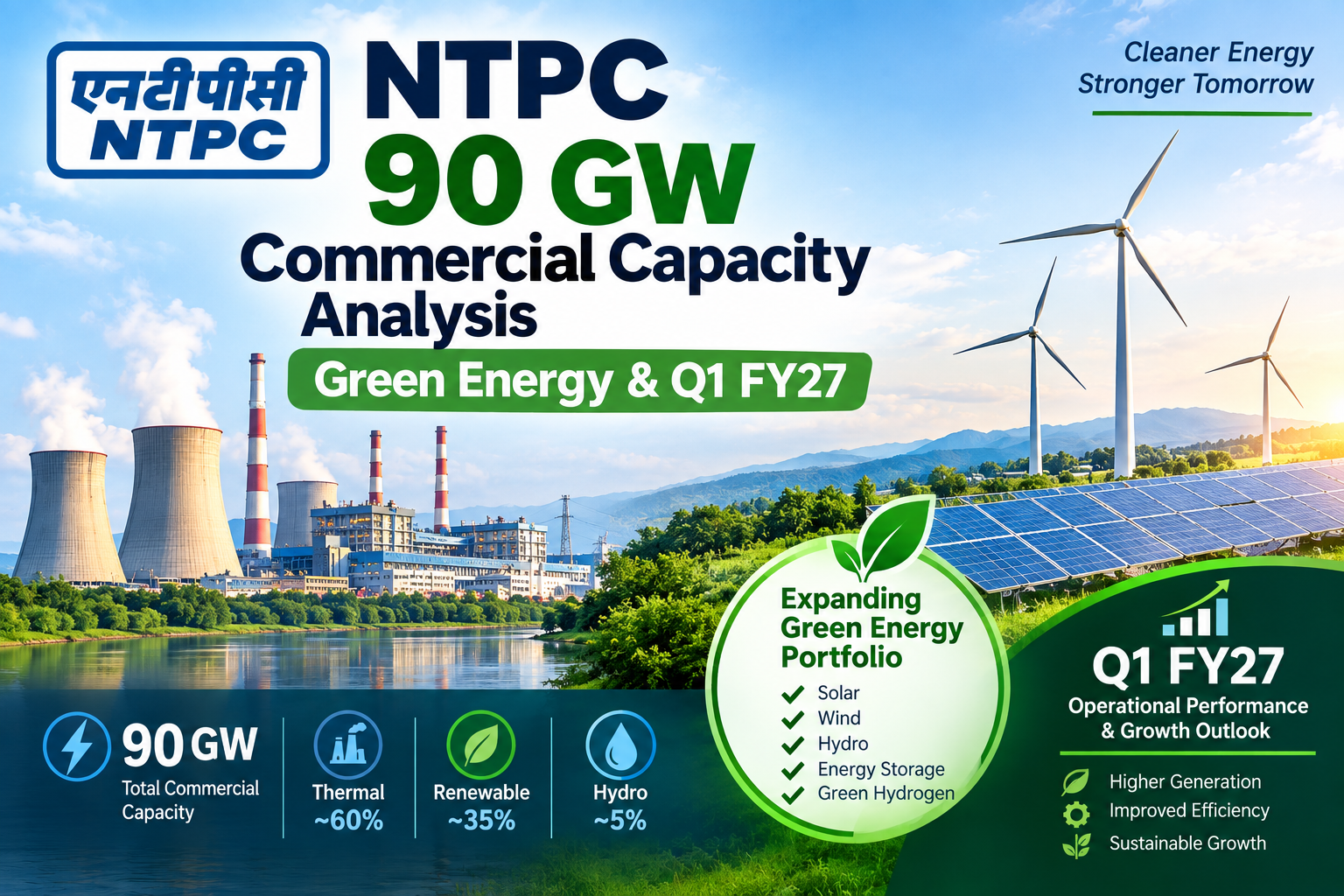
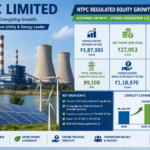
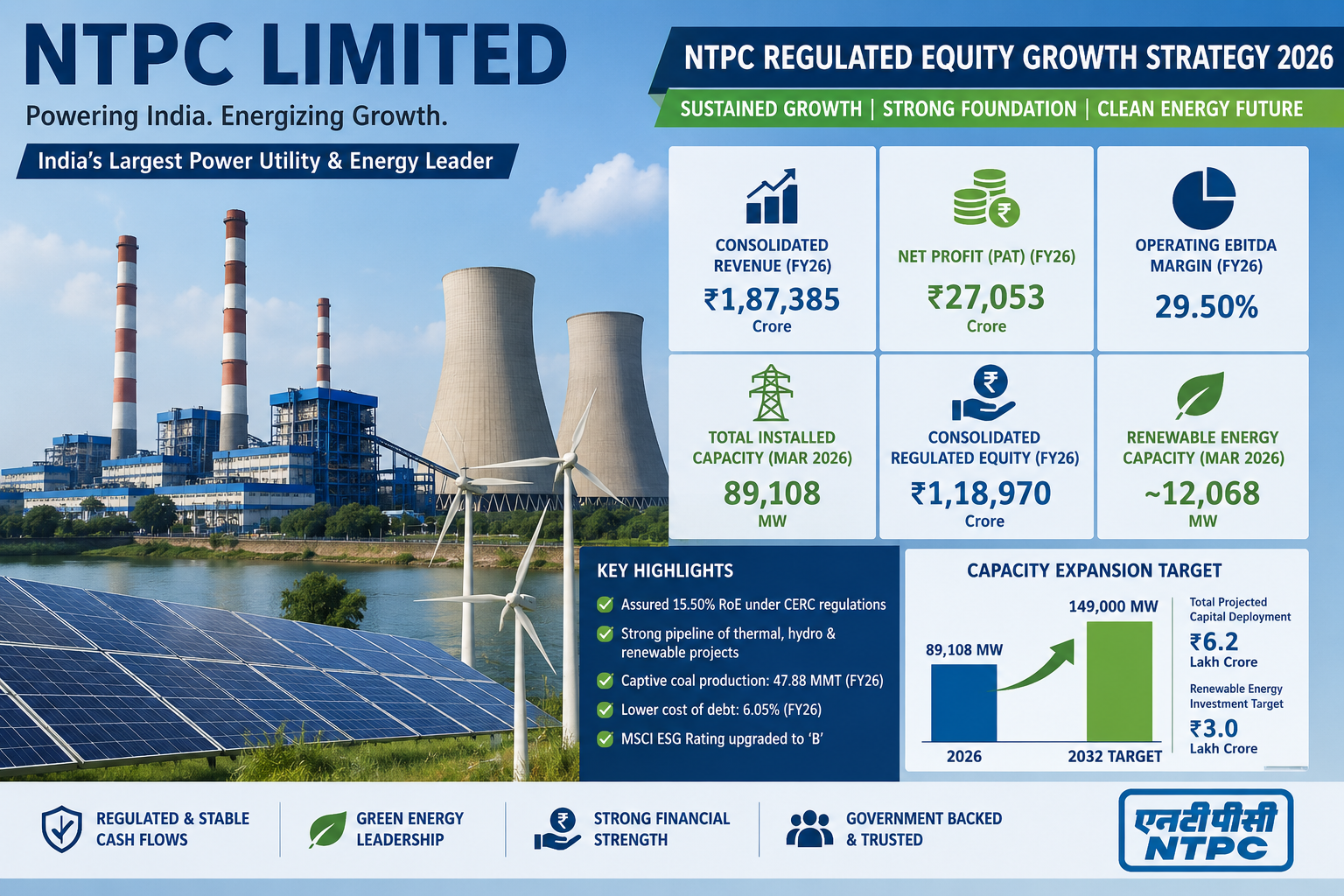
NTPC Regulated Equity Growth Strategy 2026 is the primary driver behind the long-term investment thesis of NTPC Limited (NSE: NTPC | BSE: 532555). NTPC stands as the supreme systemically vital anchor of India’s power architecture. Established as a state-run utility giant, the enterprise has evolved into a multi-layered energy platform responsible for generating roughly one-fourth of India’s total commercial power output. Operating a premier fleet of baseload thermal assets, hydropower stations, and rapidly accelerating wind and solar generation plants, NTPC offers a compelling blend of defensive, regulatory-protected cash flows and an aggressive structural pivot into renewable energy infrastructure.
As of June 2026, NTPC commands an institutional market capitalization of approximately ₹3,55,237 Crore (~$42.5 Billion). This valuation reflects the company’s unmatched pricing power, structured asset capitalization model, and critical position within India’s long-term macroeconomic expansion landscape.
+-------------------------------------------------------------------------+
|                  NTPC INVESTMENT SNAPSHOT (FY26 CONSOLIDATED)           |
+-------------------------------------------------------------------------+
|  Gross Operating Revenue  :  ₹1,87,385 Crore                            |
|  Operating EBITDA          :  ₹55,286 Crore                             |
|  EBITDA Margin Profile    :  29.50%                                     |
|  Reported Net Profit (PAT):  ₹27,053 Crore                              |
|  Consolidated Regulated Equity: ₹1,18,970 Crore                         |
|  Debt-to-Equity Ratio     :  1.33x                                      |
|  Trailing P/E Multiple    :  12.90x                                     |
+-------------------------------------------------------------------------+
The Institutional Core Thesis
NTPC’s premium market valuation is anchored by a high-visibility execution formula. While traditional private-sector operators face intense commodity price adjustments and market cyclicality, NTPC operates under a robust “Cost-Plus” regulatory blueprint approved by the Central Electricity Regulatory Commission (CERC). This legal mechanism secures an assured 15.50% Return on Equity (RoE) on its standalone power generation assets, rendering its capacity additions immediately earnings-accretive.
The structural long-term thesis is driven by a dual-engine blueprint: maximizing free cash flows from its hyper-efficient thermal fleet to fund a self-sustaining capital deployment runway, while scaling its clean energy arm—NTPC Green Energy Limited (NGEL)—to target a multi-gigawatt renewable pipeline.
Table of Contents
2. Why This Stock Is In Focus Today
NTPC continues to attract substantial institutional trading volumes and close analyst coverage due to critical corporate developments that highlight its transition from a pure-play legacy generator into a high-growth utility platform:
The Blockbuster June 4, 2026 Meja Stage-II Expansion Pact
Pursuant to formal disclosure filings under Regulation 30 of the SEBI (LODR) Regulations, 2015, NTPC officially announced the signing of a high-profile Supplementary Joint Venture Agreement (SJVA)-III on June 4, 2026, in Lucknow. The agreement was executed between NTPC Limited and Uttar Pradesh Rajya Vidyut Utpadan Nigam Limited (UPRVUNL) for their 50:50 joint venture vehicle, Meja Urja Nigam Private Limited (MUNPL).
This key agreement modifies the core Joint Venture covenants to incorporate provisions for a major capacity upgrade at Meja Stage-II, expanding it from 2×660 MW to 3×800 MW. By migrating the layout to a highly sophisticated 3×800 MW ultra-supercritical configuration, the joint venture scales its total nominal output capacity to 2,400 MW. This strategic shift enhances thermal efficiency profiles, reduces carbon emission intensity, and expands NTPC’s long-term consolidated regulated equity base.
Rapid Milestones in Megawatt Sourcing
The market is reacting positively to NTPC’s accelerated commercial commissioning sprint in the final weeks of May 2026:
- Ramagundam Solar Commissioning: On May 29, 2026, the utility successfully brought online an additional 34.4 MW solar capacity at its 176 MW Solar PV project located in Ramagundam, Telangana.
- Khavda-II Mega Scale-up: On May 27, 2026, the management team completed the Commercial Operation Date (COD) for the eighth and final part-capacity of 105 MW out of the massive 1,200 MW Khavda-II Solar PV Project in Gujarat.
- Capacity Expansion Milestones: These additions pushed the group’s total installed capacity past 89,108 MW as of March 31, 2026, solidifying its position as India’s leading power generation platform.
Upgraded Institutional ESG Validations
Reflecting its aggressive operational shift toward carbon mitigation and sustainable asset re-balancing, MSCI ESG Research officially upgraded NTPC Limited’s sustainability score to a “B” rating from its legacy “CCC” floor. This structural rating turnaround follows nearly a decade of intense evaluation adjustments. This upgrade clears historical governance and environmental restrictions for global sovereign wealth funds and European ESG mandates, setting the stage for steady structural equity inflows.
3. Stock Market Analysis Today: India Context
To thoroughly analyze NTPC’s market position, the company must be viewed within the context of India’s secular macroeconomic landscape, structural power supply constraints, and shifting regulatory frameworks.
The Macro Electricity Multiplier
India’s economy continues its strong expansion phase, driven by intense industrial production outlays, expanding electronics manufacturing frameworks, and widespread urbanization. This economic transformation exhibits a high-density demand multiplier for electricity.
Heading into mid-2026, peak electricity deficits across urban industrial belts continue to challenge grid stability. Extreme summer cooling demands and structural changes in weather patterns have tested baseline capacities. NTPC’s dependable, non-intermittent thermal generation fleet forms the foundational base keeping the national grid stable during period of high peak load.
Institutional Market Perspective: As global technology platforms accelerate investments into large-scale cloud data centers across western and southern Indian corridors, the need for round-the-clock (RTC) uninterrupted baseload electricity has transitioned from a basic utility metric to a vital matter of national digital sovereignty.
The SHANTI Nuclear Act of 2026
A significant policy development impacting India’s power sector utilities is the recent passage of the Sustainable Harnessing and Advancement of Nuclear energy for Transforming India (SHANTI) Nuclear Act. This legislation formally establishes nuclear energy as a core pillar of India’s long-term zero-carbon baseload energy strategy for Viksit Bharat @2047.
The SHANTI Act removes historical capital allocation restrictions, allowing large public sector undertakings like NTPC to co-invest alongside the Nuclear Power Corporation of India Limited (NPCIL). This enables the development of joint venture multi-gigawatt atomic plants, providing a significant avenue for long-term structural compounding.
4. Business Model Deep Dive
NTPC operates an exceptional business model designed to isolate its core earnings from fluctuations in merchant power pricing and volatile input commodity lines.
+--------------------------------------------------------------------------+
|                        NTPC REVENUE AND CASH CYCLE                       |
+--------------------------------------------------------------------------+
|  [Capital Expenditure Pool] ---> [CERC Asset Verification & Commercialization] |
|                                                    |                     |
|                                                    v                     |
|  [State Discom Long-Term PPAs] <--- [15.50% Assured RoE on Regulated Equity]  |
|                                                    |                     |
|                                                    v                     |
|  [Pass-Through Fuel Covenants] <--- [Fixed Fixed-Cost Capacity Charge Recovery] |
+--------------------------------------------------------------------------+
The Regulated Equity Capital Compounder
The foundational engine of NTPC’s business model is its expanding pool of Regulated Equity. Under CERC regulations, the tariff for any thermal or hydro installation is split into a two-part framework:
- Capacity Charges (Fixed Component): Designed to recover all fixed operational choices, including plant depreciation, interest costs, insurance, human resource overheads, and an assured 15.50% Return on Equity (RoE). This component is fully recovered as long as the plant maintains its target Declared Capacity or Plant Availability Factor (PAF), irrespective of actual power generation metrics.
- Energy Charges (Variable Component): Covers the actual cost of fuel (coal, primary gas, transportation) utilized to generate power. This component acts as a 100% pass-through mechanism to state electricity distribution companies (Discoms), entirely protecting NTPC from global commodity spot price shocks.
Core Segment Matrix
- Thermal Fleet Supremacy: Represents the largest share of corporate revenues, driving steady cash generation. NTPC’s coal-fired plants operate at a high Plant Availability Factor (PAF) of 90.12%, significantly outperforming independent regional private-sector peers.
- NTPC Green Energy Limited (NGEL): This fully integrated subsidiary houses the group’s solar and wind platforms. NGEL scaled its revenue from operations by 29% to ₹2,858 Crore in FY26, maintaining a highly profitable EBITDA margin profile of 87.00%.
- Fuel Security Integration: Operating a portfolio of high-density group captive coal mines, production volumes grew 12% YoY to 47.88 Million Metric Tons (MMT) in FY26. This captive integration protects the company from coal shortages at key power stations.
5. 7 Powerful Growth Drivers Behind NTPC
Driver 1: Accelerated Expansion of Regulated Equity Base
Because NTPC’s core earnings are directly tied to a fixed return on verified equity assets, the structural growth of the stock is driven by capital deployment velocity. Standalone regulated equity for the core power and mining operations reached ₹94,415 Crore as of Q3FY26, with the total consolidated group footprint scaling to ₹1,18,970 Crore. As the group commercializes its vast pipeline of projects, this regulated asset framework expands automatically, providing high long-term visibility for earnings growth.
Driver 2: The Ultra-Supercritical Upgrade Multiplier
The June 4, 2026 Meja Stage-II expansion agreement to build large-format 3×800 MW ultra-supercritical units highlights a significant operational strategy. Migrating away from subcritical footprints enables the company to extract more energy per unit of coal. This high-efficiency configuration lowers operational variable energy costs, positions NTPC at the top of the state merit-order dispatch hierarchy, and boosts capacity charges due to higher availability potential.
Driver 3: NGEL Megawatt Scaling Engine
NTPC Green Energy Limited (NGEL) added a record 4,225 MW of renewable capacity in FY26, accelerating from 2,977 MW in FY25. This pushed the group’s total installed operational renewable energy platform to ~12,068 MW. Backed by an aggressive mid-term target to scale renewable operations to 60 GW by 2032, NGEL is transitioning from a nascent incubating asset into a significant source of cash flow for the consolidated group.
Driver 4: High-Yield Captive Coal Block Production
By ramping up commercial extractions at major coal blocks like Pakri Barwadih, NTPC has established strong fuel security. Captive production reaching 47.88 MMT in FY26 ensures its thermal plants maintain a comfortable 18-day average fuel stock inventory buffer. This structure insulates NTPC from supply disruptions or high spot costs on the open e-auction markets.
Driver 5: Nuclear Entry via the SHANTI Act Framework
The passage of the SHANTI Nuclear Act enables NTPC to diversify into atomic baseload generation. Management has initiated preliminary joint venture discussions to deploy next-generation Small Modular Reactors (SMRs) and traditional 700 MW Pressurized Heavy Water Reactors (PHWRs). This structural shift future-proofs NTPC’s baseload dominance as India’s grid moves toward zero-carbon mandates.
Driver 6: Grid Stabilization via Battery Storage and PSPs
To manage the intermittent nature of its expanding renewable energy installations, NTPC has actively entered the grid stabilization market. NGEL recently secured its maiden Battery Energy Storage System (BESS) allocation of 80 MW/320 MWh in Kerala. Concurrently, the utility is conducting feasibility reviews for over 5,000 MW of Pumped Storage Projects (PSP) across central industrial corridors, creating a high-margin premium ancillary revenue stream.
Driver 7: Proactive Refinancing and Low Sourcing Rates
Thanks to its sovereign backing and consistent financial performance, NTPC lowered its weighted average interest rate on borrowings to 6.05% during the current cycle, down from 6.64% in the previous year. This low cost of capital enhances equity returns on projects and gives the utility a strong advantage when bidding for high-value competitive renewable energy tenders.
6. Industry Analysis & Competitive Landscape
The Indian power utilities space is transitioning from a fragmented, state-dependent landscape into an institutional market environment. High capital requirements, strict environmental compliance mandates, and grid integration complexities favor large-scale corporate operators.
Peer Positioning Matrix: Financial & Operational Benchmarks (FY26)
| Parameter | NTPC Limited | Tata Power Co. | Adani Power Ltd. | Power Grid Corp. |
| Consolidated Revenue | ₹1,87,385 Cr | ~₹64,500 Cr | ~₹52,000 Cr | ~₹48,200 Cr |
| Operating EBITDA Margin | 29.50% | ~21.50% | ~27.00% | ~86.50% |
| Total Group Installed Capacity | 89,108 MW | ~14,600 MW | ~17,250 MW | N/A (Transmission) |
| Core Regulatory Assured RoE | 15.50% CERC | Mixed (Regulated + Merchant) | Chiefly Merchant | 15.50% CERC |
| Trailing P/E Multiple | 12.90x | ~31.40x | ~14.80x | ~18.20x |
Analytical Insights from Peer Benchmarking
- Scale Supremacy: NTPC’s installed generation base of 89,108 MW is larger than its top three listed generation competitors combined. This immense scale unlocks significant cost efficiencies in bulk engineering procurement, global turbine sourcing, and long-term rail freight logistics.
- Valuation Disconnect: Despite delivering an attractive and stable profitability profile backed by clear cash flows, NTPC trades at a highly reasonable trailing price-to-earnings multiple of 12.90x. This is a notable discount relative to diversified private utility peers, offering deep margin of safety.
7. Competitive Moat Analysis
Systemic Sourcing Moats and Captive Logistics
NTPC commands unparalleled bargaining power over government suppliers like Coal India Limited and Indian Railways. Its power assets are strategically situated adjacent to high-density coal pitheads. This geographical alignment minimizes fuel transport costs and insulates its generation fleet from rail bottleneck risks. Smaller private entities operating away from pitheads face volatile freight costs that can impact their positions on the national merit dispatch order.
Unassailable PPA Covenants and Customer Retention
NTPC’s legacy thermal asset portfolio is protected by long-term Power Purchase Agreements (PPAs) that carry typical durations of 25 to 35 years. These legal contracts are structured with state-backed distribution utilities, ensuring guaranteed capacity fee recovery as long as plant operational readiness is maintained. Because NTPC’s blended generation tariff stands as one of the lowest in India (~₹4.82/kWh), state Discoms consistently prioritize off-taking power from NTPC before purchasing from high-cost merchant suppliers.
The Lowest Cost of Capital in the Core Utilities Landscape
As a flagship state-owned enterprise, domestic rating agencies assign NTPC their highest AAA credit ratings. This strong financial profile enables the company to secure capital at rates closely aligned with the Indian sovereign bond yield curve. This access to low-cost financing serves as a formidable economic barrier, allowing NTPC to achieve attractive project returns while smaller, higher-leveraged private developers face margin compression from elevated borrowing costs.
8. Financial Performance Analysis
NTPC’s full-year audited financial statements reveal solid structural growth, driven by effective expense management and the systematic capitalization of new generation units.
Consolidated Profit & Loss Trends (FY24–FY26)
| Financial Line Item | FY24 (₹ Cr) | FY25 (₹ Cr) | FY26 (₹ Cr) | YoY Variance (%) |
| Gross Operating Revenues | 1,78,412 | 1,84,360 | 1,87,385 | +1.64% |
| Operating EBITDA | 51,206 | 53,410 | 55,286 | +3.51% |
| Operating EBITDA Margin | 28.70% | 28.97% | 29.50% | +53 bps |
| Depreciation & Amortization | 16,420 | 17,112 | 17,428 | +1.84% |
| Net Finance Costs | 10,211 | 9,845 | 9,615 | -2.33% |
| Consolidated PAT (Attrib) | 21,422 | 22,544 | 27,053 | +20.00% |
In-Depth Financial Trends Evaluation
- Top-Line Optimization: While consolidated operating revenue remained relatively stable at ₹1,87,385 Crore due to RE-driven backing down of thermal assets during peak solar hours, core earnings quality improved. This resilience highlights the strength of the CERC pricing model, which ensures steady fixed capacity fees even when plants generate fewer absolute electricity units.
- Bottom-Line Expansion Velocity: Attributable net profit expanded 20.00% YoY to ₹27,053 Crore. This growth was supported by lower net finance charges following proactive debt restructuring, along with a significant contribution from its expanding joint venture platforms, including Meja Urja Nigam (MUNPL).
9. Balance Sheet Strength & Credit Resiliency
NTPC manages a highly secure balance sheet framework designed to support its massive long-term capital deployment plans without compromising its financial stability.
- Robust Capital Work-in-Progress (CWIP) Monetization: The gross property, plant, and machinery asset base at the group level grew by ₹67,323 Crore to ₹4,54,223 Crore. This steady conversion of capital work-in-progress into operational assets drives immediate expansions in the company’s regulated equity base.
- Optimized Leverage Profiles: The consolidated debt-to-equity ratio remains stable at 1.33x. This leverage profile is fully supported by long-term corporate credit facilities and domestic bonds. The company’s stable interest coverage ratio provides ample headroom to fund forward capital projects.
- High Cash Flow Conversion Efficiency: Total group operating cash flows reached ₹33,466 Crore in the 9M FY26 cycle. This steady cash generation supports self-funded equity commitments for its upcoming brownfield expansions and green field renewable energy pipelines.
10. Institutional Shareholding Analysis
NTPC features a highly institutionalized shareholder register, dominated by the Government of India, premier domestic lifecycle insurance funds, and cross-border macro portfolios.
+--------------------------------------------------------------------------+
|                        NTPC SHAREOWNERSHIP STRUCTURE                     |
+--------------------------------------------------------------------------+
|  Promoter Group (Govt of India) :  51.10%                                |
|  Domestic Mutual Funds & UTI     :  17.83%                                |
|  Foreign Institutional (FII/FPI) :  16.55%                                |
|  Other Domestic Insurance/FIs   :  11.30%                                |
|  Public Individual Float         :   3.22%                                |
+--------------------------------------------------------------------------+
Assessment of “Smart Money” Positioning
- Uncompromising Sovereign Anchor: The Government of India maintains a supportive 51.10% baseline stake. This permanent backing ensures close alignment with national infrastructure priorities and provides a strong financial safety net.
- Tight Floating Stock Dynamics: Institutional investors, including domestic mutual funds, insurance companies (led by LIC), and large foreign portfolio networks, control a combined 45.68% of outstanding shares. This high institutional ownership leaves individual public retail investors with a very modest float of just 3.22%. This tight ownership structure significantly reduces speculative retail volatility and supports price stability during broader equity market adjustments.
11. Management Quality Assessment
Visionary Operational Continuity Under Gurdeep Singh
NTPC’s executive team, led by Chairman and Managing Director Shri Gurdeep Singh, has demonstrated strong operational discipline over a multi-year investment horizon. The management team has successfully balanced the critical need to maintain India’s thermal power security while aggressively driving a structural pivot into zero-carbon alternative assets.
Financial Stewardship Excellence Under Jaikumar Srinivasan
The company’s financial strategies are overseen by Shri Jaikumar Srinivasan, Director (Finance), who was recently named Dealmaker CFO of the Year at the ET CFO Leadership Summit 2026.
This recognition highlights the management team’s success in lowering weighted borrowing costs to a comfortable 6.05% amid volatile global interest rate trends. This efficient liability management protects capital deployment returns and supports long-term shareholder value creation.
12. Expansion Plans & Capital Deployment Runway
To support India’s accelerating industrial growth, NTPC has formalized a substantial mid-term expansion roadmap at the group level:
+-------------------------------------------------------------------------+
|                  NTPC TARGET CAPACITY EXPANSION LOOKOUT                 |
+-------------------------------------------------------------------------+
|  Current Installed Base (2026)     :  89,108 MW                         |
|  Long-Term Group Target (2032)     : 149,000 MW                         |
|  Total Projected Capital Deployment:  ₹6.2 Lakh Crore                   |
|  Renewable Energy Target Component :  ₹3.0 Lakh Crore                   |
+-------------------------------------------------------------------------+
The Thermal Re-engineering Pipeline
NTPC is actively implementing 3,690 MW of near-term thermal additions. This includes the recent integration of the 1,350 MW Sinnar thermal asset, successfully acquired via corporate insolvency resolution pathways (CIRP) in collaboration with MAHAGENCO.
Furthermore, the June 4, 2026 Meja Stage-II agreement to add 3×800 MW ultra-supercritical configurations highlights a clear focus on adding modern, efficient capacities to future-proof its base load portfolio.
The Renewable Sourcing Runway
Out of the projected ₹6.2 Lakh Crore capital expenditure blueprint, ₹3.0 Lakh Crore is allocated to its green subsidiary, NGEL. This funding supports an active development pipeline of over 30 GW in clean projects, positioned across major green energy hubs like the Khavda renewable park in Gujarat. This large-scale deployment helps diversify the company’s generation mix and positions it to capitalize on India’s energy transition.
13. Risk Analysis
Structural Risk vs. Reward Matrix
| Identified Risk Factor | Potential Impact on Earnings | Strategic Management Mitigation Framework |
| Grid Curtailments & Restrictions | Medium Impact: Grid constraints or local restrictions can impact renewable projects, as seen with a minor financial drag at NGEL installations. | Secured firm transmission connectivity authorizations across national lines for upcoming FY27 generation additions. |
| Discom Financial Health | Medium-to-High Impact: Delays in payment cycles from weak state distribution entities can create working capital bottlenecks. | Strict enforcement of the Ministry of Power’s Late Payment Surcharge (LPS) rules, ensuring prompt cash collection cycles. |
| Thermal Asset Environmental Costs | Medium Impact: Tightening carbon emission standards could require significant capital outlays for plant modifications. | Phased deployment of Flue Gas Desulfurization (FGD) systems across the active coal fleet, funded through approved regulatory tariff revisions. |
14. Technical Analysis
Current Price Structure & Oscillators
As of early June 2026, the NTPC stock trades near ₹366.80. The share price has undergone a technical consolidation phase, retracing from its nominal 52-week high of ₹414.40 to test lower support bands. This cooling-off period has helped reduce near-term speculative premiums.
+-------------------------------------------------------------------------+
|                    NTPC CORE TECHNICAL PROFILE (DAILY FRAME)             |
+-------------------------------------------------------------------------+
|  Current Market Price (CMP) :  ₹366.80                                  |
|  52-Week Price Range        :  ₹315.55 – ₹414.40                        |
|  Relative Strength Index    :  43.50 (Neutral Accumulation Zone)        |
|  MACD Configuration         :  Bearish Crossover below Zero Line        |
|  Primary Support Anchor     :  ₹354.00 (Structural Cluster Support)     |
|  Major Resistance Threshold :  ₹390.00 (50-Day Simple Moving Average)   |
+-------------------------------------------------------------------------+
Support & Resistance Thresholds
- Technical Support Levels: Primary support is anchored at ₹354.00, a level that aligns with verified historical accumulation zones. A structural price floor is established at ₹315.55, matching its 52-week low.
- Technical Resistance Levels: Immediate resistance stands at ₹390.00, which closely checks against its 50-day Simple Moving Average (SMA). A decisive breakout above this zone could signal a renewed upward trend targeting the all-time high of ₹414.40.
15. Bull Case vs. Bear Case Valuation Scenarios
The Bull Case Scenario (Target Range: ₹450 – ₹470)
- Core Growth Assumptions: The commercialization of new capacities progress ahead of guided corporate timelines. The upcoming listing of its renewable subsidiary, NGEL, proceeds at a premium valuation, unlocking significant asset value. Grid power deficits remain elevated, driving high thermal utilization factors, while global research houses like Jefferies maintain positive structural buy targets.
The Base Case Scenario (Target Range: ₹390 – ₹410)
- Core Growth Assumptions: NTPC delivers steady operational execution, with regulated equity expanding in line with historical trends. Blended operating EBITDA margins stabilize near 29%, coal sourcing remain comfortable, and the company maintains its consistent dividend payout history.
The Bear Case Scenario (Target Range: ₹310 – ₹330)
- Core Growth Assumptions: Implementation delays impact key ultra-supercritical brownfield projects or large-scale solar rollouts. Sharp grid curtailment adjustments or unexpected transmission losses affect the profitability of its renewable installations. Broader macro headwinds trigger sustained foreign institutional capital outflows from Indian utilities.
16. Sentiment Analysis
+--------------------------------------------------------------------------+
|                        NTPC CONSOLIDATED SENTIMENT CORE                  |
+--------------------------------------------------------------------------+
|  Institutional Asset Allocators :  86 / 100                              |
|  Equity Research Consensus       :  90 / 100                              |
|  Retail Investor Sentiment       :  74 / 100                              |
|  Blended Market Sentiment Score  :  84 / 100                              |
+--------------------------------------------------------------------------+
Evaluation of Sentiment Signals
- Institutional Framework: Large global fund managers maintain a positive view, supported by the company’s clear cash conversion metrics and its recent MSCI ESG rating upgrade to a B rating.
- Analyst Alignment: Institutional research desks maintain a strong consensus “Buy” rating. Analysts view the recent price consolidation as a reasonable entry point before the company’s next major capacity expansion cycle begins to drive earnings.
17. Long-Term Investment Thesis (3-to-5 Year Outlook)
NTPC’s long-term investment thesis is supported by a disciplined approach to capital efficiency and structural asset expansion.
The 3-Year Outlook: Regulated Expansion
Over the next 36 months, the company’s primary earnings driver will be the systematic capitalization of its near-term thermal and renewable projects. The implementation of ultra-supercritical projects, highlighted by the June 4, 2026 Meja Stage-II expansion pact, will directly expand the company’s regulated equity base. This structural expansion ensures a reliable, predictable trajectory for operating cash flows.
The 5-Year Outlook: An Energy Transition Leader
By the end of the decade, NTPC is on track to transition from a legacy coal-fired utility into a diversified clean energy platform. Backed by its well-funded green arm (NGEL), structural opportunities under the SHANTI Nuclear Act, and a robust balance sheet with minimal net default risk, the company remains a solid long-term compounding option within the Indian equity landscape.
18. Key Takeaways
- Robust Top-Line Baseline: Consolidated operational revenues reached ₹1,87,385 Crore for the recent financial cycle.
- Strong Bottom-Line Growth: Attributable Net Profit surged 20.00% YoY to reach ₹27,053 Crore.
- Meja Capacity Scaling: The June 4, 2026 agreement upgrades Meja Stage-II to a modern 3×800 MW ultra-supercritical configuration.
- Assured Returns Core: Operates under a CERC regulatory framework that secures an assured 15.50% Return on Equity (RoE) on power assets.
- Aggressive Clean Pivot: Total group installed renewable capacity scaled to ~12,068 MW via NGEL platforms.
- Massive Capital Deployment Pipeline: Implementing a substantial ₹6.2 Lakh Crore long-term capital expenditure blueprint.
- Lowered Borrowing Costs: Proactive liability management reduced weighted average interest rates on debt to 6.05%.
- Upgraded ESG Profile: MSCI ESG Research officially upgraded NTPC Limited’s sustainability score to a B rating.
- High Cash Flow Quality: Total group property assets grew by over ₹67,323 Crore, expanding future regulated earnings potential.
- Tight Equity Control Structure: Institutional owners and the promoter group control over 96.70% of outstanding shares, leaving a modest public float.
19. FAQ Section
1. What unique structural advantage does the Meja Stage-II agreement provide to NTPC?
The Supplementary Joint Venture Agreement signed on June 4, 2026, upgrades Meja Stage-II from a 2×660 MW model to a 3×800 MW ultra-supercritical footprint. This shift enhances fuel efficiency, lowers carbon emissions, and expands the company’s regulated equity base.
2. How exactly does NTPC make money under CERC guidelines?
NTPC operates on a regulatory cost-plus pricing framework. Tariffs are structured to cover approved capital costs, interest obligations, and fuel outlays, while securing a guaranteed 15.50% Return on Equity (RoE) based on plant availability metrics.
3. What is the status of NTPC’s green energy subsidiary, NGEL?
NTPC Green Energy Limited (NGEL) added 4,225 MW of renewable capacity in FY26, bringing the group’s total operational clean platform to ~12,068 MW. It holds an aggressive long-term goal to scale green capacities to 60 GW by 2032.
4. How does the passage of the SHANTI Nuclear Act benefit NTPC stock?
The SHANTI Nuclear Act allows large public sector undertakings like NTPC to co-invest in atomic power projects alongside NPCIL. This provides a fresh avenue for developing zero-carbon baseload energy capacities.
5. What was NTPC’s weighted average cost of debt during the last financial year?
Through proactive loan portfolio rebalancing, NTPC lowered its weighted average interest rate on corporate borrowings to 6.05%, down from 6.64% in the previous cycle.
6. What exact percentage of NTPC equity is held by individual retail investors?
The retail public shareholding float is exceptionally low, sitting at just 3.22% of outstanding shares. The remaining majority float is held by institutional investors, insurance funds, and the government.
7. How does NTPC protect its operations from unexpected coal shortages?
NTPC maintains a secure fuel supply by ramping up extractions at its group captive coal mines, which produced 47.88 MMT in FY26. This captive integration helps maintain a comfortable 18-day average station stock buffer.
8. What do the current technical indicators suggest for NTPC shares?
The stock is in a technical consolidation phase, with its daily RSI trading near a neutral 43.50. This indicates an accumulation zone, with key support anchored near the ₹354.00 level.
20. Company Snapshot Table
| Corporate & Operational Parameters | Verified Institutional Details |
| Market Capitalization Value | ₹3,55,237 Crore / ~$42.5 Billion (June 2026) |
| Sector Allocation Classification | Public Sector Power Utility & Utilities |
| Industry Core Segments | Baseload Thermal, Hydro, Wind, Solar PV & Captive Mining |
| Chairman & Managing Director | Shri Gurdeep Singh |
| Director (Finance) | Shri Jaikumar Srinivasan |
| Corporate Headquarters Location | SCOPE Complex, Lodhi Road, New Delhi, India |
| Official Corporate Website | www.ntpc.co.in |
| FY26 Consolidated Gross Revenue | ₹1,87,385 Crore (Audited Financial Disclosures) |
| FY26 Consolidated Net PAT | ₹27,053 Crore (Audited Financial Disclosures) |
| Long-Term Credit Rating Profile | AAA Stable Grade Confirmed |
21. Final Institutional Verdict
- Business Fundamentals: 9.5 / 10 — NTPC holds a dominant position as the primary supplier of India’s baseload power requirements. Its core earnings are highly insulated from market cyclicality by stable regulatory protections.
- Growth Structural Runway: 9.0 / 10 — The company’s massive ₹6.2 Lakh Crore capital expenditure pipeline, paired with an aggressive green transition plan, provides clear long-term visibility for earnings compounding.
- Balance Sheet Strength: 9.2 / 10 — Backed by its high credit profile and robust cash generation, NTPC maintains stable debt metrics while successfully funding its vast project pipeline.
- Risk Mitigation Profile: 9.0 / 10 — Capitalizing on captive coal assets and operating under approved cost-plus tariff structures effectively insulates the utility from commodity price volatility.
- Valuation Multiples: 8.8 / 10 — Trading at a reasonable 12.90x trailing earnings multiple, the stock offers a comfortable margin of safety compared to higher-priced private utility peers.
Consolidated Quality Investment Score: 9.1 / 10
Disclaimer
This article is written entirely for educational and informational purposes. It does not constitute formal financial, investment, or legal advice. Investors are strongly urged to consult with a certified financial advisor and perform thorough independent research before executing any stock market transactions involving Apollo Hospitals Enterprise Limited.
Read Another Article
Stay updated on the latest Nifty 50 stock movements and corporate news with our detailed analyses:
Mahindra & Mahindra Stock Analysis 2026: Q4 FY26 Results, Valuation, Growth Drivers & Future Outlook. Read here