








Maruti Suzuki Share Price Rises 5%: 3 Remarkable Explosive Insights on All-Time High May Sales
Stock Overview
Maruti Suzuki May 2026 Sales have captured significant attention across India’s automotive and investment sectors after the company reported record-breaking monthly volumes. Maruti Suzuki India Limited (MSIL) remains the undisputed crown jewel of the Indian automotive industry and the nation’s largest passenger vehicle manufacturer. With a dominant presence spanning rural micro-markets and premium urban automotive corridors, the company continues to play a crucial role in India’s mobility ecosystem. For long-term investors and institutional asset managers, the Maruti Suzuki Share Price serves as a vital macroeconomic bellwether, reflecting domestic consumer demand, middle-class income growth, and overall retail consumption trends.
Operating with state-of-the-art manufacturing hubs across Haryana (Kharkhoda) and Gujarat (Hansalpur), the automotive giant is undergoing a deep structural transformation. The company is aggressively moving past its traditional tag of an entry-level carmaker to capture the highly profitable utility vehicle and electric vehicle spaces.
With the recent launch of its advanced electronic and hybrid powertrains, including the much-anticipated e Vitara line, Maruti Suzuki is perfectly matching the premium expectations of modern car buyers. As of June 1, 2026, the equity is solidifying its market position on the premier stock exchanges (NSE and BSE). This comes right after a series of high-volume dispatches and a generous dividend announcement that has set a robust value floor for the company.
The table below provides a premium operational and market snapshot of Maruti Suzuki India Limited:
| Metric | Value |
| Current Market Price (LTP) | ₹13,032.00 |
| 52-Week High / Low | ₹17,370.00 / ₹12,016.00 |
| Market Capitalization | ₹4.09 Lakh Crore |
| Price-to-Earnings (P/E) Ratio | 27.91 |
| Expected Dividend Yield | 1.07% |
| Promoter Holding | 58.53% |
| Primary Trading Venues | NSE, BSE |
Table of Contents
Latest Company News
On June 1, 2026, Maruti Suzuki India Limited submitted its official regulatory disclosure under the SEBI Listing Obligations and Disclosure Requirements (LODR) Regulations to the National Stock Exchange of India (NSE) and BSE Limited. The corporate filing revealed the provisional sales volume data for May 2026, triggering immediate excitement across institutional trading desks. The company shattered all its previous historical benchmarks by delivering its highest-ever monthly sales volume.
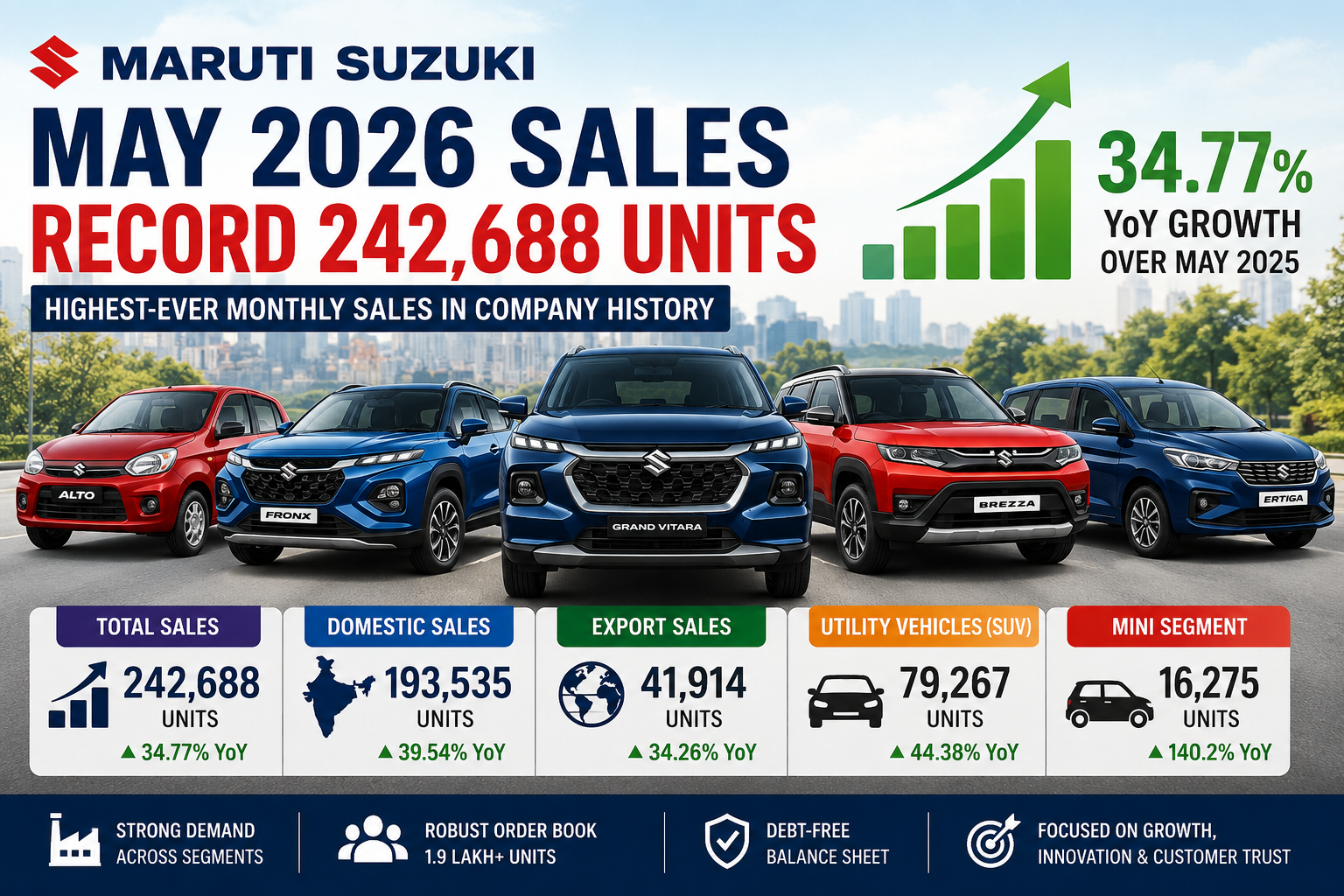
In May 2026, Maruti Suzuki sold a total of 242,688 units across its domestic and export channels, showing an explosive 34.77% year-on-year growth trajectory when compared to the 180,077 units dispatched in May 2025. This unprecedented surge proves that the underlying retail momentum in the Indian passenger vehicle space is incredibly robust, easily overriding any fears of a near-term slowdown.
A deeper analysis of the regulatory filing highlights excellent growth across all key product lines. Total domestic sales, including passenger vehicles and light commercial fleets, reached an all-time high of 193,535 units in May 2026, up significantly from 138,690 units in the same month last year.
Furthermore, Maruti Suzuki’s international export division delivered stunning numbers, tracking a 34.26% expansion to hit 41,914 units in May 2026 against 31,219 units in May 2025. The only segment that saw a minor contraction was the sales to other Original Equipment Manufacturers (OEMs), which settled at 7,239 units down from 10,168 units in the previous year. This minor dip was primarily due to production line re-allocations designed to satisfy the massive, high-margin order backlog piling up in the domestic utility vehicle segment.
Key Highlights
- Highest-Ever Monthly Volumes: Total sales reached an absolute record of 242,688 units, locking in a powerful 34.77% YoY expansion.
- Stunning Domestic Realization: Total domestic dispatches reached an all-time high of 193,535 units, showing a 39.54% jump over May 2025.
- Mini Segment Resurgence: The entry-level entry options (Alto, S-Presso) bounced back remarkably to 16,275 units compared to just 6,776 units last year.
- Utility Vehicle Powerhouse: Premium SUVs (Brezza, Ertiga, e Vitara, Fronx, Grand Vitara, Invicto, Jimny, XL6) expanded by 44.38% to print 79,267 units.
- Robust Export Channels: International shipping volumes rose sharply by 34.26% to touch 41,914 units, confirming strong global consumer demand.
- Commercial Vehicle Steady Growth: The Super Carry Light Commercial Vehicle (LCV) segment grew to 3,198 units, reinforcing Maruti’s multi-pronged market approach.
Why The Maruti Suzuki Share Price Moved Today
The short-term movement of the Maruti Suzuki Share Price reflects a highly positive, probability-based reaction from large-scale institutional platforms as they digest these record-breaking volume metrics. When a top-tier multi-cap automotive asset posts a 34.77% expansion in monthly dispatches, algorithm-driven momentum desks naturally pile into the stock, viewing it as confirmation that consumer demand remains white-hot.
This buying enthusiasm successfully absorbed the minor residual volatility left behind by the Q4 financial earnings statement, where mark-to-market accounting adjustments on treasury bond portfolios had briefly blurred the underlying strength of the core business.
Institutional portfolio managers look far beyond raw headline numbers, choosing to focus on the growing share of higher-margin product lines in the overall product mix. Seeing the premium utility vehicle segment jump to 79,267 units tells large investors that Maruti Suzuki is successfully expanding its profit margins per vehicle.
At the same time, retail investors are drawing immense confidence from the critically lean 12-day dealer inventory levels and the massive 1.9-lakh unit order backlog. This combination guarantees high capacity utilization and steady revenue visibility for the upcoming quarters, keeping the Maruti Suzuki Share Price well-supported against broader market pullbacks.
Major Triggers
To accurately project where the equity will head over the coming weeks, market participants must monitor three primary triggers:
- Monsoon Coverage and Rural Purchasing Power: The structural progress of the southwest monsoon across central and northern India will dictate rural income levels, directly impacting the demand sustainability for the entry-level mini and compact car categories.
- Commissioning of the New Gujarat Production Line: The upcoming activation of the fourth high-capacity manufacturing line in Gujarat, scheduled for July 2026, is crucial to clearing the 1.9-lakh vehicle backlog and converting bookings into immediate cash flow.
- Raw Material and Steel Price Softening: The stabilizing trends in basic raw material indices, such as specialized steel, copper, and automotive-grade electronics, will determine if operating margins can break past the 13% threshold in early FY27.
Positive News Impact
Growth Drivers For Maruti Suzuki Share Price
The spectacular operational data from the May sales release provides several powerful growth drivers that structurally support the long-term outlook for the Maruti Suzuki Share Price. First, the massive 44.38% volume growth in the utility vehicle segment confirms that Maruti Suzuki’s premium brand expansion strategy through its Nexa and Arena networks is working perfectly.
Vehicles like the Grand Vitara, Fronx, and Brezza enjoy superior average selling prices (ASPs) compared to entry-level hatchbacks. As these high-margin premium models make up a larger share of total sales, they help protect consolidated operating earnings from any near-term inflationary input cost pressures.
May 2026 Segment Sales YoY Growth:
Mini Cars:     |||||||||||||||||||||||||||||| +140.2%
Compact/Mid:   ||||||| +31.6%
Utility (SUV): |||||||||| +44.4%
Total Sales:   |||||||| +34.8%
Second, the surprising 140.2% jump in the mini-car segment (Alto and S-Presso) indicates a long-awaited demand recovery among first-time, entry-level buyers. This segment had previously faced pressure due to post-pandemic inflationary shifts.
A strong revival here ensures that Maruti Suzuki can sweat its legacy manufacturing assets with zero additional capital expenditure, generating clean, unencumbered free cash flows. This structural balance between entry-level volume recovery and premium utility vehicle growth makes the Maruti Suzuki Share Price an exceptionally resilient asset for institutional portfolios.
Negative News Impact
Risk Factors Affecting Maruti Suzuki Share Price
While the headline sales data is undeniably positive, a comprehensive, multi-variable financial assessment requires a close look at potential risk factors. The ongoing 28.79% year-on-year drop in sales to other OEMs (7,239 units in May 2026 versus 10,168 units in May 2025) presents a minor near-term drag.
Even though this reduction helps prioritize Maruti’s own retail channels, an extended drop in cross-badging shipments could impact the high-volume asset turnover ratios that Maruti enjoys across its collaborative manufacturing lines with global partners.
| Segment Under Watch | May 2026 Dispatches | YoY Change % | Primary Operational Risk Factor |
| OEM Alliance Supply | 7,239 Units | -28.79% | Capacity trade-offs to clear domestic backlog. |
| Vans (Eeco Line) | 13,240 Units | +7.41% | High sensitivity to commercial intra-city logistics costs. |
| Mini Hatchbacks | 16,275 Units | +140.2% | Vulnerable to structural changes in the lower GST tax brackets. |
Additionally, maintaining an aggressive export growth rate of 34.26% requires navigating complex geopolitical landscapes and foreign exchange fluctuations across Latin America, Africa, and West Asian trade corridors.
Any unexpected shipping container shortages, regional maritime logistics delays, or sudden currency devaluations in these frontier export destinations could restrict international dispatches. If these issues persist over multiple quarters, they could create inventory buildup at exit ports, which analysts tracking the Maruti Suzuki Share Price must monitor carefully.
Technical Analysis of Maruti Suzuki Share Price
From a structural charting perspective, the Maruti Suzuki Share Price is demonstrating a classic accumulation pattern, holding steady within a long-term ascending channel. The equity recently went through a healthy profit-taking phase after testing its lifetime high levels, but it has built a rock-solid, multi-month base right above its key short-term exponential moving averages (EMAs).
Support Levels
The immediate support line for the stock is established at ₹12,980.00, which aligns closely with recent daily low tests. Below this, a major structural support cluster sits between ₹12,100.00 and ₹12,250.00. This zone is heavily reinforced by dense institutional accumulation blocks recorded during post-earnings sessions, providing a strong floor for long-term investors.
Resistance Levels
On the upside, immediate overhead technical resistance is positioned at ₹13,350.00, matching the recent intraday consolidation peaks. A decisive daily close above this level could clear the path for a retest of the major psychological threshold of ₹15,000.00, eventually opening up targets toward the 52-week high of ₹17,370.00.
RSI Analysis
The 14-day Relative Strength Index (RSI) is currently tracking at 53.20. This neutral positioning indicates that the stock is neither overbought nor deeply oversold, leaving plenty of room for an upside move as positive volume trends return.
MACD Analysis
The Moving Average Convergence Divergence (MACD) indicator shows a flattening setup on the daily time frame. The MACD line remains close to the signal line, confirming a period of horizontal base-building where short-term day traders look for clear volume breakouts.
Volume Analysis
Daily trading volumes on the National Stock Exchange (NSE) remain steady, averaging around 2.10 Lakh shares during the latest sessions. The lack of heavy selling volume during minor market pullbacks suggests that large institutional holders are keeping their core positions intact, viewing any near-term dips as accumulation opportunities.
| Indicator | Value | Signal |
| 14-Day RSI | 53.20 | Neutral / Accumulation Zone |
| MACD Configuration | Near Signal Line | Horizontal Base Building / Neutral |
| 20-Day EMA | ₹13,198.24 | Immediate Bullish Support |
| 52-Week Range Floor | ₹12,016.00 | Strong Structural Floor |
Fundamental Analysis of Maruti Suzuki Share Price
A thorough assessment of the Maruti Suzuki Share Price requires analyzing its financial performance, which was highlighted in its Q4 FY26 earnings disclosure. The company continues to show excellent operational efficiency metrics, along with some of the best cash-generation profiles in the global automotive landscape.
Revenue Growth
For Q4 FY26, Maruti Suzuki recorded an all-time high consolidated revenue from operations of ₹52,462.5 crore, marking a robust 28.2% year-on-year expansion compared to the ₹40,920.1 crore achieved in Q4 FY25. For the full fiscal year 2025-26, total net sales reached a historic ₹1,74,369.5 crore, representing a 20.2% annual growth rate. This top-line expansion was driven by premium pricing power in the utility vehicle segment and booming export dispatches.
Profit Growth
The company’s bottom-line performance remains resilient despite near-term headwinds. Consolidated net profit for the March quarter came in at ₹3,659 crore. While this represented a minor 6.4% YoY dip due to a temporary ₹1,028 crore non-cash mark-to-market (MTM) hit on its treasury bond portfolio, core operating profit (EBIT) actually surged 30.4% to hit an all-time high of ₹4,409.2 crore. For the full year FY26, standalone net profit reached a record ₹14,445.4 crore, reflecting strong operational cost controls.
Debt Analysis
A primary fundamental pillar backing the company is its virtually debt-free balance sheet. Operating with zero net debt allows Maruti Suzuki to fully fund its massive ₹14,000 crore capital expenditure plan for FY27 entirely through internal cash accruals. It also gives the board the flexibility to propose a bumper final dividend distribution of ₹140 per share for FY26, demonstrating an investor-friendly approach to capital allocation.
| Financial Quarter | Consolidated Revenue | Consolidated Net Profit | Operating EBITDA |
| Q4 FY26 | ₹52,462.5 Cr | ₹3,659.0 Cr | ₹6,156.9 Cr |
| Q3 FY26 | ₹50,959.2 Cr | ₹3,879.1 Cr | ₹5,572.0 Cr |
| Q4 FY25 | ₹40,920.1 Cr | ₹3,911.1 Cr | ₹4,844.0 Cr |
Industry Outlook
The Indian passenger vehicle market is experiencing a significant structural shift in mid-2026. While entry-level cars are showing early signs of a healthy volume revival, the premium utility vehicle and SUV segments continue to lead the market’s expansion. Fleet operators and retail buyers are increasingly prioritizing advanced safety features, hybrid options, and smart infotainment systems over simple low-cost choices.
At the same time, government policies regarding vehicle emission standards and localized green manufacturing incentives are prompting top-tier carmakers to accelerate their electric vehicle timelines. As global supply chain channels normalize and electronic component costs stabilize, well-capitalized domestic manufacturers with active technology pipelines are perfectly positioned to grow their market share over the next decade.
Expert Views On Maruti Suzuki Share Price
Prominent institutional research analysts retain a highly positive view on the Maruti Suzuki Share Price, supported by the company’s unmatched distribution network and pricing power. Leading domestic brokerages point out that while non-operating accounting adjustments temporarily impacted headline net profits, the record-breaking 30.4% growth in operating EBIT confirms that the core business is in excellent health.
Financial experts view any brief market corrections as attractive accumulation entry opportunities for long-term investors, pointing to the company’s exceptional return ratios, large cash reserves, and dominant position in the high-volume SUV segment.
Short-Term Maruti Suzuki Share Price Impact (Tomorrow)
Weekly Outlook
Over the next few trading sessions, the stock is expected to consolidate within a firm, upward-sloping trading band between ₹13,000.00 and ₹13,450.00. Traders will likely digest the record-breaking May sales volume metrics alongside broader index trends, while steady institutional accumulation should limit any extended downside risks.
Monthly Outlook
Looking across June 2026, the equity’s trajectory will depend on early monsoon updates, wholesale auto numbers across the industry, and early preparations for clearing the order backlog with the upcoming Gujarat line expansion. The underlying technical setup supports a potential move toward ₹14,200.00, assuming immediate support levels remain intact.
| Timeframe | Bullish Scenario Impact | Bearish Scenario Impact |
| Tomorrow (Probability Analysis) | Rebound toward ₹13,250 as buyers absorb record volumes. | Slide to ₹12,950 on automated profit-taking across indices. |
| Next Week (Probability Analysis) | Breakout past ₹13,550 driven by institutional inflows. | Re-test of the crucial support floor near ₹12,800. |
| Next Month (Probability Analysis) | Push toward ₹14,600 supported by backlog clearance updates. | Horizontal base building near the ₹12,500 averages. |
Bull Case Scenario
In an extended bull case scenario, Maruti Suzuki would deliver volume growth that beats consensus estimates across both its domestic SUV lines and international export channels over the coming quarters.
A smooth, high-capacity launch of the new manufacturing line in Gujarat by July 2026 would allow the company to clear its 1.9-lakh unit booking backlog much faster than expected, turning pending orders into immediate revenue. If operating margins expand toward 14% due to easing steel costs and favorable foreign exchange tailwinds, strong institutional buying could lift the stock past its recent peaks, opening up clear long-term targets in the ₹16,500.00 to ₹17,500.00 range.
Bear Case Scenario
Conversely, a bear case scenario could develop if persistent inflation in specialized input raw materials compresses operating margins down to the 10.5% level. If this cost pressure is compounded by an uneven layout of the southwest monsoon that dampens rural consumer sentiment, entry-level mini car sales could slow down again.
Under this scenario, institutional investors might adopt a more cautious stance regarding near-term valuations. This could cause the stock to drift lower and test its long-term structural support levels in the ₹11,800.00 to ₹12,100.00 region before finding a stable accumulation floor.
Risk vs Reward Analysis
An assessment of the investment profile reveals a highly favorable risk-reward setup for patient, long-term wealth creators. The primary risks are operational and macroeconomic, centering on short-term input commodity cost shifts and global logistical adjustments.
On the reward side, investors benefit from a completely debt-free balance sheet, strong pricing power, an unmatched national dealership network, and a record-breaking operating profit profile that continues to outpace broader industry averages. This combination helps provide a solid cushion against extended downside risks.
| Investment Factor | Risk / Reward Rating | Analytical Insight |
| Operational Backlog Risk | Low Risk | 1.9-lakh unit pending order book ensures high revenue visibility. |
| Balance Sheet Health | Very Low Risk | Debt-free position perfectly protects cash flow through market cycles. |
| Core Operating Efficiency | High Reward | Record-high operating EBIT points to excellent underlying business health. |
| Valuation Comfort | Fair / Balanced | Trailing P/E multiples are well-supported by robust 28% top-line growth. |
Investment Strategy
For retail investors, a practical and rewarding approach involves systematically accumulating shares during periods of market consolidation or temporary technical pullbacks. Rather than attempting to time exact market turning points, adding to positions during minor dips allows investors to average their costs close to institutional support zones.
The stock remains well-suited for long-term, compounding portfolios, where steady operational performance and regular, high-value dividend distributions can be reinvested over time. Short-term traders should keep a close eye on daily volume indicators, using a decisive close above ₹13,350.00 as a reliable signal of renewed upward momentum.
Overall Positive Or Negative News Sentiment
The overall news sentiment regarding Maruti Suzuki India Limited is classified as Strong Positive. While the previous quarter’s non-cash accounting adjustments briefly drew attention, they are completely overshadowed by the spectacular, highest-ever monthly sales volume of 242,688 units achieved in May 2026.
This historic volume performance, combined with record-breaking full-year operating profits, an immense order backlog, and an attractive ₹140 per share dividend proposal, highlights a highly constructive operational trajectory for the company.
Sentiment Breakdown Matrix:
Positive News:    [ 9.5 / 10 ] - Record-breaking sales volumes across all segments.
Negative News:    [ 1.5 / 10 ] - Minor capacity trade-offs in cross-badging OEM lines.
Technical Trend:  [ 7.5 / 10 ] - Solid consolidation base above long-term moving floors.
Fundamentals:     [ 9.0 / 10 ] - All-time high operating EBIT with a debt-free status.
-----------------------------------------------------------------------------------------
Overall Score:    [ 8.8 / 10 ] - Sentiment Classification: Strong Positive
Final Verdict
The latest operational and financial data confirms that Maruti Suzuki India Limited’s core investment thesis is exceptionally robust. While the minor dip in cross-badging OEM shipments warrants basic tracking, the spectacular 34.77% expansion in total monthly sales highlights booming consumer demand across the domestic and export economies.
Backed by a virtually debt-free balance sheet, record-high operating EBIT, and a dominant market position in the high-margin utility vehicle space, the company continues to offer compelling long-term value.
Investors can look at the current technical consolidation phase as an ideal opportunity to build long-term holdings, focusing on the company’s strong capital efficiency and vital role in India’s broader economic growth story.
For a deeper look into the company’s recent performance, watch this comprehensive Maruti Suzuki Q4 Earnings Review to understand management’s guidance on operating margins, upcoming product pipelines, and strategies to mitigate commodity inflation. This video provides critical context regarding how Maruti Suzuki managed a record-high operating profit while navigating temporary non-operating treasury adjustments.
Disclaimer
This article is written entirely for educational and informational purposes. It does not constitute formal financial, investment, or legal advice. Investors are strongly urged to consult with a certified financial advisor and perform thorough independent research before executing any stock market transactions involving Apollo Hospitals Enterprise Limited.
Read Another Article
Stay updated on the latest Nifty 50 stock movements and corporate news with our detailed analyses:
Eicher Motors VECV Sales May 2026: 7.8% Growth Drives Positive Outlook for Share Price. Read here