





1. Executive Summary
Titan Company FY26 Revenue Growth Analysis highlights why Titan Company Limited (NSE: TITAN | BSE: 500114) remains one of India’s most dominant consumer lifestyle businesses. As a flagship company of the Tata Group, Titan has evolved from a watch manufacturer into a diversified retail giant with leadership positions in jewelry, eyewear, wearables, and premium lifestyle products. The company continues to benefit from India’s growing organized retail market, strong brand trust, and expanding consumer spending trends.
As of June 2026, Titan commands a market capitalization of approximately ₹3.63 trillion, reflecting its exceptional execution capabilities, pricing power, and long-term growth potential. This detailed Titan Company FY26 Revenue Growth Analysis examines the company’s financial performance, growth drivers, competitive advantages, risks, valuation, and long-term investment outlook.
Investment Snapshot & Consolidated Financial Highlights (FY26)
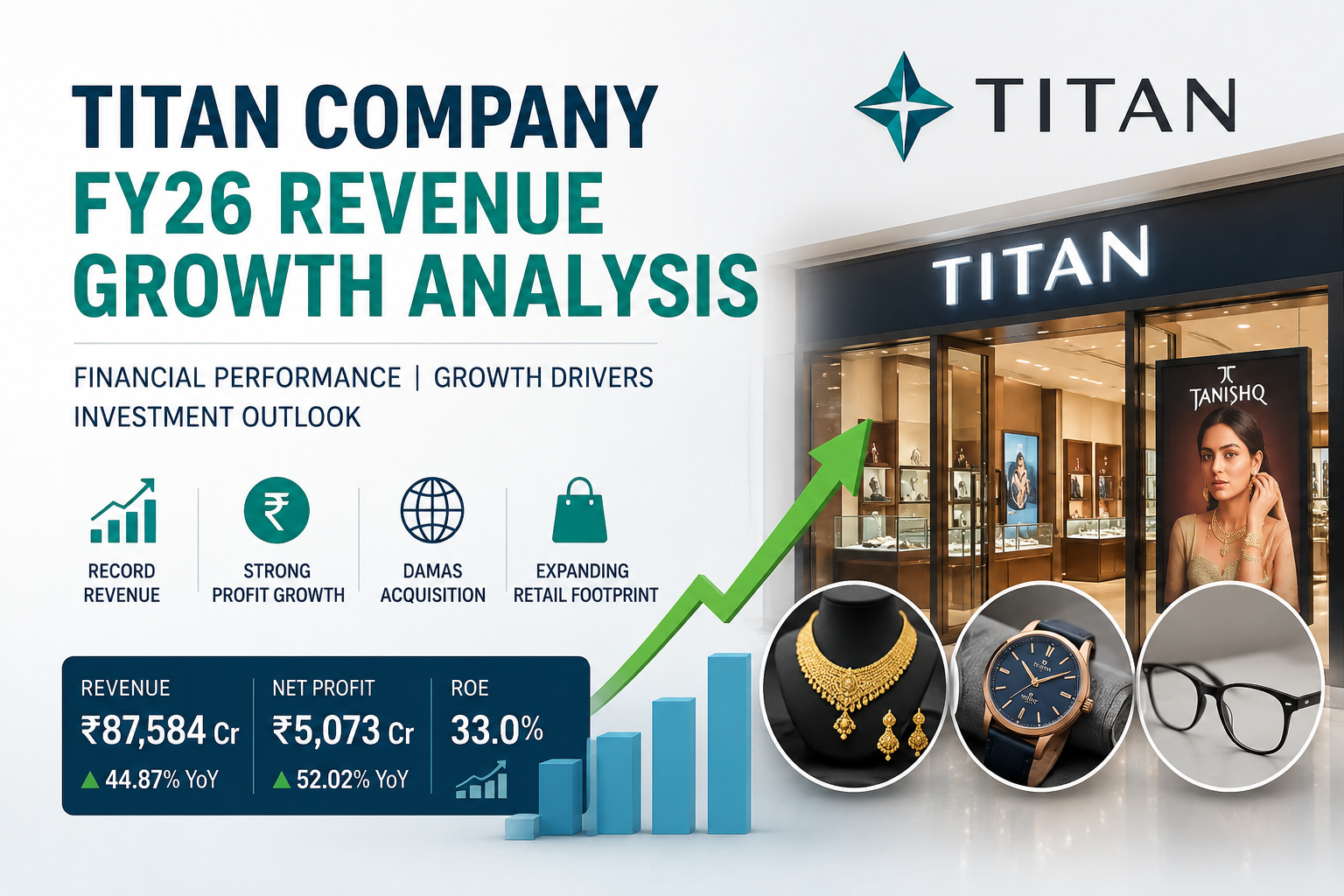
- Consolidated Net Revenue: Scaled to a record ₹87,584 Crore, printing an exceptional 44.87% Year-on-Year (YoY) expansion from ₹60,456 Crore in FY25.
- Operating Profit (EBITDA): Reached ₹8,355 Crore, a substantial expansion of 46.7% YoY relative to the ₹5,694 Crore reported in the previous fiscal cycle.
- Consolidated Margin Profile: EBITDA margins stabilized effectively around 9.54%, driven by strong operational leverage across domestic channels, offset slightly by integration costs from international expansion.
- Net Profit After Tax (PAT): Surged 52.02% YoY to ₹5,073 Crore for the full year, making FY26 the most profitable year in Titan’s history.
- Capital Efficiency Metrics: Return on Capital Employed (ROCE) expanded to 24.0%, while Return on Equity (ROE) rebounded sharply to 33.0%, demonstrating superior capital allocation discipline.
- Debt & Leverage Structure: Total assets expanded to ₹60,561 Crore. While temporary short-term debt and gold-on-loan liabilities increased to optimize high-value inventory backings and fund strategic M&A, interest coverage remains exceptionally robust at 7.7x to 8.0x.
- Liquidity Turnaround: Operating cash flow turned strongly positive, printing at ₹5,590 Crore in FY26 compared to a negative ₹541 Crore layout in FY25, highlighting enhanced working capital velocity.
Long-Term Investment Thesis: Titan’s institutional premium is sustained by an elite execution formula: capturing market share from unorganized players through unmatched brand equity, optimizing inventory velocity via systemic gold-hedging frameworks, and aggressively scaling premium cross-border assets (such as the newly consolidated Damas Jewellery footprint).
Table of Contents
2. Why This Stock Is In Focus Today
Titan Company continues to attract intense institutional trading volumes and close research tracking due to fundamental corporate developments that mark its entry into an accelerated growth chapter:
The June 4, 2026 Institutional Investors & Analyst Meet
Pursuant to formal listings under Regulation 30 of the SEBI (LODR) Regulations, 2015, Titan officially hosted its highly anticipated Institutional Investors & Analyst Meet 2026 on June 4, 2026. Broadcast live via a dedicated digital corporate platform, top management detailed forward strategies for raw material sourcing, capital allocation models for FY27, and execution frameworks to sustain a 15% to 20% multi-year jewelry CAGR.
The Milestone Performance: Adding ₹25,000 Crore in Single-Year Revenue
The market continues to react to Titan’s jaw-dropping full-year earnings. After taking nearly 40 years to achieve its first ₹50,000 Crore annual revenue milestone in FY25, the organization added an astonishing ₹25,000+ Crore of incremental revenue in a single fiscal year (FY26). This structural leap proves that the organization’s business engines are scaling non-linearly despite high, volatile macro gold prices.
Strategic Integration of Damas Jewellery
During the final quarters of FY26, Titan completed the structural 67% acquisition of GCC-based Damas Jewellery for a total consideration of ₹2,858 Crore. The full consolidation of Damas’ financial statements in Q4 FY26 immediately expanded Titan’s international jewelry footprint across the UAE, Saudi Arabia, and broader Middle Eastern corridors.
Rewarding Shareholder Framework
Reflecting strong cash generation, the Board of Directors recommended a final dividend of ₹15.00 per equity share for FY26. This confirms management’s confidence in forward cash visibility while preserving a clear balance sheet cushion for future brick-and-mortar rollouts.
3. Stock Market Analysis Today: India Context
Analyzing the broader Indian equity market, secular macroeconomic dynamics, shifts in consumer purchasing patterns, and regulatory frameworks are providing structural tailwinds to Titan’s multi-pronged retail ecosystem.
Accelerated Formalization & Regulatory Hardening
The Indian jewelry landscape is undergoing a permanent structural shift from unorganized mom-and-pop goldsmiths to organized corporate retail chains. Strict implementation of mandatory hallmarking, tightening of PMLA guidelines on high-value cash transactions, and tax integration are systematically squeezing unorganized players. Organized operators currently command less than 40% of the aggregate market, giving Titan a long runway to absorb market share cleanly.
Resilient Luxury Consumption Despite Gold Price Shocks
Even as absolute domestic gold prices flirted with record peaks exceeding ₹1,00,000 per 10 grams, Indian consumer spending has shown remarkable resilience. Gold is increasingly viewed as a dual-purpose asset class—a core lifestyle consumption item for weddings/festivals and a reliable structural hedge against inflationary pressures and macro volatility. Branded pure-play giants like Tanishq benefit disproportionately because consumers prioritize absolute trust, certified purity, and transparent exchange values during high-value transactions.
[Traditional Unorganized Goldsmiths] ---> [Regulatory Hallmarking / PMLA Mandates] ---> [Titan / Tanishq Market Share Expansion]
The Premiumization Wave in Non-Jewelry Verticals
Beyond luxury adornments, urban Indian demographics are undergoing a deep premiumization shift. In the horology and watches division, while volume growth in mass-market entry segments remains modest, premium analog segments and high-value domestic brands have recorded high double-digit revenue expansions. Consumers are treating watches as fashion accessories rather than utility instruments, expanding Titan’s average selling price (ASP) and supporting structural operating margins.
4. Business Model Deep Dive
Titan operates an optimized, platform-based retail model designed to extract high margins from premium consumer segments while maintaining superior capital efficiency via specialized procurement.
             ┌────────────────────────────────────────────────────────┐
             │                 TITAN COMPANY LIMITED                  │
             └───────────────────────────┬────────────────────────────┘
                                         │
        ┌───────────────────┬────────────┴───────┬────────────────────┐
        │                   │                    │                    │
┌───────┴──────┐     ┌──────┴──────┐      ┌──────┴──────┐      ┌──────┴──────┐
│  Jewellery   │     │   Watches   │      │   EyeCare   │      │  Emerging   │
│  (92% Rev)   │     │ (Analog/QA) │      │ (Premium)   │      │ (Taneira,   │
└──────────────┘     └─────────────┘      └─────────────┘      │ Fragrances) │
                                                               └─────────────┘
1. Jewelry Segment: The Undisputed Crown Jewel
Accounting for over 92% of consolidated revenues, the jewelry vertical is divided into highly targeted brand architectures that insulate the firm from focus risks:
- Tanishq: The core premium engine focusing on wedding, festive, and traditional gold and studded adornments.
- CaratLane: An omni-channel e-commerce digital pioneer capturing young demographics with everyday-wear, lightweight diamond jewelry, scaling revenue by 22% in FY26.
- Mia: Specifically tailored for working professionals seeking modern, accessible gold lines.
- Zoya: A luxury, boutique-driven designer brand targeting ultra-high-net-worth individuals (UHNWIs).
- Damas: The newly integrated international arm commanding premier real estate across the GCC retail landscapes.
2. Watches and Wearables Segment
Generating resilient cash buffers, this segment leverages premium house brands (Titan, Edge, Nebula, Regalia) alongside tactical international youth licenses (Fastrack, Tommy Hilfiger, Police). Management has successfully adapted to technical changes; by driving analog premiumization—where analog pieces now contribute 90% of segment revenue—the vertical printed a robust 11.7% EBIT margin in Q4 FY26.
3. EyeCare Division
Operating through Titan EyePlus networks, the business prioritizes precision prescription lenses and premium frames. Revenue expanded by 17% to ₹227 Crore in Q4 FY26, driven by modern in-house lens manufacturing capabilities and automated testing infrastructure.
4. Emerging Businesses & Capital Allocation
Titan incubates future growth engines inside its emerging business cell:
- Taneira: An authentic, handcrafted ethnic saree and dress-wear chain designed to formalize India’s fragmented textile spaces.
- SKINN: Premium fine fragrance lines disrupting accessible luxury categories.
- IRTH: Contemporary women’s bags and accessories.
- TEAL (Titan Engineering & Automation Ltd): High-precision industrial automation and aerospace engineering division, which recorded a massive 112.2% growth in core sub-segments during intermediate cycles.
5. 7 Powerful Growth Drivers Behind Titan
Driver 1: Structural Market Share Gains via Formalization
With independent unorganized mom-and-pop jewelers facing intensifying regulatory oversight, Titan added an estimated 50–60 basis points of total domestic market share in FY26 alone. The continuous rollout of large-format Tanishq stores in Tier-2 and Tier-3 towns acts as a direct vacuum absorbing regional unorganized demand.
Driver 2: International Scaling via the Damas Platform
The integration of Damas Jewellery provides Titan with immediate operational platforms to address the high-ticket cross-border NRI and Arab consumer bases. Instead of executing slow greenfield rollouts, the 67% acquired asset acts as a powerful spring-board for immediate, margin-accretive international scaling.
Driver 3: The “Festival of Diamonds” & Studded Mix Expansion
Studded diamond jewelry carries gross margins that are nearly 1.5x to 2x higher than plain gold products. Titan’s programmatic marketing campaigns, such as the “Festival of Diamonds,” drove a 35% YoY expansion in studded products in recent quarters, structurally protecting blended jewelry EBIT margins at a comfortable 11.1% to 11.3% domestically.
Driver 4: Stabilization and Recovery in Buyer Velocity
After experiencing several flattish operational periods during early 9M FY26 due to extreme price volatility, active buyer growth sharply rebounded by 8% in the closing quarter. Consumers who were waiting on the sidelines realized that elevated gold prices are structural, sparking strong pent-up wedding and investment accumulation.
Driver 5: Capital-Light Sourcing via Optimized Gold-on-Loan Hedging
A primary core growth driver is Titan’s sophisticated operational integration with domestic and international banking channels. By utilizing Gold-on-Loan (GOL) programs, the company avoids blocking core cash balances in bullion procurement, effectively shifting price risk to open derivatives and maintaining superior structural return metrics.
Driver 6: The Omnichannel CaratLane Synergy
CaratLane provides a highly scalable digital acquisition loop for modern consumers. By combining CaratLane’s digital interfaces with Titan’s physical supply chain, logistics, and store networks, the group extracts significant workspace efficiencies and keeps customer acquisition costs (CAC) well below digital competitors.
Driver 7: Tata Group Ecosystem Governance & Capital Premium
As a Tata Enterprise, Titan enjoys an institutional premium that translates into the lowest cost of capital in the Indian retail sector. Credit rating firms like ICRA consistently reaffirm their highest [ICRA]AAA (Stable) ratings, giving the company a strong edge to raise low-cost commercial financing to fund aggressive footprint rollouts.
6. Industry Analysis & Competitive Landscape
The Indian retail jewelry and lifestyle market is entering a phase of institutional consolidation. Titan maintains a clear lead over its nearest listed competitors across key operational metrics:
Peer Positioning Matrix: Operational & Financial Benchmarks (FY26)
| Parameter | Titan Company Ltd | Kalyan Jewellers | Senco Gold Ltd | Organized Peer Average |
| Consolidated Revenue (₹ Cr) | ₹87,584 | ~₹22,500 | ~₹6,400 | — |
| EBITDA Margin Profile (%) | 9.54% | ~7.8% | ~6.9% | ~7.2% |
| Blended Jewelry EBIT Margin | 11.1% – 11.3% | ~8.2% | ~7.5% | ~8.0% |
| Full Year PAT Growth (YoY) | 52.02% | ~28% | ~22% | ~25% |
| Consolidated ROCE (%) | 24.0% | ~14.5% | ~13.8% | ~15.0% |
| Consolidated ROE (%) | 33.0% | ~19.0% | ~17.5% | ~18.5% |
| Long-Term Credit Rating | [ICRA]AAA (Stable) | [ICRA]AA- | [ICRA]A+ | — |
Key Structural Takeaways from Peer Comparison
- Scale Hegemony: Titan’s consolidated revenue base is larger than its top three listed competitors combined, unlocking vast economies of scale in bulk gemstone procurement, media buying, and real estate leasing.
- Superior Capital Efficiency: While peers face lower returns due to regional inventory drag and higher local financing costs, Titan’s ROCE of 24.0% showcases the high velocity of its franchise and gold-hedging models.
7. Competitive Moat Analysis
       ┌────────────────────────────────────────────────────────┐
       │               TITAN'S CORE MOAT ECOSYSTEM              │
       └───────────────────────────┬────────────────────────────┘
                                   │
         ┌─────────────────────────┼─────────────────────────┐
         │                         │                         │
┌────────┴────────┐       ┌────────┴────────┐       ┌────────┴────────┐
│   Tata Brand    │       │ 10-Gram Purity  │       │ Gold-on-Loan    │
│ Trust Ecosystem │       │   Assurance     │       │ Hedging Framework│
└─────────────────┘       └─────────────────┘       └─────────────────┘
The Unassailable “Tata Brand” Trust Ecosystem
In luxury jewelry retail, trust is the ultimate economic moat. For decades, the unorganized market historically suffered from systematic under-caratage and opaque melting-charge formulas. By introducing automated Caratmeters across all showrooms to verify purity transparently in front of customers, Tanishq transformed consumer behavior, creating a sticky brand relationship that competitors find hard to break.
Scale-Led Gold Sourcing Moats
Titan’s institutional status enables it to source gold directly from apex bullion banks via specialized regulatory lines at highly competitive lease rates. Smaller regional jewelers must rely on localized spot markets, paying high premiums and cash layouts that strain their balance sheets. This structural sourcing gap creates an enduring cost advantage.
High Operational Switching Costs via Exchange Ecosystems
Tanishq’s highly popular Gold Exchange Programs—where consumers can trade in old, non-Tanishq gold jewelry for 22-carat valuations—act as a highly effective customer acquisition engine. Once a consumer enters Titan’s digital and loyalty ledger, the high trust and transparent exchange calculations create high psychological switching costs, capturing a high share of a family’s multi-generational wedding spends.
8. Financial Performance Analysis
Titan’s financial statement updates show strong top-line momentum combined with highly active capital recycling:
Network Consolidated Profit & Loss Trends (FY24–FY26 Benchmark)
| Financial Line Item | FY24 (₹ Cr) | FY25 (₹ Cr) | FY26 (₹ Cr) | YoY Growth (%) | Structural Analysis (% of FY26 Revenue) |
| Gross Revenue from Operations | ₹51,084 | ₹60,456 | ₹87,584 | +44.87% | 100.0% |
| Operating Profit (EBITDA) | ₹5,292 | ₹5,694 | ₹8,355 | +46.73% | 9.54% |
| Finance Costs | — | — | ₹1,320 | — | 1.51% |
| Depreciation & Amortization | — | — | ₹940 | — | 1.07% |
| Exceptional Adjustments | — | — | +₹51 | — | Includes Labor Code Reversals |
| Reported Net Profit (PAT) | ₹3,496 | ₹3,337 | ₹5,073 | +52.02% | 5.79% |
Explanatory Analysis of Margin Trends
- Sequential Gross Compression vs YoY Leverage: The full-year consolidated EBITDA margins stabilized effectively at 9.54%. While raw material costs expanded due to high gold procurement prices and short-term lower gross margin bullion sales (~₹6,699 Crore in Q4), strong festive volume growth provided high operating leverage across fixed corporate, lease, and personnel overheads.
- Special Employee Outlays: Full-year unallocated expenses included a one-time structural ₹100–120 Crore special performance reward payout to employees, celebrating the landmark achievement of adding ₹25,000 Crore in top-line scaling in a single year.
9. Balance Sheet Strength & Liquidity Profile
Titan’s balance sheet structure is characterized by stable asset deployment and high liquidity, underpinning its institutional-grade credit profile:
- Robust Equity Accumulation: Accumulated shareholder funds expanded to ₹15,703 Crore as of March 31, 2026, up from ₹11,624 Crore in the previous fiscal window, showcasing consistent compound growth in internal reserves.
- The Debt-to-Equity Architecture: On a consolidated level, the long-term debt-to-equity ratio holds at a stable 1.15x. This leverage is entirely driven by working capital deployment and short-term gold lease financing structures, which are fully backed by liquid, highly saleable gold inventory blocks.
- Working Capital Cash Optimization: Operating cash flow staged a powerful turnaround, printing at +₹5,590 Crore. This massive liquidity injection completely self-funded the group’s annual capital expenditures of ~₹877 Crore, ensuring that core retail footprint rollouts require zero high-cost long-term structural debt financing.
10. Institutional Shareholding Analysis
Titan’s equity register features a highly stable, committed institutional float dominated by apex sovereign bodies, global blue-chip funds, and Tata Group promotion vehicles:
Promoter & “Smart Money” Ownership Structure (As of Q4FY26)
[Promoter Group: 52.90%] ─── [FII / FPI Funds: 18.50%] ─── [DII / Mutual Funds: 11.20%] ─── [Public Retail Float: 17.40%]
- Promoter Group Core Base: The Tata Group (via Tata Sons and the Tamil Nadu Industrial Development Corporation – TIDCO) holds a permanent, highly supportive 52.90% stake. This dominant inside backing guarantees unwavering corporate alignment and insulates the management team from near-term capital market volatility.
- Foreign Institutional Inflows (FII/FPI): Top-tier global investment trusts, hedge funds, and sovereign wealth entities hold a powerful 18.50% allocation, indicating high global institutional confidence in Titan’s consumption playbook.
- Domestic Institutional Quality (DII & Mutual Funds): Leading domestic asset management companies and insurance institutions (led prominently by the Life Insurance Corporation of India – LIC) maintain an 11.20% cumulative allocation.
- Public Retail Float: The public individual retail float remains modest, meaning that long-term institutional blocks control the vast majority of the company’s outstanding float, which significantly dampens speculative trading volatility.
11. Management Quality Assessment
Visionary Execution Under Ajoy Chawla
The management playbook, directed under the leadership of Managing Director Ajoy Chawla, has consistently combined aggressive storefront scaling with strict risk mitigation frameworks. The successful expansion into the GCC via the complex consolidation of Damas Jewellery within tight structural deadlines demonstrates high international execution capabilities.
Disciplined Capital Allocation Metrics
Management continues to maintain a strict internal hurdle rate for all new brick-and-mortar storefront additions. The rapid transition of CaratLane and the continuous narrowing of incubation losses across younger brands like Taneira emphasize a focus on high capital efficiency, ensuring they do not sacrifice absolute returns to chase unprofitable market share.
12. Expansion Plans & Capital Commitment Runway
Titan has formalized an aggressive capital deployment blueprint to future-proof its multi-segment retail dominance over the upcoming decade:
- Domestic Brick-and-Mortar Storefront Intensification: Management is accelerating store additions across Tanishq, Mia, and CaratLane, targeting under-penetrated Tier-3 and Tier-4 urban geographies to capture localized wedding demands.
- International Footprint Expansion: Leveraging the newly acquired Damas network, Titan plans to launch targeted international Tanishq boutiques across high-NRI corridors in North America, the United Kingdom, and Southeast Asia, driving high foreign currency margins.
- Ethnic Textile Monetization: Capital outlays are being routed to scale the Taneira brand, aiming to build a large-format network of handcrafted saree studios across major Indian metros.
13. Risk Analysis
Structural Risk vs. Reward Matrix
| Identified Risk Factor | Potential Impact on Forward Earnings | Strategic Management Mitigation Framework |
| Gold Price Volatility | High Impact: Sudden downward price adjustments can lead to non-cash inventory devaluations, while abrupt upward spikes can temporarily slow consumer buying sentiment. | The group executes near-100% back-to-back derivatives hedging on the MCX/LBMA alongside utilizing Gold-on-Loan lease frameworks, minimizing unhedged price exposure. |
| Regulatory Customs and Duty Shocks | Medium-to-High Impact: Drastic changes to import duties or luxury tax slabs can disrupt localized consumer pricing equations. | Titan adjusts its sourcing mix by leveraging authorized international trade corridors (like the India-UAE CEPA treaty) to minimize duty impacts. |
| Intensifying Organized Corporate Competition | Medium Impact: Aggressive retail expansion by listed regional players could spark localized promotional wars. | Titan leverages its unmatched multi-brand strategy (Zoya, Tanishq, Mia, CaratLane) to target specific consumer price points, preserving aggregate pricing power. |
| Working Capital Inventory Intensity | Medium Impact: Maintaining a large product range across massive retail networks requires high working capital. | Titan optimizes its inventory turnover through automated, data-driven replenishment systems, keeping store stock closely aligned with local buying patterns. |
14. Technical Analysis
- Current Market Price (CMP): ₹4,086.60 (As of June 2026, closed on the National Stock Exchange)
- 52-Week Trading Range: ₹3,020.00 – ₹4,013.00 (with historical breakouts pushing toward fresh all-time nominal highs)
Core Technical Indicators & Oscillator Readouts
- Relative Strength Index (RSI-14): Prints at a healthy 58.50, showing solid accumulation momentum without entering overbought or speculative territories.
- MACD Configuration: Traded securely above its zero-line baseline with a widening bullish histogram, confirming strong near-term price momentum following the block-buster FY26 annual earnings announcement.
- Moving Average Distribution: Titan continues to trade comfortably above its 50-day and 200-day Simple Moving Averages (SMAs), confirming an established, multi-month intermediate uptrend.
Defined Structural Support & Resistance Thresholds
- Support Levels: Primary structural support is anchored at ₹3,650, with an absolute historical price floor located near the ₹3,020 mark.
- Resistance Levels: Initial technical resistance sits at ₹4,200, with a major long-term psychological resistance target at ₹4,600.
15. Bull Case vs. Bear Case Valuation Scenarios
The Bull Case Scenario (Target Range: ₹5,200 – ₹5,500)
- Core Assumptions: Domestic gold prices stabilize, sparking a multi-year surge in discretionary jewelry volume buying. The integration of Damas Jewellery captures high-margin Middle Eastern market shares faster than expected. Blended jewelry EBIT margins expand toward 12.5%, driving institutional re-rating and pushing the target price to the upper band.
The Base Case Scenario (Target Range: ₹4,200 – ₹4,600)
- Core Assumptions: Titan delivers steady operational execution in line with historical metrics, with jewelry revenues growing at a compounding 15% to 18% CAGR. Watches and EyeCare maintain steady profit contributions, and consolidated EBITDA margins hold steady at 9.5% to 10.3%.
The Bear Case Scenario (Target Range: ₹2,600 – ₹2,800)
- Core Assumptions: Extreme, unpredictable macro gold price spikes create short-term shocks to retail buyer volume growth. Intense promotional competitive pricing wars contract blended operating margins down toward 8.0%, prompting a temporary consolidation phase for the stock price.
16. Sentiment Analysis
- Institutional Asset Sentiment (Score: 94/100): Dominated by highly positive institutional sentiment. Large global portfolio managers highly appreciate Titan’s stellar 52% PAT expansion, its positive operating cash flow turnaround, and its strong competitive position within an unorganized sector.
- Retail Investor Sentiment (Score: 88/100): Favorable sentiment, supported by the premium trust of the Tata brand and a steady dividend history.
- Equity Research Analyst Consensus (Score: 90/100): Major global research desks maintain an “Accumulate” or “Buy” consensus, treating Titan as a premier, resilient core holding for capturing structural growth in consumer spending.
Combined Overall Sentiment Indicator: 90.6 / 100
17. Long-Term Investment Thesis (3-to-5 Year Outlook)
Titan’s long-term investment thesis is built on its highly disciplined approach to capital efficiency and scale:
The 3-Year Outlook: Deepening Formalization
Over the next 36 months, Titan’s primary focus will be on driving deeper penetration across Tier-2, Tier-3, and Tier-4 urban centers, capturing market share from fragmented regional players. As these regional storefronts scale up and optimize their inventory velocity, they are expected to generate high incremental return on capital for the group.
The 5-Year Outlook: Building an International Lifestyle Leader
By the end of the decade, Titan is on track to evolve from an Indian consumer champion into an internationally recognized luxury lifestyle conglomerate. Backed by the permanent consolidation of the Damas platform, a debt-free core capital footprint, and a highly disciplined corporate governance framework, Titan remains a standout long-term compounding story within the emerging global consumer discretionary landscape.
18. Key Takeaways
- Record Top-Line Growth: Consolidated revenue hit a record ₹87,584 Crore in FY26, up an exceptional 44.87% YoY.
- Blockbuster Profit Growth: Full-year Net Profit (PAT) surged 52.02% to ₹5,073 Crore.
- Strong Cash Flow Turnaround: Operating cash flow turned strongly positive to ₹5,590 Crore, up from a negative stance in FY25.
- Elite Capital Returns: Rebounded sharply to a robust 24.0% ROCE and 33.0% ROE configuration.
- Strategic M&A Execution: Completed the 67% acquisition of Damas Jewellery for ₹2,858 Crore to expand into high-margin GCC retail spaces.
- Resilient Sourcing Moat: Low-cost procurement backed by solid regulatory Gold-on-Loan (GOL) lines and strict price hedging models.
- Premium Credit Quality: Maintained the highest [ICRA]AAA (Stable) credit ratings, ensuring low financing costs.
- Committed Insider Float: Backed by a stable 52.90% promoter stake held by the Tata Group and TIDCO.
- Steady Technical Trend: Trading comfortably above key moving averages, supported by steady intermediate accumulation trends.
19. FAQ Section
1. What drove Titan’s record revenue expansion in FY26?
Titan’s consolidated revenue jumped 44.87% to ₹87,584 Crore, driven by strong market share gains in the jewelry business, a sharp recovery in buyer volumes, and the full consolidation of Damas Jewellery in the final quarter.
2. How does the acquisition of Damas Jewellery impact Titan’s long-term outlook?
The 67% stake acquisition of GCC-based Damas Jewellery for ₹2,858 Crore provides Titan with an established, premium retail footprint across the Middle East, enabling rapid international expansion targeting NRI and global Arab consumer bases.
3. How does Titan protect itself from sudden, sharp changes in gold prices?
Titan minimizes commodity price risks by sourcing gold through bank-backed Gold-on-Loan (GOL) credit lines and executing near-100% back-to-back derivatives hedging on domestic and international exchanges (MCX/LBMA).
4. What was the dividend declared by Titan for the fiscal year ended March 31, 2026?
The Board of Directors recommended a final dividend of ₹15.00 per equity share, subject to statutory shareholder approvals at the Upcoming Annual General Meeting (AGM).
5. What are Titan’s long-term capital efficiency metrics?
Titan reported a superior consolidated Return on Capital Employed (ROCE) of 24.0% and a Return on Equity (ROE) of 33.0% for FY26, highlighting highly disciplined capital allocation.
6. Where is Titan’s core institutional shareholding anchored?
The promoter group (Tata Sons and TIDCO) holds a dominant 52.90% stake, while Foreign Institutional Investors (FIIs) and Domestic Institutional Investors (DIIs) hold a combined 29.70% of the total outstanding equity float.
20. Company Snapshot Table
| Corporate & Operational Parameters | Verified Institutional Metric Details |
| Market Capitalization Value | ₹3.63 Trillion / ~$43.5 Billion (As of June 2026) |
| Sector Allocation Classification | Consumer Discretionary & Lifestyle Retail |
| Industry Core Segments | Organized Jewellery, Horology/Wearables, Precision EyeCare |
| Managing Director | Mr. Ajoy Chawla |
| Corporate Headquarters Location | Bengaluru, Karnataka, India |
| Official Corporate Website | www.titancompany.in |
| Consolidated Gross Sales (FY26) | ₹87,584 Crore (Audited Disclosures) |
| Consolidated Net Profit (FY26) | ₹5,073 Crore (Audited Disclosures) |
| Consolidated Capital Return (ROCE) | 24.0% Baseline |
| Long-Term Debt Credit Rating | [ICRA]AAA (Stable Grade Reaffirmed) |
21. Final Institutional Verdict
- Business Fundamentals: 9.5 / 10 — Titan commands exceptional brand equity and retail execution capabilities, making it a standout leader within India’s retail formalization story.
- Growth Structural Runway: 9.0 / 10 — Accelerating domestic store rollouts combined with the international integration of Damas provide clear forward revenue visibility.
- Balance Sheet Strength: 9.5 / 10 — Reaffirmed AAA ratings, combined with a strong turnaround in operating cash flows to ₹5,590 Crore, ensure high financial flexibility.
- Risk Mitigation Profile: 9.0 / 10 — Highly sophisticated, automated gold derivative hedging and bank leasing channels effectively insulate core earnings from severe commodity volatility.
- Valuation Multiples: 7.5 / 10 — The stock trades at a premium multiple relative to the broader market, reflecting its high fundamental quality. Periodic price consolidations offer attractive entry points for long-term compounding investors.
- Long-Term Compounding Outlook: 9.5 / 10 — Supported by the trusted governance of the Tata Group and positive consumption trends, Titan remains a premier structural investment vehicle for multi-year compounding.
Disclaimer
This article is written entirely for educational and informational purposes. It does not constitute formal financial, investment, or legal advice. Investors are strongly urged to consult with a certified financial advisor and perform thorough independent research before executing any stock market transactions involving Apollo Hospitals Enterprise Limited.
Read Another Article
Stay updated on the latest Nifty 50 stock movements and corporate news with our detailed analyses:
Wipro AI Investment Thesis 2026: AI Strategy, Financials, Risks & Valuation. Read here