




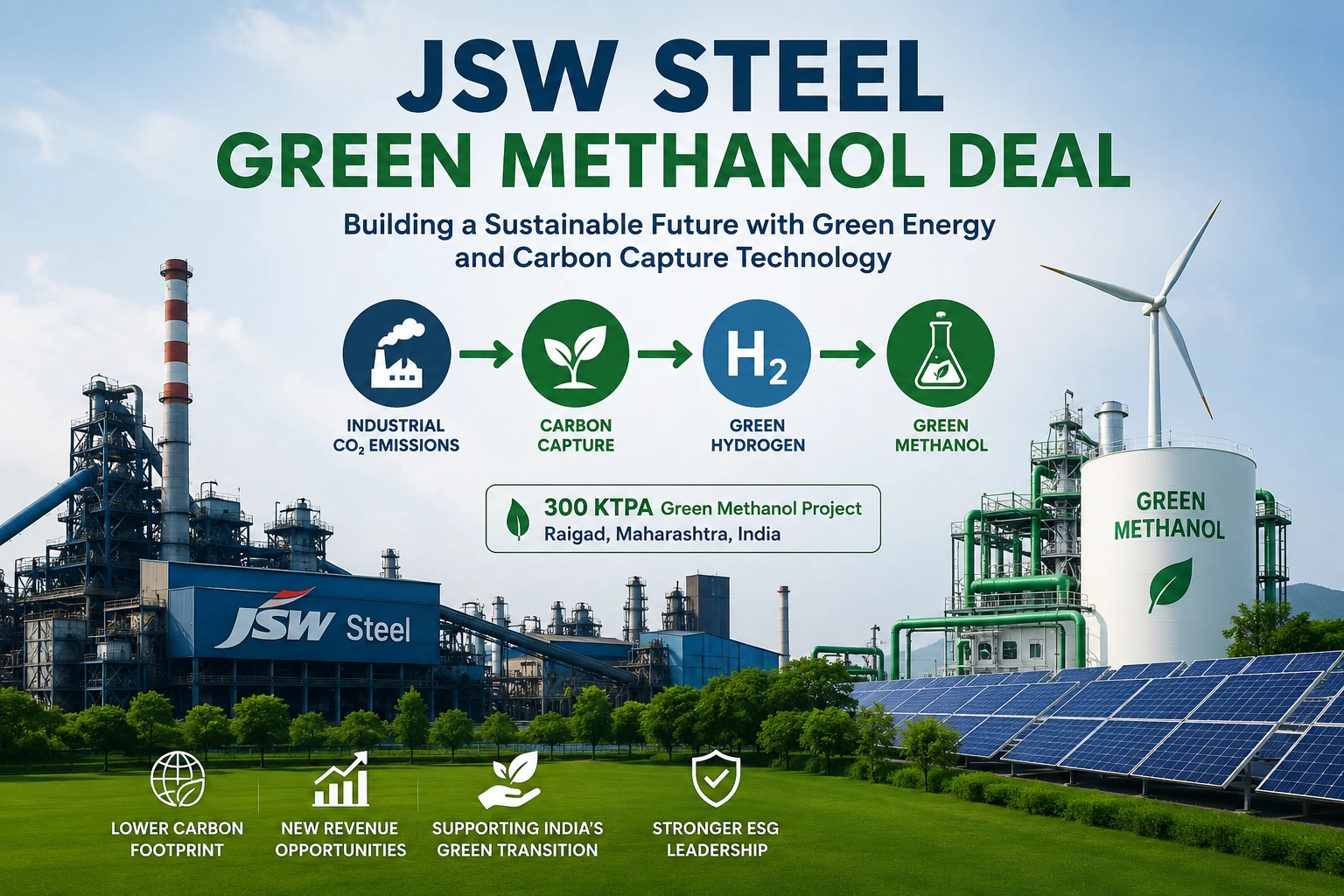
JSW Steel stock impact: 1 Massive Green Deal and Ultimate Price Forecast
Introduction to a Green Industrial Era 🌍
JSW Steel Green Methanol Deal became one of the biggest industrial sustainability announcements of 2026 after the company signed a strategic Nordic partnership focused on green fuel and carbon capture technology.The global steel industry is standing at a historic crossroads where traditional manufacturing meets aggressive climate technology. On May 25, 2026, JSW Steel Limited made a foundational move that could redefine its market value for the next decade. In a formal disclosure submitted to the National Stock Exchange of India (NSE) and the BSE Limited, the corporate giant announced a major international partnership.
Investors are tracking the long-term JSW Steel stock impact as the company builds out its sustainable energy infrastructure. The engineering marvel behind this news was formalized far from Mumbai, deep within the regulatory heart of Europe. During the prestigious 3rd India-Nordic Summit held in Oslo, Norway, JSW Steel signed a strategic Memorandum of Understanding (MoU).
This agreement brings together JSW Steel, Bharatia, and Carbon Iceland International. The main objective of this consortium is to establish a large-scale green methanol (eMethanol) development project inside India. This initiative turns industrial carbon waste into highly valuable, low-emission commercial fuel.
Table of Contents
The Architecture of the Deal: Oslo Commitments 🤝
The signing ceremony in Norway was not just another standard corporate event. The diplomatic and geopolitical importance of this green infrastructure deal was clear from the high-profile leaders in attendance. The MoU was witnessed by the Prime Minister of Iceland, Hon. Kristrún Frostadóttir, alongside the Icelandic Ambassador to India, H.E. Benedikt Höskuldsson.
Their presence highlights the growing strategic cooperation between India and the Nordic region around climate tech and heavy industrial transition. Key corporate leaders present at the event included Mr. Naresh Lalwani (EVP, JSW), Mr. Sanmit Ahuja (MD & CEO, Bharatia), Mr. Hal Oskarsson (CEO, Carbon Iceland), and Mr. Björn I. Victorsson (Chairman, Carbon Iceland).
This multi-party agreement combines massive industrial scale with specialized environmental engineering capabilities. JSW Steel provides the extensive physical infrastructure and capital base. Bharatia offers project development architecture and ecosystem integration through platforms anchored with institutions like IIT Kanpur. Meanwhile, Carbon Iceland International provides the proprietary technical frameworks for carbon capture integration and e-fuel production.
Technical Deep-Dive: Understanding the 300 KTPA Raigad Facility 🏗️
To calculate the clear JSW Steel stock impact, we must analyze the specific technical parameters of the proposed facility. The project is designed with a production capacity of 300 KTPA (Kilo-Tonnes Per Annum) of green methanol. The production facility will be located in the Raigad district of Maharashtra, an area where JSW already runs major manufacturing operations.
            [Industrial CO2 Emissions from JSW Raigad]
                                 +
           [Green Hydrogen from Renewable Energy Sources]
                                 │
                                 ▼
                  [Carbon Capture & Utilisation]
                                 │
                                 ▼
               [300 KTPA Green eMethanol Production]
The core process relies on advanced Carbon Capture and Utilisation (CCU) technologies. Instead of releasing carbon dioxide ($CO_2$) emissions from iron and steelmaking into the atmosphere, the Raigad plant will capture these gases directly from the source. The captured carbon is then chemically synthesized with green hydrogen, which is generated using dedicated renewable energy sources.
The initial scope focuses on using an existing high-purity $CO_2$ stream from JSW Steel’s current facility. Over time, the engineering plan will scale up to capture additional $CO_2$ emissions across their broader steel manufacturing operations. This creates a scalable decarbonization model that can be replicated throughout the Global South.
Why Green Methanol is a Game-Changer ⚡
Green methanol, or eMethanol, is rapidly becoming one of the most critical commodities in the global energy transition. Heavy transportation sectors, especially international maritime shipping, face strict regulatory mandates to eliminate fossil fuels. Because eMethanol remains liquid at ambient temperatures, it works well within existing bunkering infrastructure, making it a preferred alternative fuel for global shipping lines.
By entering this market early, JSW Steel changes its market positioning. It is no longer just a cyclical commodity producer vulnerable to raw material price swings. Instead, the company is positioning itself as a key supplier of sustainable chemical feedstocks and green fuels.
This helps protect the company against potential carbon taxes or border adjustment mechanisms, such as Europe’s CBAM. It also creates a new, non-cyclical revenue stream from green fuel sales, helping to balance out the traditional volatility of the domestic steel market.
Analyzing the Positive News Catalyst 📈
Strengthening Global ESG Leadership Credentials 🌿
Institutional investors globally are allocating capital based on Environmental, Social, and Governance (ESG) frameworks. This latest Nordic alliance significantly strengthens JSW Steel’s position as a top sustainable steelmaker. The company is already ranked #1 globally in the steel sector within the S&P Global Corporate Sustainability Assessment (CSA 2025).
It has also been recognized as a WorldSteel Sustainability Champion for eight consecutive years, from 2019 to 2026. Showing clear, capital-backed progress toward its goal of a 42% reduction in $CO_2$ emissions by 2030 helps de-risk its equity profile for large European and American green funds.
Creating Real Value from Industrial Waste Streams 💰
From a financial operations perspective, carbon dioxide has traditionally been viewed as an expensive environmental liability. This CCU project turns that liability into a commercial asset.
By converting industrial exhaust into a premium, low-carbon fuel, JSW Steel builds a higher-margin business line alongside its core steel manufacturing. This structural improvement can help expand the company’s operating profit margins over the long run.
Capitalizing on the Corporate Size of the JSW Group 🔋
JSW Steel is the primary driver of the $23 billion diversified JSW Group. The wider group has deeply integrated business interests spanning energy, infrastructure, cement, paints, and mobility.
This corporate structure provides JSW Steel with a distinct competitive advantage when executing large projects. JSW Energy can supply the affordable, large-scale renewable power needed to generate green hydrogen, while JSW Infrastructure can manage the logistics and export ports required to distribute the eMethanol to global markets.
Evaluating the Negative News Counter-Weights 📉
High Execution and Technology Risks ⚙️
While the fundamental concept of carbon capture and utilization is proven, building and running a 300 KTPA eMethanol facility involves significant engineering complexities. Large-scale green hydrogen production is still capital-intensive and highly sensitive to power costs.
Any extended delays during the technical validation or initial engineering phases could postpone the project’s financial returns. This might lead some short-term market participants to view the agreement as a distant, non-binding corporate roadmap.
Significant Capital Expenditure Demands 💸
JSW Steel is currently in a major organic growth phase, working to expand its total crude steel production capacity from 37.9 MTPA up to 54.8 MTPA over the next four years. This expansion already requires substantial capital expenditure.
Adding large climate-tech projects alongside this core expansion could stretch the company’s balance sheet if cash flows slow down. Investors must monitor the company’s leverage ratios and debt-to-equity levels to ensure these green initiatives do not impact near-term returns on capital.
Cyclical Realities of the Steel Industry 🌊
Even with highly positive green energy initiatives, JSW Steel’s short-term stock performance remains tied to global steel cycles, iron ore price fluctuations, and domestic construction activity.
If global steel margins contract due to weak demand or rising raw material costs, the positive sentiment from this ESG deal could be offset by near-term earnings pressures.
Immediate Price Impact: Tomorrow 🎯
When Indian equity markets open for trading tomorrow, the JSW Steel stock impact is expected to be mildly positive to highly stable. Stock market traders generally welcome strategic international MoUs, especially those backed by foreign governments and signed at major diplomatic events. The involvement of Iceland’s Prime Minister adds strong credibility to the project’s long-term viability.
From a technical trading perspective, expect to see early accumulation from institutional accounts that focus on ESG mandates. However, because this is an early-stage MoU progressing from a feasibility study to technical validation, it may not trigger an immediate runaway rally.
Instead, it sets a solid floor for the stock price, shielding it against broader market volatility tomorrow. The stock is likely to see higher trading volume, with key moving averages acting as immediate support lines.
Mid-Term Price Impact: Coming Weeks 📊
Over the next few weeks, the initial market excitement will settle, and analysts will begin updates on their financial models. The broader JSW Steel stock impact during this period will depend on how the market balances this green news against quarterly domestic steel production data and global pricing trends.
[Positive ESG Sentiment] ───► Balanced By ◄─── [Global Steel Margins & Domestic Demand]
Brokerage research reports will likely highlight the project’s potential to shield the company from upcoming global carbon taxes. Expect analysts to maintain steady to positive price targets, factoring in a slightly lower cost of capital due to the company’s strong ESG scoring.
If the company provides further details regarding the capital expenditure breakdown for the Raigad facility, it could act as an additional catalyst to support the stock’s performance relative to its domestic peers.
Long-Term Price Impact: Coming Months and Years 📈
Looking ahead several months, the JSW Steel stock impact will shift from sentiment-driven movements to milestones based on project execution. As the consortium advances through the technical validation and feasibility phases toward commercial-scale setup, the market can begin pricing in these future revenue streams.
JSW Steel Long-Term Capacity Growth Roadmap
- Current Capacity (2026): 37.9 MTPA
- Target Capacity (2030): 54.8 MTPA
- Vijayanagar Plant Target (FY30): ~25 MTPA (Projected to become the world’s largest single-location steel plant)
This long-term capacity expansion, combined with the transition toward green fuel infrastructure, positions the company for a potential structural re-rating.
If JSW Steel successfully executes the 300 KTPA eMethanol plant, it will demonstrate a viable carbon capture model for heavy industry. This could attract long-term sovereign wealth funds and global pension funds, helping support steady capital appreciation over the coming years.
Technical Analysis Indicators & Market Sentiment 🔍
The market’s reaction to this announcement aligns well with the stock’s long-term technical indicators. JSW Steel has consistently traded above its key long-term moving averages, demonstrating resilient institutional backing. The stock’s relative strength index (RSI) remains in balanced territory, indicating there is ample room for steady upward movement without entering overbought conditions.
Delivery percentages on the NSE and BSE show steady accumulation, confirming that long-term investors are steadily building positions rather than engaging in speculative day trading.
The low beta of the stock relative to the broader Nifty 50 index further underscores its defensive qualities during times of global market volatility. This makes it a foundational holding for investors looking for exposure to India’s industrial growth.
Strategic Evaluation: The Role of Partners 🧩
Understanding the JSW Steel stock impact requires a closer look at the roles played by the project partners. This project is structured to share risks and combine complementary operational strengths. JSW Steel provides the industrial scale and manufacturing footprint.
Bharatia acts as a key bridge between policy, technology, and finance. By leveraging its accelerator platforms and connections with academic research institutions, Bharatia helps ensure the project aligns with national bio-fuel mandates and clean energy funding.
Carbon Iceland International brings specialized global expertise in $CO_2$ capture and e-fuel production. This technology partnership reduces execution risk by ensuring the Raigad facility uses tested engineering designs for synthesis and carbon conditioning. This collaborative structure allows JSW Steel to pursue decarbonization without absorbing all the early-stage development risks alone.
Macro Trends: Decarbonization of the Global South 🌐
The partnership signed at the India-Nordic Summit highlights a larger macro trend: the decarbonization of heavy industry across developing economies. Historically, emerging economies resisted strict emissions targets, fearing they would slow industrial growth. This project demonstrates a new approach where economic expansion and carbon reduction can happen at the same time.
By producing green methanol domestically, India reduces its reliance on imported fossil fuels and builds a local clean energy supply chain. For JSW Steel, this alignment with national priorities opens up access to concessional green finance, low-interest sustainability bonds, and potential government incentives.
These factors help lower overall financing costs, directly benefiting equity shareholders over the long run.
Overall Verdict: Net Positive or Net Negative? ⚖️
When balancing the immediate capital requirements against the long-term strategic advantages, this development is a clear net positive for long-term investors. The partnership addresses the steel industry’s biggest existential challenge—carbon emissions—and transforms it into a viable business model.
While short-term price movements will always be influenced by global steel demand and raw material cycles, the strategic shift toward green infrastructure enhances the company’s long-term value. JSW Steel is effectively demonstrating that heavy industrial manufacturing can successfully adapt to a low-carbon economy.
Investor Takeaways: How to Navigate the Stock 🎯
For retail and institutional investors, the JSW Steel stock impact highlights the value of a patient, long-term investment approach. Sharp trading reactions around early-stage MoUs often clear path for steady accumulation during standard market corrections.
Investors should monitor key project milestones over the coming months, including the completion of the technical feasibility assessments and the formal allocation of capital for the Raigad facility.The success of the JSW Steel Green Methanol Deal will depend on project execution, renewable energy integration, and carbon capture scalability.
Maintaining a balanced position in JSW Steel allows investors to participate in India’s domestic infrastructure growth while gaining exposure to the emerging green hydrogen and eMethanol economies.
Final Thoughts on Industrial Evolution 🌅
The partnership between JSW Steel, Bharatia, and Carbon Iceland International shows how traditional manufacturing is evolving. By capturing carbon emissions in Maharashtra and converting them into next-generation marine fuel, JSW Steel is expanding its business model beyond traditional steel production.
As the company works toward its target of 54.8 MTPA capacity, integrating sustainable practices early helps ensure its future competitiveness. For the smart investor, tracking the evolving JSW Steel stock impact offers a clear view into how heavy industry is adapting to a sustainable, low-emission future.
Frequently Asked Questions ❓
What was the main announcement made by JSW Steel on May 25, 2026?
JSW Steel signed a strategic MoU with Bharatia and Carbon Iceland International during the 3rd India-Nordic Summit in Oslo, Norway, to develop a 300 KTPA green methanol project in India.
Where will the proposed green methanol project be located?
The production facility is planned for the Raigad district in Maharashtra, utilizing carbon dioxide emissions from JSW Steel’s local industrial operations.
What are JSW Steel’s long-term carbon emission targets?
JSW Steel aims to reduce its carbon emissions by 42% by the year 2030 and has committed to achieving net-neutral carbon emissions across its direct operations by 2050.
How does this green methanol project impact JSW Steel’s business model?
It converts industrial carbon emissions into a valuable, low-carbon fuel asset. This creates a new revenue stream and improves the company’s global ESG profile.
What is the short-term expected JSW Steel stock impact?
The near-term stock impact is expected to be positive and stable, driven by favorable institutional sentiment around the company’s sustainability initiatives.
What is the planned production capacity of the new green methanol plant?
The project is designed to reach an initial production capacity of 300 KTPA (Kilo-Tonnes Per Annum) using carbon capture and utilization pathways.
Disclaimer
This professional stock market analysis blog post is intended solely for educational and informational purposes and should not be considered financial, investment, or trading advice. Stock market investments are subject to market risks. Always conduct your own research and consult a certified financial advisor before making any investment decisions.
Read Another Article
Stay updated on the latest Nifty 50 stock movements and corporate news with our detailed analyses:
HDFC Bank Annual Report Analysis 2026: 5 Massive Secrets Unveiled 📈. Read here