





HDFC Bank Annual Report Analysis 2026
Welcome, smart investors! Today, we are cracking open the massive annual report of India’s banking giant. This comprehensive HDFC Bank Annual Report Analysis 2026 breaks down everything into simple, easy-to-understand language so you can make informed decisions about your hard-earned money.
This HDFC Bank Annual Report Analysis 2026 reveals how the bank is preparing for the next phase of India’s banking expansion.Banking in India is shifting rapidly, and looking at the past year’s performance gives us vital clues about what lies ahead. Let us dive deep into the numbers, management strategies, and hidden details of this financial powerhouse. 🔍
Table of Contents
Company Business Summary: The Financial Empire 🏛️
HDFC Bank has solidified its crown as India’s largest private sector bank by balance sheet size. Following its mega-merger with HDFC Limited, it has transformed into a financial supermarket. The bank now offers everything from basic savings accounts to complex corporate loans, home loans, and insurance products under one massive roof.
The bank serves over 9.7 crore customers through an extensive network of 9,455 branches. What is truly amazing is its reach into rural India. More than half of its physical branches are located in semi-urban and rural areas, tapping into the rising wealth of the Indian countryside.
Apart from the core banking business, the group boasts an incredible array of subsidiaries. This includes giants like HDFC Life Insurance, HDFC ERGO General Insurance, HDFC Asset Management Company, and HDFC Securities. This structural shift gives the bank an unmatched cross-selling edge across India.
Revenue Growth Analysis and CAGR Trends 📊
When we look closely at this detailed HDFC Bank Annual Report Analysis 2026, the revenue engine shows impressive resilience. The total income of the bank reached a staggering ₹3,46,149.3 crore for the financial year.
This massive top-line growth is driven primarily by core interest earned from advances and a healthy jump in fee-based income.
Net Interest Income, which is the core money a bank earns from lending minus what it pays on deposits, grew by 13.0% to hit ₹1,22,670.1 crore. The Net Interest Margin stood steady at 3.48%, showing that the bank can protect its core profit spreads even in a tough, high-interest-rate environment.
One major highlight from the HDFC Bank Annual Report Analysis 2026 is the strong resilience in net interest income growth.While sequential year-on-year numbers are not perfectly comparable due to the full integration of HDFC Limited’s operations, the broader multi-year revenue CAGR remains strongly in the double digits. This steady compounding proves that the bank’s earning capacity remains fully intact post-merger.
Net Profit Analysis and Profitability Growth 💸
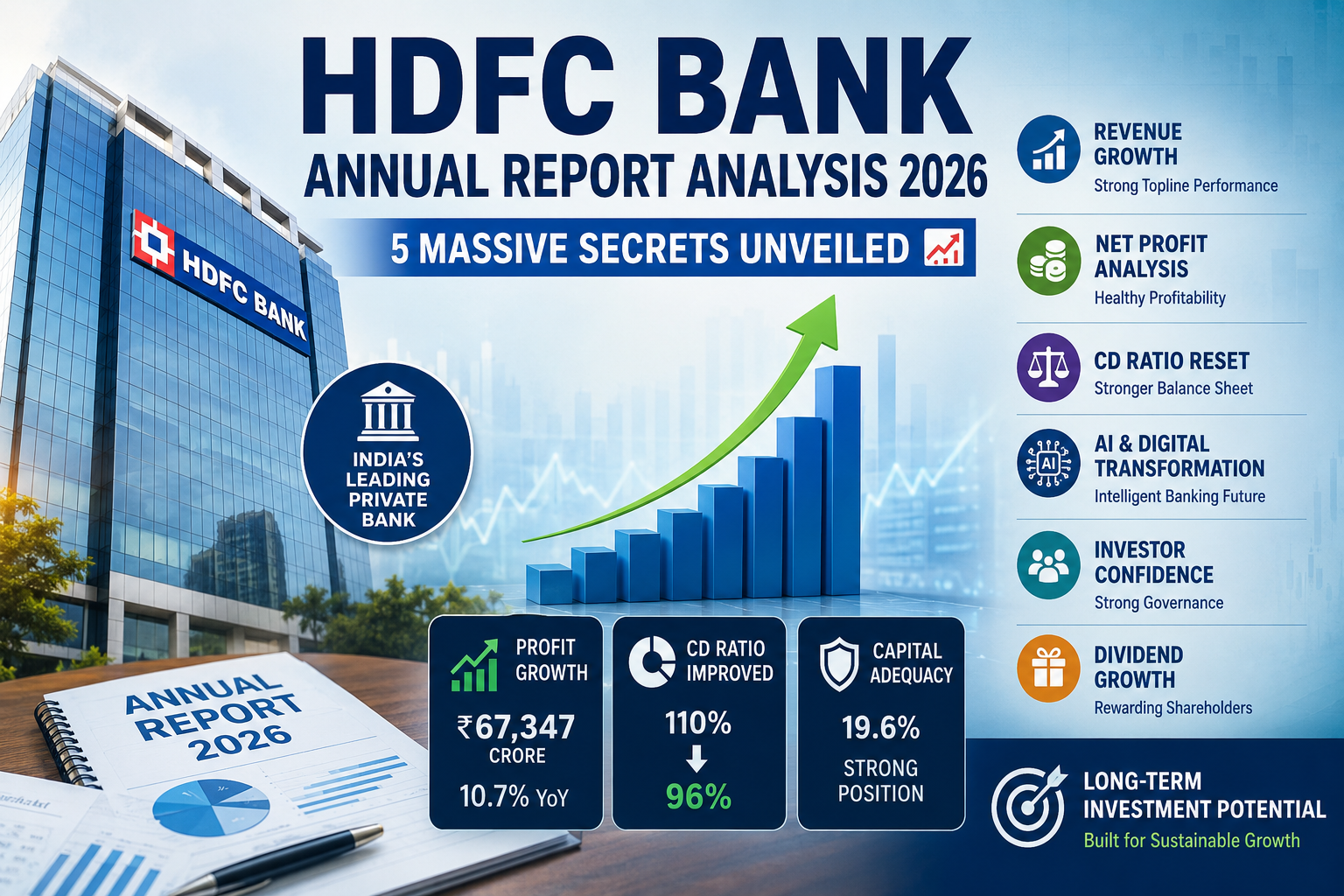
Profitability is where the bank truly flexes its muscles. Profit After Tax jumped by 10.7% to arrive at ₹67,347 crore. Generating this level of pure profit while absorbing a massive merger is a testament to the bank’s operational efficiency.
The Earnings Per Share rose to ₹88.3, giving shareholders solid value. However, because of the expanded capital base after the merger, the Return on Equity came in at 14.6%, down slightly from 16.1% in the previous year. This is a natural cooling period as the bank optimizes its massive new balance sheet.
According to the HDFC Bank Annual Report Analysis 2026, profitability remains highly stable despite post-merger adjustments.The Return on Average Assets stood healthy at 1.91%. For a bank of this gigantic scale, keeping the ROA close to the 2% mark is highly commendable and indicates that assets are being deployed very prudently to generate returns.
Debt, Liabilities, and the Critical CD Ratio Reset ⚖️
Lending institutions run on liabilities, and the past year was all about a massive balance sheet cleanup. At the time of the merger, the bank inherited a large amount of high-cost wholesale liabilities, pushing its Credit-to-Deposit ratio to an uncomfortable 110%.
Management took aggressive, affirmative action during the year to fix this imbalance. They intentionally slowed down loan growth to focus heavily on deposit mobilization. As a result, deposits grew 2.5 times faster than loans, rising 14.1% to reach ₹27,14,715 crore. Total advances grew at a tempered pace of 5.4% to reach ₹26,19,609 crore.
Thanks to this deliberate strategy, the CD ratio dropped down to a much safer 96%. Furthermore, high-cost borrowings were pared down to just 14% of the funding mix. This massive reset provides a clean, highly stable liability base to fuel future high-margin loan growth.
Cash Flow Analysis: The Underlying Liquidity 🌊
An equity research study requires analyzing how money flows in and out. The bank maintained an exceptionally robust liquidity buffer throughout the year. Cash inflows from retail deposits remained highly granular and sticky, which is the ultimate shield for any large bank during volatile times.
The bank’s liquidity management ensured full compliance with regulatory reserve mandates. The Treasury department actively managed a high-quality portfolio of government securities to support everyday cash requirements and buffer against market fluctuations.
With the deliberate reduction of high-cost wholesale market borrowings, the bank’s structural liquidity profile has become significantly more self-sustaining, relying on everyday retail savers rather than volatile institutional money markets.
Promoter Holding, Pledged Shares, and Confidence Signals 🤝
Here is a fascinating piece of corporate intelligence that every retail investor must understand: HDFC Bank is a widely held financial institution with no traditional “promoter group.” Since HDFC Limited merged into the bank, it operates purely as a professionally managed company owned by public and institutional shareholders.
Because there are no traditional promoters, the percentage of pledged shares stands at absolute zero. This removes any risk of forced market liquidations or promoter-driven financial stress, which is a massive green flag for conservative investors.
Management confidence remains exceptionally high. Key executives and directors hold meaningful personal stakes in the bank, aligning their financial incentives directly with the long-term wealth creation of regular retail shareholders.
Deep Dive: Risk Factors and Management Risks ⚠️
No investment is entirely risk-free, and this comprehensive HDFC Bank Annual Report Analysis 2026 highlights several key risk areas. On the macroeconomic front, rising protectionism, global geopolitical conflicts, and trade realignments present persistent headwinds that could impact corporate credit quality.
Domestically, the bank faces intense competition for low-cost retail deposits across the banking sector. This can lead to higher funding costs if interest rates remain elevated for longer periods. Additionally, managing a workforce of over 2.14 lakh employees across thousands of locations requires impeccable operational control.
Asset quality saw a very marginal softening, with the Gross NPA ratio ticking up to 1.33% from 1.24%. While this remains incredibly low by industry standards, it signals that retail and small business portfolios require continuous, highly vigilant monitoring.
Future Expansion Plans and Capex Strategy 🚀
The bank is moving forward with a highly clear growth roadmap. After spending a year focusing on consolidation and taking “singles,” management has explicitly stated that they are now fully positioned to go for the “boundaries” in terms of growth.
The bank added over 700 physical branches during the past year and plan to keep expanding their physical footprint. Management strongly believes that physical branches are essential customer experience hubs that drive long-term deposit collection.
On the corporate front, the bank is expanding its reach into construction finance and Lease Rental Discounting. They are targeting a presence in eight additional cities for their real estate finance cluster, unlocking massive cross-sell opportunities for home loans.
AI and Digital Transformation Plans: The Intelligent Core 🤖
HDFC Bank is undergoing a massive, silent technological evolution. The bank has successfully transitioned its core banking system to a next-generation engineered platform built for extreme speed, agility, and massive scalability.The HDFC Bank Annual Report Analysis 2026 also highlights the bank’s aggressive AI and digital banking transformation roadmap.
The bank is moving entirely away from old, rigid systems through its “Hollow the Core” initiative. A staggering 97% of all financial transactions are now executed seamlessly through digital channels. The bank has also launched fully redesigned, hyper-personalized versions of its mobile and internet banking platforms.
What is most exciting is the structured adoption of Generative AI. Management has moved past simple pilots to create a centralized GenAI platform, launching over 15 distinct “lighthouse programs”. These advanced AI tools are being used to automate complex operations, boost staff productivity, and deliver instant customer service.
Operating Margin and Key Financial Ratios Trends 📈
Let us break down the vital health indicators of the bank in simple investor language. The Cost-to-Income ratio stood steady at 40.5%. This shows that despite massive tech investments and branch expansions, the bank maintains excellent control over its operational overheads.
The asset quality remains best-in-class. The Net NPA ratio stands at a minuscule 0.43%, backed by a highly comfortable Provision Coverage Ratio of 67.86%. This means the bank has built a massive financial cushion to absorb any unexpected bad loans.
Capital adequacy is exceptionally strong at 19.6%, which is way above the regulatory minimums. This massive capital buffer ensures the bank is perfectly safe and has plenty of firepower to accelerate its lending activities as the Indian economy expands.
Dividend Analysis: Rewarding Shareholders 🎁
For income-seeking investors, the bank continues to be a highly reliable wealth compounder. The Board of Directors proposed a healthy dividend of ₹22.0 per equity share. This represents a solid 12.8% jump compared to the ₹19.5 dividend paid out in the previous financial year.
This steady increase in dividend payouts proves that the bank’s cash generation capabilities are incredibly robust. Management is successfully balancing the need to retain capital for future business expansion while consistently rewarding loyal retail shareholders with cash payouts.
Institutional Investor Insights and Corporate Governance 🏛️
As a Domestic Systemically Important Bank, HDFC Bank faces the absolute highest level of regulatory scrutiny and oversight. The bank undertook a massive transformation of its compliance function over the past year to ensure absolute regulatory excellence.
The board is highly independent, with 7 out of 13 directors being independent professionals. Corporate governance practices are world-class, with zero tolerance for ethical lapses. Related party transactions are handled with strict arm’s-length discipline and disclosed transparently to the exchanges.
Independent auditor reports came back completely clean with no major adverse remarks. This clean bill of health gives massive comfort to large domestic mutual funds and foreign institutional investors, who continue to hold a commanding stake in the bank’s equity base.
Value Addition: Industry Growth Opportunities 🌟
The medium-term structural growth story for Indian banking is incredibly bright. With India holding steady as one of the fastest-growing major global economies, credit demand across infrastructure, manufacturing, and housing is poised to accelerate.
The formalization of the economy, driven by digital footprints and tax compliance tools like GST, is unlocking a massive new pool of lendable retail and MSME customers. HDFC Bank’s deep presence across 2.35 lakh Indian villages positions it perfectly to capture this massive rural wealth wave.
Furthermore, the bank’s ability to cross-sell home loans to its massive existing customer base is a game-changer. Currently, over 95% of new home loan customers open savings accounts with the bank, turning them into highly profitable, lifetime primary banking relationships.
Hidden Red Flags and Negative Signals 🔎
To deliver an authentic equity research review, we must highlight areas that require careful investor monitoring. First, loan growth was heavily restricted at just 5.4% this year. While this was a deliberate management choice to lower the CD ratio, it means top-line growth could remain soft for a few more quarters.
Second, the slight increase in Gross NPAs to 1.33% shows that minor stress is creeping into pockets of the retail or small business segments due to high interest rates. Third, operating in a highly regulated landscape means any sudden regulatory changes by the RBI regarding risk weights can impact profitability margins.
Share Price Impact and Long-Term Investment Potential 🚀
In the short term, the stock price might consolidate as the market fully processes the slower loan growth and the cooling of the Return on Equity post-merger. However, stock markets are forward-looking engines.
The complete reset of the CD ratio from 110% down to 96% is a massive structural victory. The bank has successfully digested the mega-merger, cleaned up its liability profile, and built a state-of-the-art digital core.
📈For long-term investors with a multi-year horizon, this consolidation phase offers an exceptional accumulation window. The bank is essentially a leveraged bet on the growth of the Indian economic story, backed by flawless corporate governance and best-in-class risk management.
Bullish and Bearish Case Conclusion 🎯
Let us wrap up this extensive HDFC Bank Annual Report Analysis 2026 with a balanced, clear conclusion for smart wealth creators.
The Bullish Case: The bank has successfully cleared its post-merger liability hurdles, bringing the CD ratio down to a safe 96%. With a clean balance sheet, a powerful digital core, massive capital adequacy of 19.6%, and an incredible cross-selling engine across 14 subsidiaries, the bank is fully primed to accelerate profitable market share capture in the coming years.
The Bearish Case: Intense competition for low-cost retail deposits could keep funding costs elevated, capping immediate net interest margin expansions. If global geopolitical headwinds cause a sharp slowdown in domestic private capital expenditure, the bank’s corporate loan growth could face near-term pressure.
Ultimately, the structural strengths far outweigh the temporary cyclical hurdles. HDFC Bank remains a foundational financial powerhouse for any long-term Indian equity portfolio. 🌟
Disclaimer
This professional stock market analysis blog post is intended solely for educational and informational purposes and should not be considered financial, investment, or trading advice. Stock market investments are subject to market risks. Always conduct your own research and consult a certified financial advisor before making any investment decisions.
Read Another Article
Stay updated on the latest Nifty 50 stock movements and corporate news with our detailed analyses:
L&T Boardroom Transition Impact on Share Price: Major Governance Update Sends Signals to Investors in 2026. Read here