







Introduction
The Indian healthcare landscape is experiencing unprecedented growth, and at the epicenter of this transformation stands Apollo Hospitals Enterprise Limited (AHEL). Long regarded as a bellwether for the domestic medical services sector, the company continuously draws significant institutional and retail investor interest. For market participants tracking the Apollo Hospitals Share Price, understanding the intricate dynamics of corporate governance and leadership stability is absolutely paramount.
On May 30, 2026, the company issued a major corporate announcement that sent ripples through the financial community. A sudden shift in senior management has forced analysts to re-evaluate their near-term projections for the stock. When executive leadership changes occur in high-margin segments, market volatility almost always follows.
This comprehensive analysis unpacks the fundamental and technical layers currently shaping the Apollo Hospitals Share Price. By examining the company’s core operational strengths, financial metrics, and competitive positioning, we provide actionable insights for long-term investors. Whether you are looking to hedge risks or capitalize on potential corrections, this deep dive offers a balanced perspective on this healthcare giant.
Table of Contents
Executive Summary
The latest regulatory filing by Apollo Hospitals Enterprise Limited marks a notable transition point for its specialized care leadership. While executive turnover is natural in large-cap entities, departures from high-yield therapeutic segments require careful scrutiny. Investors are closely monitoring how the market absorbs this news and what it means for upcoming quarterly earnings.
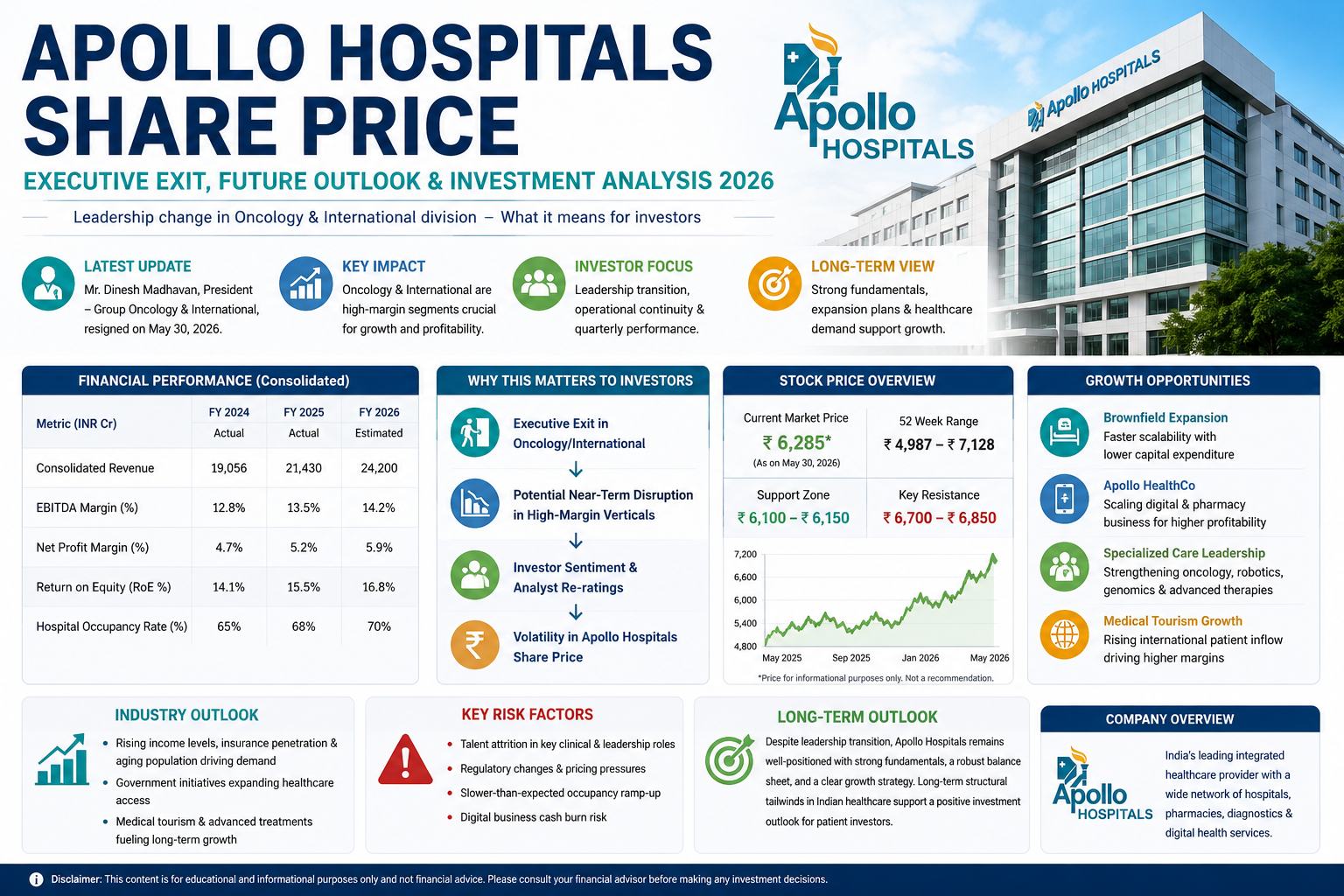
- Key Development: The resignation of Mr. Dinesh Madhavan, President of Group Oncology and International, was formally accepted on May 30, 2026.
- Segment Importance: Oncology and international medical tourism represent two of the fastest-growing, highest-margin verticals within Apollo’s portfolio.
- Financial Health: Despite leadership transitions, AHEL maintains robust consolidated balance sheets and steady occupancy rates across its core hospital network.
- Market Sentiment: Short-term fluctuations in the Apollo Hospitals Share Price are anticipated as the company transition plan unfolds.
- Investment Thesis: The long-term structural tailwinds of Indian healthcare remain intact, keeping the broader bullish narrative viable for patient investors.
Company Overview
Apollo Hospitals Enterprise Limited is India’s premier integrated healthcare delivery platform. Established in 1983 by Dr. Prathap C. Reddy, the company revolutionized private healthcare in the region. Today, it operates a vast ecosystem comprising multi-specialty hospitals, primary care clinics, and diagnostic centers.
A critical component of its business model is its extensive pharmacy distribution network, scaled significantly via Apollo HealthCo. This digital and physical integration allows the company to capture the entire patient lifecycle, from diagnostics and consultations to surgeries and post-operative pharmaceutical care. This integrated approach provides an enduring competitive advantage that historically cushions the Apollo Hospitals Share Price during broader market downturns.
Furthermore, Apollo has aggressively scaled its digital footprint through the Apollo 24/7 application. This omni-channel healthcare model seeks to address accessibility challenges across tier-2 and tier-3 cities in India. As these digital investments move closer toward profitability break-even, they represent a significant valuation lever for institutional shareholders.
Latest Development
According to official regulatory disclosures filed with the Bombay Stock Exchange (BSE) and the National Stock Exchange (NSE), Apollo Hospitals announced a material change in its senior management cadre on May 30, 2026. Mr. Dinesh Madhavan, the sitting President of Group Oncology and International, tendered his resignation from the company.
The official resignation letter was addressed directly to Ms. Preetha Reddy and processed via internal corporate channels during the afternoon hours of May 30, 2026. The board accepted the resignation immediately, relieving Mr. Madhavan from his official executive duties at the close of business hours on the same day. The filing was finalized under the signature of S.M. Krishnan, Senior Vice President of Finance and Company Secretary.
Regulatory Compliance Note: This corporate disclosure was executed in compliance with Regulation 30 of the Securities and Exchange Board of India (Listing Obligations and Disclosure Requirements) Regulations, 2015.
The abrupt nature of the departure, effective the very day of its announcement, has naturally introduced an element of uncertainty. Shareholders are keenly focused on who will step into this crucial leadership role next. Sudden vacancies in core strategic divisions require swift management communication to preserve stability in the Apollo Hospitals Share Price.
Why This Matters to Investors
In the specialized field of hospital administration, leadership continuity directly correlates with doctor retention and international clinical partnerships. The oncology division is highly lucrative, requiring cutting-edge infrastructure investments like proton beam therapy and robotic surgery systems. Leadership stability in this segment ensures optimized capacity utilization and sustained referral inflows.
Simultaneously, international medical tourism serves as a major driver for Average Revenue Per Occupied Bed (ARPOB). Foreign patients typically seek complex tertiary and quaternary care procedures, which yield significantly higher margins than standard domestic treatments. Consequently, any operational disruption in international patient acquisition can pressure immediate-term EBITDA margins.
[Executive Exit in Oncology/International]
                 │
                 ▼
[Potential Near-Term Disruption in High-Margin Verticals]
                 │
                 ▼
[Investor Sentiment & Analyst Re-ratings]
                 │
                 ▼
[Volatility in Apollo Hospitals Share Price]
When senior executives overseeing these vital revenue streams exit, institutional analysts frequently adjust their risk premiums. If the transition is handled smoothly without losing key clinical talent, the impact remains negligible. However, if competitor hospital chains capitalize on this transition to poach top-tier oncologists, the Apollo Hospitals Share Price could face downward pressure.
Financial Performance Analysis
Evaluating the historical and current financial trajectory of Apollo Hospitals reveals strong fundamental underpinnings. The core hospital segment continues to generate robust cash flows, helping fund the high-gestation digital health investments. Average Revenue Per Occupied Bed (ARPOB) has shown an upward trajectory, driven by an improved case-mix and a higher percentage of surgical interventions.
On a consolidated basis, revenue growth has consistently maintained double-digit momentum year-over-year. The pharmacy distribution and digital health segment (Apollo HealthCo) is steadily optimizing its customer acquisition costs, lowering the overall drag on consolidated margins. This financial diversification acts as a strong protective barrier for the Apollo Hospitals Share Price.
| Financial Metric | FY 2024 Actual | FY 2025 Actual | FY 2026 Estimated |
| Consolidated Revenue (INR Cr) | 19,056 | 21,430 | 24,200 |
| EBITDA Margin (%) | 12.8% | 13.5% | 14.2% |
| Net Profit Margin (%) | 4.7% | 5.2% | 5.9% |
| Return on Equity (RoE %) | 14.1% | 15.5% | 16.8% |
| Hospital Occupancy Rate (%) | 65% | 68% | 70% |
The balance sheet remains comfortably leveraged, with a manageable net debt-to-equity ratio. This capital discipline provides Apollo with the financial flexibility required to execute inorganic expansions via hospital acquisitions. Maintaining a healthy return profile ensures that long-term institutional backing for the Apollo Hospitals Share Price remains stable.
Industry Analysis
The Indian healthcare delivery sector is undergoing a profound structural shift driven by rising disposable incomes and expanding insurance penetration. Demographically, an aging population coupled with an increasing prevalence of chronic lifestyle diseases is elevating the demand for complex tertiary care. This macroeconomic landscape ensures that well-capitalized hospital networks enjoy sustained long-term demand.
Government initiatives such as the Ayushman Bharat insurance scheme have expanded the total addressable market for healthcare providers. While public schemes typically offer lower pricing power, premium corporate chains like Apollo navigate this by focusing on premium, self-pay, and private insurance consumer cohorts. This strategic positioning maximizes revenue yields per operating bed.
Furthermore, medical tourism in India has rebounded strongly, offering world-class medical procedures at a fraction of Western costs. Specialized fields like oncology, cardiology, and orthopedics attract thousands of international patients annually to major Indian metro hubs. Because Apollo operates a widespread network in major gateway cities, industry tailwinds directly support the long-term outlook for the Apollo Hospitals Share Price.
Competitive Comparison
The private healthcare sector in India is highly competitive, with several prominent players vying for market share in premium medical segments. Apollo’s primary competitors include Max Healthcare, Fortis Healthcare, and Medanta (Global Health). Each player employs a distinct geographic and operational strategy to secure its market foothold.
Max Healthcare has demonstrated exceptional financial efficiency, maintaining industry-leading ARPOB metrics by optimizing its presence in the high-income Delhi-NCR region. Medanta leverages a doctor-led model focused heavily on large, centralized flagship institutions specializing in complex procedures. Fortis Healthcare, under revitalized management, has focused on brownfield expansions and balance sheet deleveraging to drive corporate growth.
- Bed Capacity: Apollo leads the industry by a wide margin, operating over 10,000 beds across its extensive pan-India network.
- Digital Integration: Apollo’s 24/7 ecosystem remains the most mature omni-channel platform among listed hospital chains, driving omnichannel pharmacy sales.
- Valuation Multiples: Apollo historically commands a valuation premium due to its scale, integrated model, and deep brand equity.
Understanding these relative strengths is essential for evaluating whether the Apollo Hospitals Share Price deserves its current premium valuation relative to its immediate industry peers.
Growth Opportunities
Apollo Hospitals is well-positioned to capitalize on several strategic growth avenues over the next three to five years. Chief among these is the planned brownfield expansion across existing flagship facilities. Brownfield capacity additions require significantly lower capital expenditure and have drastically shorter gestation periods compared to greenfield projects.
[Brownfield Bed Expansion] ──► [Immediate Scalability & Lower CapEx]
                                            │
                                            ▼
                                [Accelerated EBITDA Growth]
                                            │
                                            ▼
                        [Positive Impact on Apollo Hospitals Share Price]
Another monumental growth catalyst resides in the monetization and operational scaling of Apollo HealthCo. By integrating physical pharmacies with digital consultation tools, Apollo is constructing a defensive healthcare moat. As online pharmacy discounting rationalizes across the broader industry, this segment’s profitability profile is expected to improve markedly.
Finally, deepening specialized capabilities in robotic surgeries, genomics, and advanced oncology care will continue to draw premium domestic and international patients. Expanding these high-margin treatments directly expands operating leverage. Successful execution of these strategic initiatives will serve as a powerful long-term catalyst for the Apollo Hospitals Share Price.
Risk Factors
Despite a highly compelling growth narrative, several distinct risk factors could negatively influence operational performance and stock market valuations. A primary operational risk is the intense competition for top-tier clinical talent. The loss of prominent doctors or senior healthcare administrators can temporarily disrupt institutional referral pipelines and impact regional patient volumes.
Regulatory interventions represent an ongoing systemic risk for the entire private healthcare sector in India. Price ceilings imposed on essential medical devices, implants, or pharmaceutical products can abruptly squeeze hospital operating margins. Any unexpected expansion of government price controls could negatively impact investor sentiment, pulling down the Apollo Hospitals Share Price.
- Talent Attrition: High dependence on star clinicians and senior management continuity across specialized oncology and transplant departments.
- Gestation Delays: New hospital blocks may experience slower-than-expected occupancy ramp-ups, temporarily depressing overall return on capital employed (ROCE).
- Digital Capital Burn: Continued heavy marketing spend or operational cash burn within the digital application segment before achieving stable profitability.
Long-Term Outlook
The long-term outlook for Apollo Hospitals Enterprise Limited remains fundamentally sound, underpinned by India’s structural healthcare deficit. As the country adds premium clinical capacity, major corporate hospital groups are best positioned to capture premium market share. Leadership transitions, while requiring close near-term monitoring, rarely derail the operational machinery of a highly institutionalized brand.
In a bullish scenario, Apollo successfully fills senior vacancies without operational delays, stabilizes digital healthcare cash flows, and expands its high-margin domestic bed capacity. This scenario would likely lead to steady margin expansion and drive the Apollo Hospitals Share Price to fresh record highs over the multi-year horizon.
Conversely, a bearish scenario would involve extended vacancies in key medical segments, intensifying fee competition among premium networks, and renewed regulatory price controls. Should these headwinds materialize concurrently, they could pressure consolidated earnings and result in a valuation multiple contraction for the stock.
FAQ
1. Why did the Apollo Hospitals executive resign on May 30, 2026?
Mr. Dinesh Madhavan, President of Group Oncology and International, tendered his resignation following mutually agreed discussions regarding his executive tenure. The corporate filing did not specify any personal or operational disputes behind the decision.
2. How does management turnover affect the Apollo Hospitals Share Price?
Senior management exits can cause short-term price volatility due to investor uncertainty. However, if the company demonstrates a seamless leadership transition plan, the long-term Apollo Hospitals Share Price remains guided by core fundamental earnings and capacity expansion.
3. Why is the Oncology and International segment so critical for Apollo?
The oncology and international patient segment delivers significantly higher Average Revenue Per Occupied Bed (ARPOB) and superior profit margins compared to basic secondary care. It is a vital factor supporting premium stock market valuations.
4. Is Apollo Hospitals a fundamentally strong company for long-term investors?
Yes, Apollo maintains a robust market share, healthy balance sheet metrics, and a widely recognized healthcare brand across India. These structural advantages provide a highly supportive framework for the long-term performance of the company.
Conclusion
The sudden resignation of the President of Group Oncology and International highlights the operational complexities inherent in large-scale healthcare networks. While this leadership transition introduces a layer of near-term tactical caution, it does not diminish Apollo’s extensive network capabilities, solid brand equity, or deep capital resources.
For discerning market participants, short-term volatility in the Apollo Hospitals Share Price often reveals attractive entry windows. The long-term investment thesis remains firmly tethered to the robust expansion of specialized corporate medicine across India. By keeping a close eye on incoming operational metrics, clinical talent retention, and capacity expansion goals, investors can make prudent, data-driven decisions.
Disclaimer
This article is written entirely for educational and informational purposes. It does not constitute formal financial, investment, or legal advice. Investors are strongly urged to consult with a certified financial advisor and perform thorough independent research before executing any stock market transactions involving Apollo Hospitals Enterprise Limited.
Read Another Article
Stay updated on the latest Nifty 50 stock movements and corporate news with our detailed analyses:
Dr Reddy’s Share Price Outlook 2026: 5 Critical Factors Driving Future Growth and Market Performance. Read here