

Dr. Reddy’s Stock Analysis: 5 Crucial Factors Driving the Ultimate 2026 Price Shift
Dr Reddy’s Share Price Outlook 2026 is attracting significant investor attention as the global pharmaceutical landscape undergoes a major structural transformation. At the center of this shift stands India’s generic pharmaceutical giant, Dr. Reddy’s Laboratories Ltd. Following the submission of its Form 20-F annual report to the U.S. Securities and Exchange Commission (SEC) on May 30, 2026, investors are closely examining the company’s financial performance, growth opportunities, and future challenges. This comprehensive analysis explores the key factors, geographic developments, and profitability trends that could shape Dr. Reddy’s share price performance in the months ahead.
Investing in pharmaceutical stocks requires looking past basic top-line numbers. It demands a deep understanding of pipeline dynamics, regulatory compliance, and cross-border currency movements. Let’s look beyond the surface of their latest fiscal reporting to see what it means for your portfolio tomorrow, next week, and in the months ahead. 💊
Table of Contents
Financial Health Check: A Quantitative Dr. Reddy’s Stock Analysis
When conducting a granular Dr. Reddy’s Stock Analysis, the first element that stands out is the stark divergence between top-line growth and bottom-line profitability. For the fiscal year ended March 31, 2026, Dr. Reddy’s reported a consolidated revenue of Rs. 335,933 million ($3,580 million), representing a modest 3% growth compared to the Rs. 325,535 million recorded in the previous fiscal year.
However, if you strip away the favorable impact of exchange rate fluctuations—specifically the appreciation of the U.S. Dollar, Euro, and Russian Rouble against the Indian Rupee—actual revenues dropped by 2% on a constant currency basis. This top-line stagnation was primarily driven by severe price erosion of core products in the United States, notably the generic oncology drug Lenalidomide.
The real squeeze, though, shows up in the profitability margins. Gross profit for the year slid down to Rs. 177,264 million, dropping the gross margin from a healthy 58.5% in FY25 to 52.8% in FY26. This compression was exacerbated by an expansion in Selling, General, and Administrative (SG&A) expenses, which rose 14% to Rs. 106,763 million. Consequently, Profit Before Tax (PBT) plummeted by 29% to Rs. 54,817 million.
| Consolidated Income Statement Metrics | FY2024 (Rs. in Millions) | FY2025 (Rs. in Millions) | FY2026 (Rs. in Millions) | YoY Change (%) |
| Gross Revenues | 279,164 | 325,535 | 335,933 | +3.2% |
| Cost of Revenues | 115,557 | 135,107 | 158,669 | +17.4% |
| Gross Profit | 163,607 | 190,428 | 177,264 | -6.9% |
| SG&A Expenses | 77,201 | 93,870 | 106,763 | +13.7% |
| R&D Expenses | 22,873 | 27,380 | 24,058 | -12.1% |
| Impairment Losses | 3 | 1,693 | 3,519 | +107.9% |
| Profit Before Tax (PBT) | 54,817 | 76,784 | 54,817 | -28.6% |
| Net Profit for the Year | 42,466 | 57,245 | 42,466 | -25.8% |
Geographic Performance Breakdown: Wins and Losses
To truly understand how this stock behaves, we have to look at its regional markets. The company operates across highly distinct regulatory environments, meaning a setback in one country can often be counterbalanced by a breakthrough in another.
North America: The Squeeze in the U.S. Generics Market
North America has historically been a primary driver of revenue, but this Dr. Reddy’s Stock Analysis reveals a significant 22% revenue plunge in the region, dropping to Rs. 113,737 million. In absolute U.S. dollar terms, the contraction was a steep 24%.
This downturn stems from competitive pricing dynamics and shelf stock adjustments following price reductions on major generic products like Lenalidomide. To mitigate this price erosion, Dr. Reddy’s launched 25 new products in North America during the fiscal year. The company also maintains a substantial pipeline with 77 applications pending U.S. FDA approval, including 44 Paragraph IV filings.
Europe: The Haleon Acquisition Pays Off
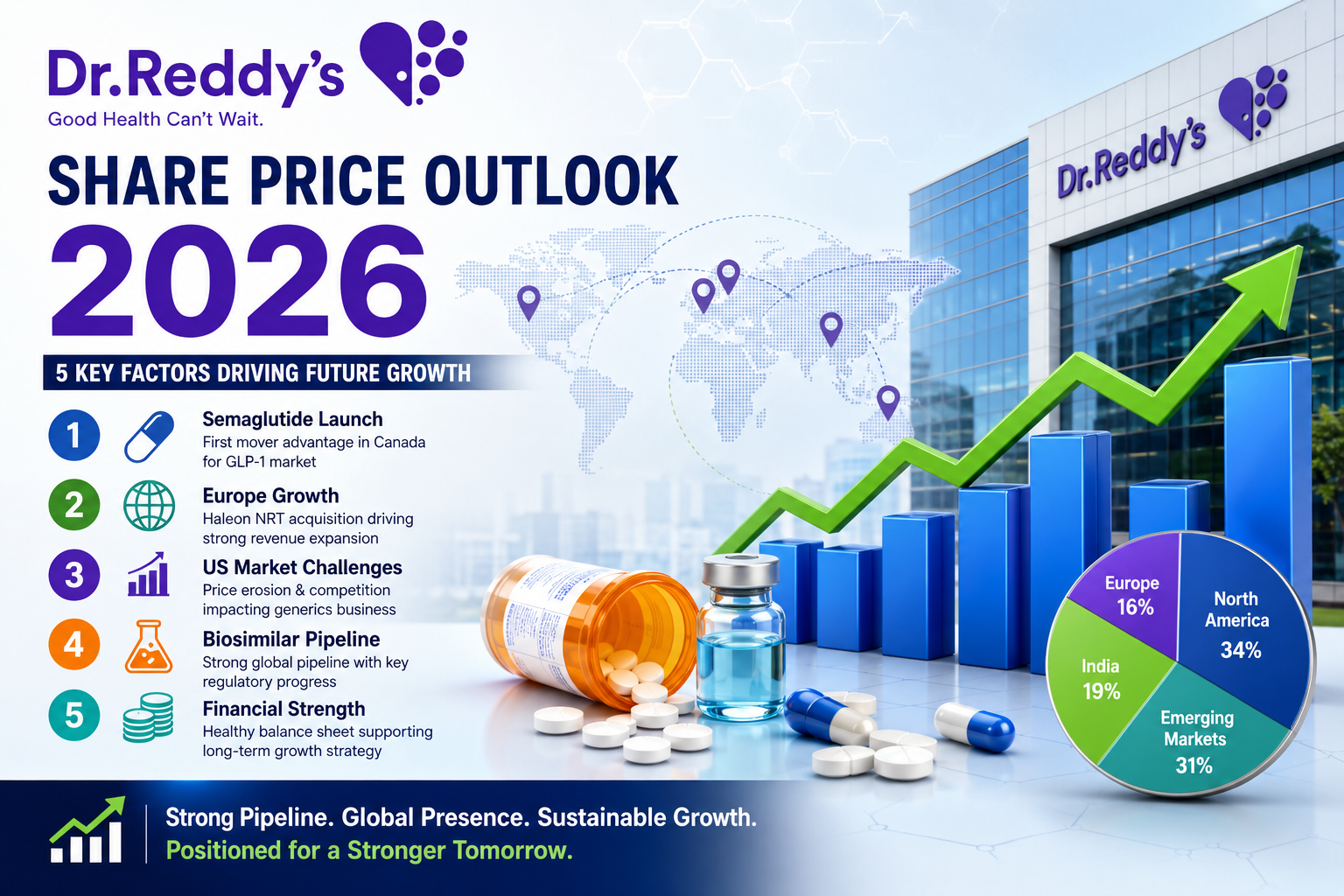
Transitioning to Europe, our Dr. Reddy’s Stock Analysis highlights a stellar 55% surge driven by strategic acquisitions, with revenues climbing to Rs. 55,501 million. This growth was fueled by the full-year consolidation of the global nicotine replacement therapy (NRT) business acquired from Haleon UK Enterprises Limited.
The NRT portfolio, anchored by the global smoking-cessation brand Nicotinell, contributed Rs. 28,189 million—accounting for 51% of total European sales. This integration successfully positions Dr. Reddy’s as a major player in the global over-the-counter (OTC) consumer healthcare space.
European Revenue Mix (FY2026)
├─ Acquired Haleon NRT Portfolio: Rs. 28,189M (51%)
└─ Core Generics & Institutional: Rs. 27,312M (49%)
India and Emerging Markets: Resilient Domestic Footprint
The Indian domestic market continues to show solid performance. Revenues grew 16% to Rs. 62,186 million, outperforming the broader Indian pharmaceutical market’s 9.9% growth rate. This outperformance was supported by strong brand equity in chronic care segments and the launch of 28 new brands.
Emerging markets also registered a 23% expansion to Rs. 67,608 million. Surprisingly, despite geopolitical challenges, Russian operations saw a 34% increase in Rupee terms (15% in Roubles), driven by volume gains and a strong mix of OTC products like Nise, Omez, and Ibuclin.
| Segment Geography | FY25 Revenue (Rs.M) | FY26 Revenue (Rs.M) | Revenue Contribution (%) | Constant Currency Trajectory |
| North America | 145,164 | 113,737 | 34% | Downward pressure due to price erosion |
| India Domestic | 53,734 | 62,186 | 19% | Strong organic growth across chronic therapies |
| Europe | 35,882 | 55,501 | 16% | Accelerated by Haleon NRT integration |
| Russia | 25,958 | 34,786 | 10% | Driven by OTC volumes and localized branding |
| Rest of the World | 19,894 | 23,749 | 7% | Expansion in Brazil, Colombia, and Africa |
The PSAI and CDMO Space: Margin Squeeze
For an all-encompassing view, this Dr. Reddy’s Stock Analysis must evaluate the Pharmaceutical Services and Active Ingredients (PSAI) segment. This division acts as the backbone of the company’s vertical integration, manufacturing APIs for both internal supply and external business-to-business sales.
PSAI Segment Revenue: Rs. 34,773 Million (+3% YoY)
PSAI Gross Margin: Dropped from 27.1% to 17.2%
While total PSAI revenues ticked up by 3% to Rs. 34,773 million, the segment’s gross margins compressed significantly, dropping from 27.1% to 17.2%. This decline was driven by lower operating leverage, intense pricing pressure from scale-led Chinese API competitors, and an unfavorable shift in product mix toward lower-margin inputs.
To counter this margin compression, the company’s contract development and manufacturing organization (CDMO) branch, Aurigene Pharmaceutical Services Limited (APSL), is expanding its capabilities into specialized technology platforms like peptides and biologics to capture higher-margin innovator contracts.
Positive Catalysts: The Bull Case For Investors
Long-term investors looking at this Dr. Reddy’s Stock Analysis will find comfort in the company’s ongoing diversification efforts. The business is actively working to transition from a pure-play small-molecule generic manufacturer into an integrated healthcare platform spanning biosimilars, nutrition, and specialized wellness categories.
- The Semaglutide Breakthrough in Canada: In May 2026, Dr. Reddy’s became the first pharmaceutical company to receive marketing authorization and launch generic Semaglutide Injection (covering 2 mg/pen and 4 mg/pen presentations) in Canada. Tapping early into the massive global GLP-1 weight loss and diabetes market represents a significant competitive win.
- Haleon OTC Scaling Success: The seamless integration of the global smoking-cessation business from Haleon provides the company with direct commercial infrastructure in consumer-heavy developed markets like Australia, the UK, and the Nordic region. OTC consumer health tends to be much more price-resilient than highly commoditized prescription generic drugs.
- Nestlé Health Science Alliance: Entering a commercialization pact with Nestlé Health Science in India opens up access to high-margin nutritional and wellness consumer lines, building a steady growth engine adjacent to its traditional prescription portfolio.
- Global Biosimilar Pipeline Progress: While the company has historically faced regulatory delays, its biosimilar Rituximab application was approved by Health Canada in February 2026. Furthermore, its Denosumab biosimilar candidate (targeting Prolia® and Xgeva® indications) secured European Medicines Agency (EMA) and UK approvals late last year, paving the way for international commercialization.
Negative Catalysts: The Bear Case & Portfolio Drag
Even the most resilient investment theses run into operational realities. Dr. Reddy’s latest Form 20-F filing highlights several near-term vulnerabilities that continue to keep institutional investors cautious.
- R&D Strategy Adjustments and Asset Write-Downs: The company recorded a substantial asset impairment charge of Rs. 3,519 million during the fiscal year. This included writing off Rs. 1,291 million following the strategic discontinuation of certain Chimeric Antigen Receptor T-cell (CAR-T) therapy programs. Additionally, Rs. 914 million was wiped off the books for Eftilagimod Alfa after its Phase III non-small cell lung cancer trial failed a futility analysis.
- Regulatory Penalties and Centralized Procurement Ban in China: In August 2024, China’s National Medical Products Administration (NMPA) suspended the import and sale of the company’s Atomoxetine Hydrochloride capsules due to GMP non-compliance. This led to a subsequent ban from participating in lucrative national centralized drug procurement activities through February 2026. Regaining this market access depends on an on-site NMPA clearance audit scheduled for November 2026.
- US FDA Regulatory Headwinds: The company continues to navigate regulatory roadblocks with the U.S. FDA. The Biologics facility in Hyderabad received a Complete Response Letter (CRL) regarding its Rituximab application, while its Denosumab BLA received a CRL in December 2025. Resolving these manufacturing and data queries pushes back anticipated U.S. product launch timelines.
Technical and Operational Outlook: Dr. Reddy’s Stock Analysis Projections
No institutional-grade Dr. Reddy’s Stock Analysis would be complete without highlighting the regulatory hurdles in emerging markets like China. To understand the future direction of the stock, we need to balance these near-term operational challenges against the company’s underlying fundamentals.
Tomorrow’s Price Impact (Short-Term Reaction) 🗓️
The stock is likely to face near-term volatility. The 29% compression in Profit Before Tax and the visible margin contraction within the North American generics segment could trigger defensive automated selling from short-term institutional algorithms.
However, because the Form 20-F details ongoing operational shifts rather than sudden surprises, forward-looking market participants may look past the headline earnings dip to focus on the robust cash balances. The company maintains Rs. 134,409 million in total available working capital, providing a solid safety cushion against abrupt downside moves.
Coming Weeks Outlook (Medium-Term Consolidation) 📈
Over the next few weeks, expect the stock price to trade within a sideways consolidation range. Market participants will likely wait for early tracking data on the generic Semaglutide launch in Canada, alongside updates regarding the resubmission of the Denosumab biological file to the U.S. FDA.
Additionally, macro-driven headwinds—including the impact of the newly passed U.S. corporate tax changes under the One Big Beautiful Bill Act (OBBBA) and complex global transfer pricing audits—will continue to be factored into valuation models.
Coming Months Outlook (Long-Term Structural Thesis) 🚀
Looking further out, the structural investment case begins to turn positive. As high-margin OTC revenues from the global Haleon NRT integration continue to scale and help offset U.S. generic price erosion, profit margins should begin to stabilize.
The primary catalysts to watch for include the successful completion of the Chinese NMPA audit in November 2026 and potential facility clearances from the U.S. FDA. These milestones could unlock significant long-term value, positioning the stock well for patient investors.
Managing Risk: Tariffs, Pricing Policies, and Inflation
Beyond company-specific operations, Dr. Reddy’s must navigate a complex array of macroeconomic and geopolitical factors.
International Trade and Global Tariffs
The global trade landscape has grown increasingly complex, marked by shifting tariff structures and trade policies designed to prioritize domestic industries. For example, the universal and reciprocal import tariffs implemented under the “Liberation Day” executive initiatives in the United States have created ongoing operational uncertainty.
While certain pharmaceutical exemptions exist, they remain subject to administrative review. Any escalation in trade tensions could raise the cost of goods sold by increasing input prices for active ingredients and packaging materials.
Drug Pricing Reforms and Most-Favored-Nation (MFN) Mandates
In addition to trade barriers, regulatory pressure on drug pricing is intensifying globally. In the United States, executive directives aimed at establishing “Most-Favored-Nation Prescription Drug Pricing” seek to align domestic drug costs with lower international benchmarks.
At the same time, the ongoing rollout of the Inflation Reduction Act (IRA) introduces new financial penalties for drugs whose prices rise faster than inflation, alongside government price-setting for high-expenditure Medicare presentations. These intersecting policies place structural caps on pricing and compress historical operating margins.
Macro Risk Matrix:
├── U.S. Tariffs (OBBBA) ──> Higher Raw Material Sourcing Costs
├── U.S. Health Policy (IRA/MFN) ──> Structural Price Caps on Generics
└── India Social Security Code ──> Incremental Operational Expense Leaps
Inflationary Pressures and Evolving Labor Regulations
Persistent global inflation continues to drive up labor, commodity, and freight costs across the pharmaceutical supply chain. Unlike other consumer-facing industries, generic drug manufacturers operate in highly regulated, fixed-price or tender-driven environments, making it difficult to pass rising input costs on to end consumers.
Furthermore, on the domestic front, the phased implementation of India’s Code on Social Security, 2020, has introduced interpretational uncertainties and incremental personnel costs, adding further pressure to operating margins.
Conclusion: Is It Time To Buy, Sell, or Hold?
In conclusion, this definitive Dr. Reddy’s Stock Analysis underscores a business in a classic structural transition phase. The era of relying solely on easy, small-molecule generic launches in the United States is drawing to a close, replaced by a more complex landscape of biosimilars, international over-the-counter wellness brands, and targeted geographic expansion.
While the immediate financial reporting shows pressure on net profit margins, the company’s strategic choices—such as the global scaling of the Nicotinell brand and its first-to-market Semaglutide launch in Canada—point to a resilient path forward. For short-term traders, caution is warranted due to near-term volatility. However, for long-term investors focused on structural fundamentals, any near-term price dips could offer an attractive entry point into a well-capitalized global healthcare leader.
Given the significant margin changes in the PSAI division alongside the strong growth in Europe, how are you adjusting your exposure to international pharmaceutical stocks in your portfolio?
Disclaimer
The financial information, market analysis, and opinions presented in this article are intended solely for educational and informational purposes and should not be considered financial, investment, legal, or trading advice. Stock market and commodity investments are subject to significant market risks, including potential loss of capital. Readers and investors are strongly advised to conduct their own independent research and due diligence or consult with a SEBI-registered financial advisor before making any investment or trading decisions based on the information provided in this article.
Read Another Article
Stay updated on the latest Nifty 50 stock movements and corporate news with our detailed analyses:
JSW Steel Share Price Skyrockets? Why 1 Huge NCLT Win Will Power Mega Gains Tomorrow!. Read here