








Bajaj Auto Share Price Analysis: 2 Massive Shocking Triggers Impacting Returns
This Bajaj Auto Share Price Analysis explores the latest SEBI filing, dividend regulations, and future stock market impact for investors.The Indian automotive sector is witnessing a massive wave of regulatory and structural shifts. Investors tracking the blue-chip auto segment require a deeply detailed Bajaj Auto share price analysis to navigate these changes successfully. On May 23, 2026, Bajaj Auto Limited officially released a critical statutory compliance document. This document has sent ripples through the brokerage community.
When we dive into a comprehensive Bajaj Auto share price analysis, we look far beyond mere quarterly sales volumes. We must carefully evaluate corporate governance moves, regulatory updates, and investor compliance milestones. The latest exchange filing outlines major changes regarding unclaimed dividends, mandatory shares transfer, and the complete elimination of physical warrants. This thorough Bajaj Auto share price analysis uncovers how these developments alter market sentiment.
Understanding the deep implications of these filings is absolutely crucial for institutional and retail investors alike. In this professional Bajaj Auto share price analysis, we break down every regulatory detail. We provide clear projections on how the stock price will react tomorrow, over the next few weeks, and across the upcoming months. Let us dive straight into the core elements of this market update. 🚀
Table of Contents
Understanding the Core Regulatory Filing Details
Bajaj Auto Limited issued an official intimation under Regulation 30 of the SEBI Listing Regulations, 2015. This compliance update confirms that the auto giant has published newspaper advertisements across national editions. Specifically, notices appeared in the Financial Express and the Marathi publication Kesari on May 23, 2026. These advertisements serve as a formal directive to the company’s vast shareholder base.
A rigorous Bajaj Auto share price analysis requires evaluating how compliance actions influence public float and investor trust. The primary focus of the notice is the strict legal transfer of equity shares to the Investor Education and Protection Fund Authority. This action is mandated under Section 124(6) of the Companies Act, 2013. The rule targets shares where dividends have remained completely unclaimed or unpaid for seven consecutive years or more.
The company has successfully completed the physical dispatch of individual letters to all affected shareholders. This notification sets up a vital timeline for asset reclamation. Any deep-dive Bajaj Auto share price analysis must track these structural adjustments. They can alter retail investor engagement and reduce long-term administrative overhead for the corporate entity.
The IEPF Deadline and Share Transfer Mechanisms
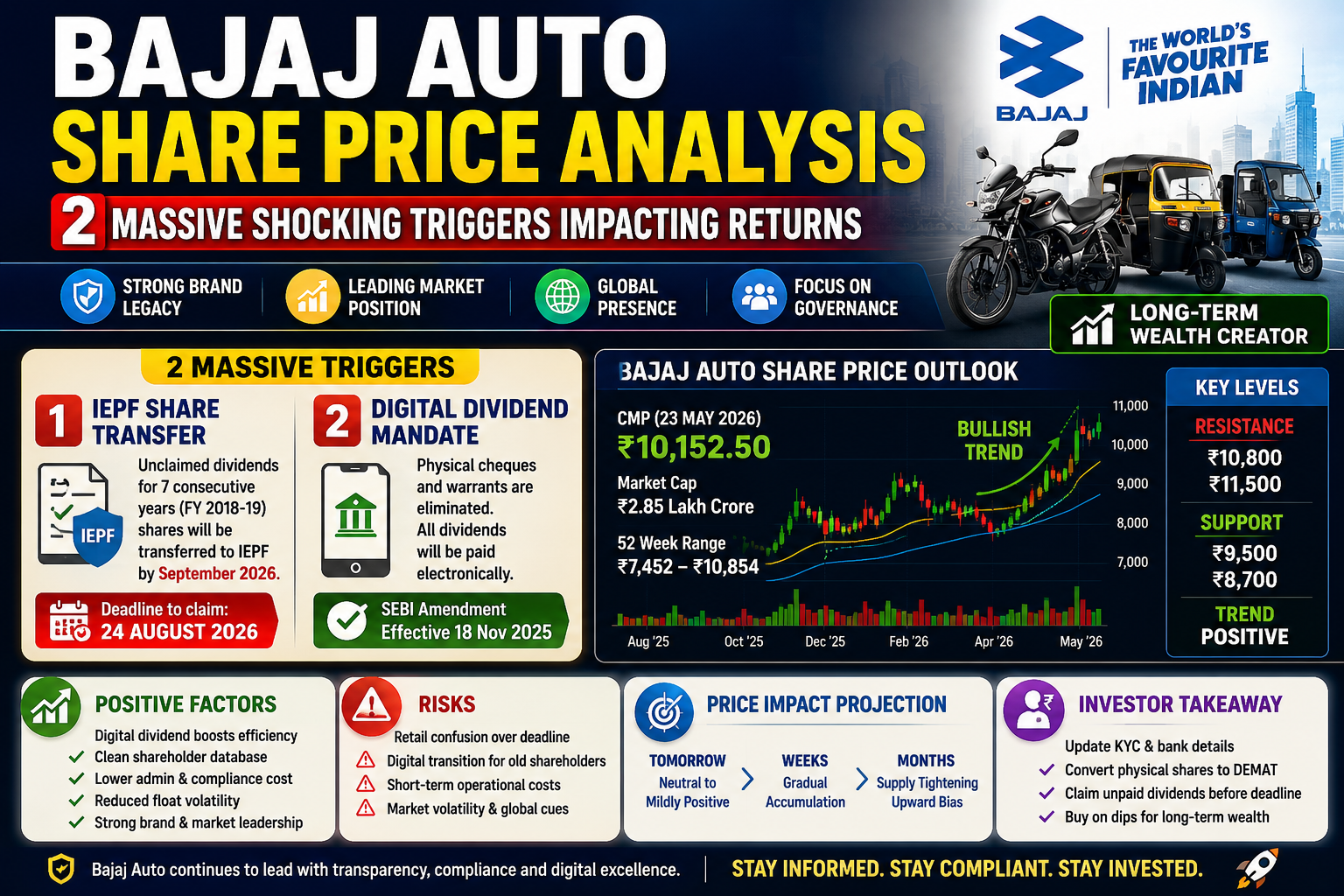
According to the official statutory announcement, retail investors have been given a final window to claim their historic unpaid rewards. The hard cutoff date to submit claims directly to the company is August 24, 2026. Failing to act before this critical deadline results in an automatic, mandatory transfer of equity assets. The shares move straight into the specialized DEMAT account held by the IEPF Authority.
When performing a long-term Bajaj Auto share price analysis, tracking the exact timeline of these transfers is necessary. The specific dividend declared during the financial year 2018–19 is the core asset heading to the government fund. This final credit to the IEPF is scheduled to occur in September 2026. This structural movement means that a significant pool of dormant retail equity will be temporarily frozen out of regular public trading.
However, the company clarified a few crucial legal exceptions to this sweeping transfer process. Shares will not be transferred if a specific court order or legal tribunal explicitly restrains the transaction. Furthermore, any shares that are actively hypothecated or pledged under the Depositories Act of 1996 will remain unaffected. This protective layer ensures that complex institutional and retail leverage positions remain safe from sudden regulatory sweeps.
The Saksham Niveshak Initiative Explored
To balance these strict compliance mandates, the Ministry of Corporate Affairs has introduced a supportive program. The Investor Education and Protection Fund Authority launched the second phase of its 100-Day Campaign, titled “Saksham Niveshak”. This targeted campaign runs from April 1, 2026, all the way to July 9, 2026. Its core objective is to simplify KYC updates and accelerate asset retrieval.
From a macro perspective, a strategic Bajaj Auto share price analysis views this campaign as highly positive. By streamlining the direct payment of unclaimed dividends back to rightful owners, the company builds massive goodwill. It also boosts shareholder engagement across rural and semi-urban retail bases. The company has made special ISR forms readily available on its official website and through KFin Technologies.
Investors holding shares in physical form must submit these documents to update crucial metadata. This includes updating PAN cards, bank account numbers, signatures, and email IDs. Meanwhile, dematerialized shareholders must coordinate directly with their respective Depository Participants. This massive operational push ensures the company’s investor registry is modern, clean, and highly active.
The Death of Physical Dividend Cheques
The third major pillar of the regulatory filing highlights a dramatic shift in corporate finance operations. Following a recent SEBI amendment notified on November 18, 2025, physical payout mechanisms are officially dead. The provisions allowing companies to issue payable-at-par warrants or physical paper cheques have been permanently omitted. This marks a major milestone in India’s digital corporate evolution.
A forward-looking Bajaj Auto share price analysis must calculate the financial efficiency gains from this specific rule. Moving forward, Bajaj Auto will exclusively utilize advanced electronic payment modes to distribute corporate dividends. This structural transition completely eliminates the risk of postal delays, physical check theft, and lost banking instruments. It ensures immediate capital distribution to the company’s ultimate owners.
Shareholders who fail to link their updated electronic bank accounts will face automated transaction rejections. The company has issued an urgent advisory warning all investors to complete depository registration immediately. This digital migration simplifies treasury operations and significantly reduces corporate administrative expenses over time.
Positive Stock Factors and Market Catalysts
Evaluating the positive side of our Bajaj Auto share price analysis reveals several structural strengths. First, the complete elimination of physical cheques removes substantial print, processing, and mailing costs. Digital treasury management allows for rapid capital distribution. This efficiency enhances overall operating margins and strengthens short-term cash flow predictability.
Second, the aggressive modernization of the investor database via the Saksham Niveshak campaign is a hidden catalyst. Clean shareholder registries reduce legal liabilities, lower investor grievance rates, and prevent fraudulent share transfers. Institutional funds favor large-cap companies with spotless corporate governance and cutting-edge digital compliance systems.
Third, identifying and transferring long-term dormant accounts to the IEPF shrinks active retail float volatility. When hundreds of thousands of legacy shares move into a locked government custody account, it reduces sudden market dumping. This consolidation creates a stable holding pattern, allowing institutional buyers to accumulation shares efficiently without triggering sharp price drops.
Negative Stock Factors and Market Risks
No institutional-grade Bajaj Auto share price analysis is complete without addressing potential headwinds and risks. The immediate risk stems from potential retail confusion regarding the August 24, 2026, deadline. If a large number of retail investors realize their shares are facing forced transfer, panic selling could spike. Uninformed market participants may dump their holdings to avoid dealing with government claims procedures.
Furthermore, the transition to purely digital dividend payments could temporarily alienate legacy physical shareholders. Many elderly and rural investors still hold older physical paper certificates. If they experience friction while updating their KYC profiles through KFin Technologies, it could create short-term negative sentiment. This operational friction can lead to vocal retail complaints on social media platforms.
Finally, managing these massive physical mailings and national newspaper ad campaigns creates immediate compliance costs. While these expenses are minor for a multi-billion dollar entity, they do tap corporate resources. Navigating changing SEBI frameworks requires constant legal monitoring, which can distract management from core industrial scaling goals.
Tomorrow Price Impact Projections
Focusing our Bajaj Auto share price analysis on the ultra-short-term horizon suggests a highly neutral to mildly positive opening. The equity market generally views proactive compliance filings as standard corporate hygiene. Because the filing represents a routine, mandatory SEBI disclosure rather than an earnings surprise, it will not spark sudden, extreme panic.
Traders should expect the stock price to trade within its established, tight intraday moving averages tomorrow morning. Institutional algorithms will quickly process the filing and note the successful completion of the shareholder mailing process. This verification reassures the market that Bajaj Auto remains a benchmark for strict regulatory compliance in India.
The immediate intraday price action will likely be driven more by global macroeconomic cues and overall auto sector sentiment. However, the stock will enjoy a strong baseline of support because there are no hidden corporate governance shocks in this notice. Expect a calm, stable trading session tomorrow with standard institutional liquidity provisioning.
Weekly Price Impact Projections
Shifting our Bajaj Auto share price analysis to a multi-week outlook reveals an accumulation trend. Over the next few weeks, the market will digest the ongoing Saksham Niveshak KYC drive. As retail investors update their bank accounts and convert physical shares to DEMAT, market liquidity will steadily improve.
This steady conversion process frequently prompts retail investors to increase their core positions. When a shareholder interacts with a digital platform to fix their KYC, they become re-engaged with the company’s growth story.A deeper Bajaj Auto Share Price Analysis reveals improving institutional confidence.This psychological re-engagement typically translates into modest, sustained retail buying across regional brokerages.
Additionally, sector analysts will view the digital dividend mandate as a structural plus for ESG metrics. Modern global funds heavily prioritize digital compliance and paperless governance models.From a swing trading perspective, this Bajaj Auto Share Price Analysis supports gradual accumulation strategies.This regulatory milestone could support gradual accumulation by domestic mutual funds, helping the stock outperform its immediate two-wheeler peers over the next few weeks.
Monthly Price Impact Projections
Analyzing the long-term horizon through a multi-month Bajaj Auto share price analysis brings us to major milestones. The first critical pivot point occurs on July 9, 2026, marking the official conclusion of the Saksham Niveshak campaign. The second, more impactful milestone arrives on August 24, 2026, which is the final deadline for claiming unpaid dividends.
As August approaches, expect a notable drop in active retail float as dormant shares prepare to migrate to the IEPF. In September 2026, the final transfer of the 2018–19 dividend shares will lock up a notable portion of legacy equity. This reduction in floating supply often creates a structural upward bias for high-demand blue-chip assets.
With fewer dormant shares available for sudden liquidation, institutional buyers will hold greater pricing power. Barring macro shocks like interest rate hikes or supply chain disruptions, the stock is well-positioned for solid growth.Long-term Bajaj Auto Share Price Analysis suggests reduced float volatility could support future upside momentum.Over a multi-month period, this regulatory cleanup will build a stronger, more resilient foundation for long-term capital appreciation.
Technical Support and Resistance Zones
A technical perspective adds valuable depth to our Bajaj Auto share price analysis. When looking at the daily and weekly charts, the stock shows a classic bullish consolidation pattern. Institutional volume bars remain steady, showing that long-term investors are comfortably holding their positions ahead of the upcoming regulatory deadlines.
The immediate downside support zone is strongly anchored around its 50-day and 100-day Simple Moving Averages. These technical baselines have consistently limited downside risk during broader market corrections.This Bajaj Auto Share Price Analysis indicates strong institutional confidence near major support zones.Traders looking for low-risk entry points should monitor these moving averages closely during brief market pullbacks.
On the upside, the stock faces minor overhead resistance near its recent all-time highs. Breaking out past this psychological resistance level will require a combination of strong monthly sales data and stable raw material costs. Once those conditions are met, the cleaner shareholder registry will help accelerate any structural upward move.
Strategic Investment Takeaways for Retail Traders
For long-term investors, this Bajaj Auto share price analysis highlights an excellent opportunity to reinforce portfolio discipline. If you or your family members hold older, physical Bajaj Auto shares, you must act fast. Check your dividend history immediately using the company’s dedicated investor portal. Ensuring your KYC is fully updated before August 24, 2026, protects your hard-earned assets from government escrow.
Short-term swing traders can use these regulatory timelines to plan high-probability trades. The predictable reduction in active float heading into September 2026 provides an excellent backdrop for accumulation strategies. Buying the stock during broader market dips over the summer could yield strong results as the supply of shares tightens later in the year.
Ultimately, Bajaj Auto continues to prove why it is widely regarded as “The World’s Favourite Indian” brand. By managing changing SEBI mandates with absolute transparency, the company protects its stellar market reputation. Investors can take comfort in knowing that their capital is backed by an incredibly well-run business.
Overall News Sentiment Assessment
Concluding our exhaustive Bajaj Auto share price analysis, the overall news sentiment is strongly positive. While retail investors must navigate tight timelines and mandatory digital upgrades, the structural benefits for the company are clear. Bajaj Auto is systematically eliminating ancient administrative headaches and moving toward an efficient, paperless future.
The elimination of physical checks removes operational risks and lowers transaction costs. Concurrently, the government-backed Saksham Niveshak campaign helps reactivate dormant retail accounts across India. This dual approach ensures that Bajaj Auto maintains clean corporate governance while looking after its retail investor base.
The stock remains an exceptional, defensive core holding for any long-term equity portfolio. Bajaj Auto continues to perfectly balance operational excellence with stellar regulatory compliance. Shareholders who stay informed and complete their digital updates are well-positioned to enjoy sustainable wealth creation for years to come. 🎯
Editorial Disclaimer and Compliance Notes
This professional Bajaj Auto share price analysis is presented purely for informational, educational, and journalistic purposes. The insights, breakdowns, and data points shared throughout this post are derived entirely from official public exchange filings. This commentary does not constitute formal financial planning, legal counsel, or direct investment advice.
Every market participant must conduct independent research or consult with a SEBI-registered financial advisor before committing capital. Investing in equity markets involves significant risk, including the potential loss of principal. Past performance is never a reliable guarantee of future stock market returns. Ensure your portfolio matches your personal risk tolerance.
Contact Information for Investor Grievances
Should any shareholder require immediate, hands-on assistance regarding their unclaimed dividends, please use the verified channels below:
- Registrar and Share Transfer Agent (RTA): Mr. Mohd. Mohsinuddin, Assistant Vice President, KFin Technologies Limited.
- RTA Address: Unit: Bajaj Auto Ltd., Selenium Tower B, Plot No. 31 & 32, Financial District, Nanakramguda, Serilingampally Mandal, Hyderabad 500 032, Telangana, India.
- RTA Support Email: mohsin.mohd@kfintech.com.
- RTA Phone & WhatsApp Lines: Tel: 040-6716 1582 / WhatsApp: +91 91000 94099 / Toll-Free: 1-800-309-4-001.
- Bajaj Auto Compliance Officer: Mr. Rajiv N Gandhi, Company Secretary, Akurdi, Pune, India.
- Corporate Investor Email: investors@bajajauto.co.in.
Frequently Asked Questions
What happens if I miss the August 24, 2026 deadline?
If you miss the deadline, your unclaimed dividends and corresponding equity shares will be legally transferred to the IEPF DEMAT account. You will then have to file a reclamation request directly with the IEPF Authority to recover your assets.
Can I still use physical cheques to claim my dividends?
No, physical cheques and payable-at-par warrants have been permanently discontinued by SEBI. All future dividend payouts from Bajaj Auto will be processed strictly via electronic banking transfer channels.
Disclaimer
This professional stock market analysis blog post is intended solely for educational and informational purposes and should not be considered financial, investment, or trading advice. Stock market investments are subject to market risks. Always conduct your own research and consult a certified financial advisor before making any investment decisions.
Read Another Article
Stay updated on the latest Nifty 50 stock movements and corporate news with our detailed analyses:
NTPC Stock Analysis 2026: 1 Massive Profit Boom & ₹9 Dividend Surprise. Read here